

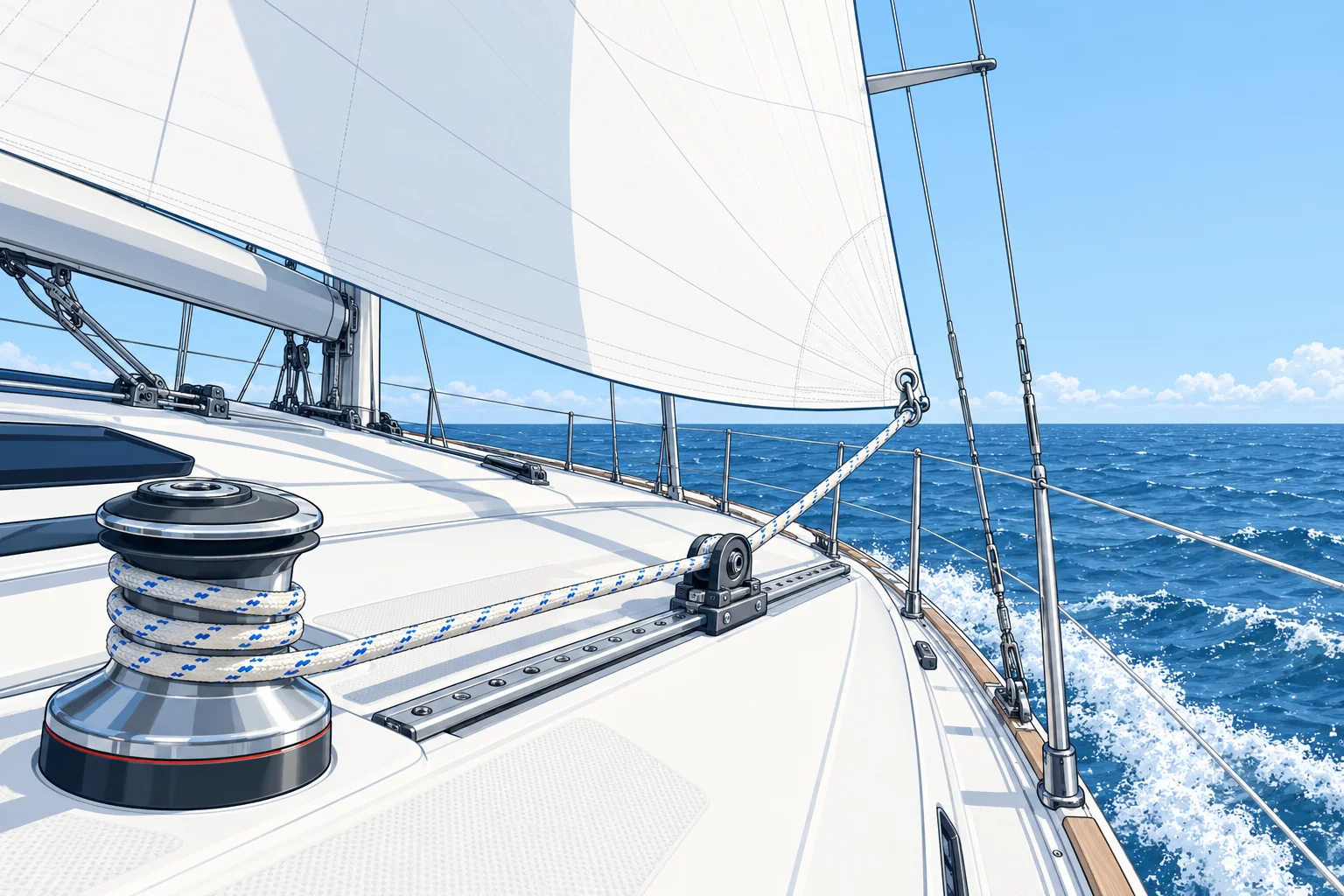
Headsail controls: sheet, car and halyard
1The lesson in plain words
Three controls set the headsail: the sheet sets angle and twist, the car sets how the sheet pulls, and the halyard sets luff tension and draft position.
Sheet
The sheet, a control rope, sets angle and twist by pulling the clew (lower aft corner) in or out. Sheeting harder closes the leech and flattens the foot (bottom edge). Upwind, a genoa, a headsail extending aft of the mast, typically has its leech near but clear of the spreader end. A spreader is a mast strut supporting the shrouds, the side supports. On a reach, ease until the luff telltales are right.
Car
The car, or fairlead, is the sliding lead block on its track. It sets the direction the sheet pulls. Moved forward, the sheet pulls more down: the leech closes, twist decreases and the foot gets deeper. Moved aft, it pulls more back: the foot flattens and the top opens, adding twist. Set it so all windward luff telltales lift together as you head up slowly with the sheet fixed.
Halyard
The halyard, the rope that hoists the sail, sets luff tension. More tension pulls the draft forward and flattens the back of the sail. Less tension lets the draft move aft and gives a finer entry for flat water. In stronger wind, persistent horizontal wrinkles with draft too far aft suggest more tension. Slight wrinkles can be acceptable in light air. A hard vertical crease suggests too much tension.
Forestay sag
The forestay, the mast support towards the bow, bows slightly under load. More sag makes the headsail deeper and more powerful, but harder to point with, or sail close to the wind. Less sag makes it flatter. On many rigs, tightening the backstay, the mast support towards the stern, reduces sag; on some, running backstays do the job. Follow your rig maker's tuning guide.
On a reach
As you bear away, ease the sheet and move the car forward, or outboard (away from the centreline) if you have a choice of tracks. The clew then lifts less as the sail swings out and the top does not twist away too much. If you have barber haulers, lines pulling the sheet down or out, they do the same job.
2Key data
- Car forward
- Less twist, deeper foot, closed leech
- Car aft
- More twist, flatter foot, open top
- More halyard tension
- Draft moves forward; for strong wind and chop
- Upwind genoa guide
- Leech near, not touching, the spreader end
- More forestay sag
- Deeper, more powerful sail; points lower
3Key points
- 1
Sheet: angle to the wind and twist.
- 2
Car forward: less twist and a deeper foot; aft: more twist and a flatter foot.
- 3
Halyard tighter: draft forward; looser: draft aft.
- 4
Stronger wind, luff wrinkles and draft aft: add halyard tension. Slight light-air wrinkles are fine; vertical crease: ease.
- 5
Forestay sag adds depth; backstay tension usually reduces it.
4Frequent mistakes
Wrong: Leave the car in one place for every wind and every course.
Right: Move it as conditions change. With the sheet fixed, head up slowly: the right position makes all windward luff telltales lift together.
Wrong: Wrinkles along the luff are just an old sail.
Right: In stronger wind, persistent horizontal wrinkles with draft too far aft suggest more halyard tension. Slight wrinkles can be acceptable in light air; avoid a hard vertical crease.
5Practice case & exam keys
In 18 knots and a short chop, your genoa is very full, with the deepest point well aft and horizontal wrinkles along the luff. The boat heels and slows in every wave.
Show the answer
Add halyard tension to bring the draft forward and clear the persistent wrinkles. Tighten the backstay, where effective on your rig, to reduce forestay sag and flatten the sail. Move the car slightly aft to open the top and flatten the foot. Recheck heel, acceleration and telltales after each change.
Exam keys
- Sheet sets angle and twist; car sets the pull direction.
- Car forward: less twist, deeper foot. Car aft: more twist, flatter foot.
- Halyard tension moves draft forward. Stronger wind, persistent luff wrinkles and draft aft: add tension; slight light-air wrinkles can be fine.
- Forestay sag deepens the headsail; backstay usually reduces sag.
Finish this unit
When you've read it, answer three questions. Get all three right to finish the unit; opening the page alone doesn't count.
My notes for this unit
No notes