

 See units
Deck equipment and machinery: winches, cranes, hatches, watertight doors, pilot ladders and gangways
Cranes and derricks: safe working load, signals, wires and SOLAS II-1/3-13
1The lesson in plain words
Never exceed the marked SWL, work to one signaller, check wires and limit switches, and never stand under a load. SOLAS II-1/3-13 applies from 2026.
Cranes and derricks
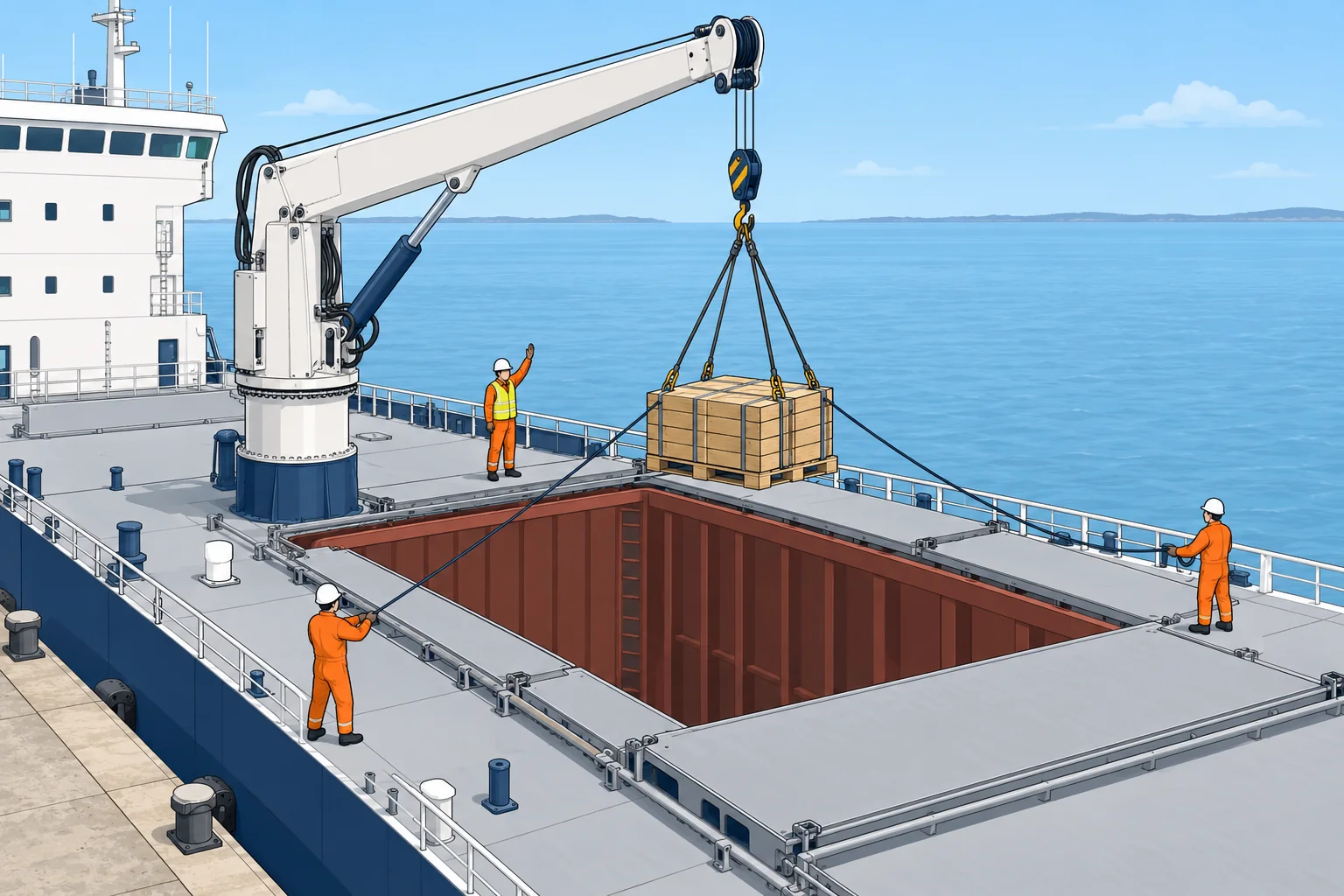
Many cargo ships with their own lifting gear use electro-hydraulic deck cranes: a pedestal, a house that slews (turns), a jib that luffs (raises and lowers), and a hoist wire to the hook. Derricks are older: a boom worked by winches, sometimes paired so their cargo wires work one hook, called union purchase. Smaller service cranes have lower capacities, but the same rules apply.
Safe working load
The safe working load (SWL) is the most an appliance may lift in service. It is permanently marked on the crane or derrick. On many cranes it changes with the radius, the horizontal distance from the crane’s centre of rotation to the vertical line through the hook, so read the load chart or load indicator. Loose gear means removable lifting items such as slings, shackles and spreaders. Include their weight in the load. Each item needs an SWL mark and an ID linked to its certificate; reject unmarked gear.
One signaller
One person, the signaller, directs the driver using the ship’s standard hand signals or agreed radio calls. Stay where you can safely see the load’s path. For hand signals, the driver must see you; radio can be used when you cannot see each other. Learn the posted signal chart, including STOP. Anyone may give the emergency stop. Never go under a suspended load. Stop if signals are lost or unclear; resume only when clear contact returns.
Wires and limits
Before use, look along the hoist and luffing wires for broken wires, kinks, birdcaging (strands opening out like a cage), crushing, corrosion or thinning. Report them; the maker’s criteria decide discard. Limit switches stop hoisting before the hook block reaches the jib and stop the jib at its luffing limits. Test them before work and never bypass them. Keep the turns on the drum that the maker specifies at the lowest hook position.
SOLAS II-1/3-13
From 1 January 2026, SOLAS II-1/3-13 covers ships’ lifting appliances and anchor-handling winches. Lifting appliances are load tested and thoroughly examined before first use and after major repair, load tested at least every five years, and thoroughly examined every year. SWL is permanently marked, an operation and maintenance manual is kept, routine inspections are recorded, and operators are trained. Existing appliances must pass their initial load test and thorough examination by the first renewal survey on or after that date; routine upkeep still applies.
2Key data
- SOLAS II-1/3-13
- Existing gear: initial test/examination by first renewal from 2026
- Load test
- Before first use, after major repair, at least every 5 years
- Thorough examination
- After each load test and at least every year
- Marking
- SWL permanently marked; loose gear marked and certified
- UK guidance
- Code of Safe Working Practices (COSWP), 2026 edition
3Key points
- 1
Never exceed the marked SWL; on many cranes it falls as the radius grows.
- 2
Work to one signaller; keep the load’s path visible and maintain clear contact with the driver.
- 3
Never stand under a suspended load; stop if signals are lost or unclear.
- 4
Check wires for broken wires, kinks and birdcaging; test limit switches; never bypass them.
- 5
SOLAS II-1/3-13 (2026): five-yearly load test, yearly thorough examination, records and trained operators.
4Frequent mistakes
Wrong: The SWL on the jib is the same at every radius, so any load under it is fine.
Right: On many cranes the SWL depends on radius. Check the load chart or indicator for the radius you will use, including the slings.
Wrong: When the hook block is close to the jib head, keep hoisting; the limit switch will stop it.
Right: The limit switch is a last safeguard. Stop by control, and report any switch that fails its test.
Wrong: Several people can signal to the driver so nobody misses a hazard.
Right: One signaller gives the signals. Anyone else may only give the emergency stop.
5Practice case & exam keys
The crane’s chart permits 2.5 tonnes at 6 m radius but only 1.8 tonnes at 10 m. The load, including loose gear, weighs 2.2 tonnes. The planned lift reaches 10 m, although the crane is marked 2.5 tonnes.
Show the answer
Do not start. The complete lift must stay within the chart limit at every radius. At 10 m, 2.2 tonnes exceeds 1.8 tonnes. Tell the officer and driver; they must revise the plan before lifting.
Exam keys
- SWL: maximum load in service, permanently marked; varies with radius on many cranes; includes slings and spreaders.
- One signaller; anyone may call emergency stop; never under a suspended load; stop for lost or unclear signals.
- Wire defects: broken wires, kinks, birdcaging, crushing, corrosion. Limit switches tested, never bypassed.
- SOLAS II-1/3-13 from 1 Jan 2026: load test ≤ 5 years, thorough examination yearly, records, trained operators.
Finish this unit
When you've read it, answer three questions. Get all three right to finish the unit; opening the page alone doesn't count.
My notes for this unit
No notes