

 See units
Deck equipment and machinery: winches, cranes, hatches, watertight doors, pilot ladders and gangways
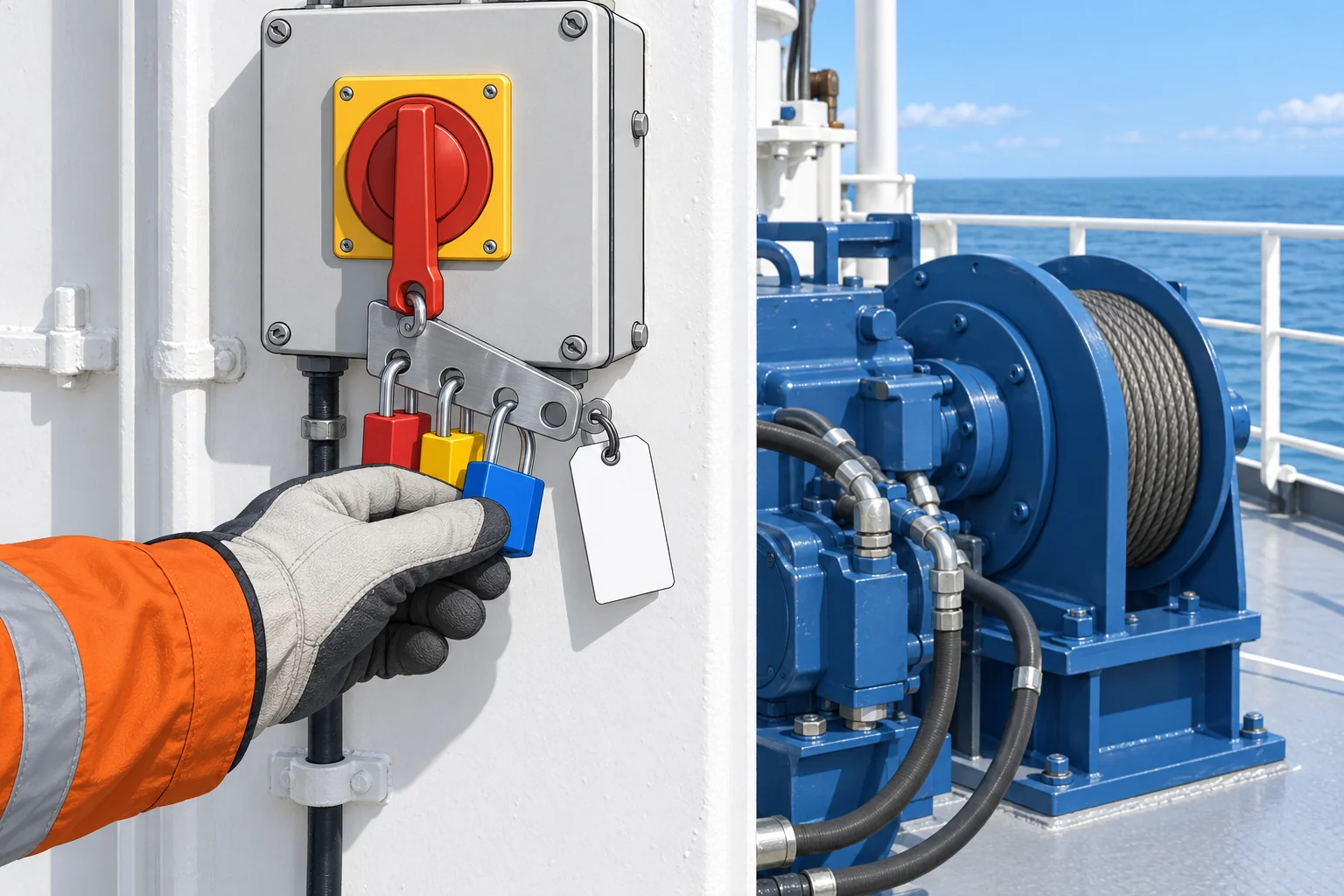
Isolating machinery: lock-out, tag-out and try-start
1The lesson in plain words
Before work, isolate every energy source and fit your own lock and tag. Control stored energy, have isolation verified and check for starting with the controls.
Why isolate
Deck machines can start without warning: a control on the bridge or in a deck house, an automatic restart when power returns, or another crew member who does not know you are inside. Before any maintenance or clearing a jam, the machine is made safe by isolation: cutting it off from every energy source and keeping it cut off.
Every energy source
Electrical: the breaker or isolator. Hydraulic: pump and valves isolated, then pressure safely released, including from accumulators, pressure stores in some circuits. Pneumatic: compressed air isolated and vented. Gravity: a crane jib, hatch panel or load lowered to rest or mechanically blocked before pressure release. Lock supplies before releasing stored pressure. Springs must be released or restrained as instructed, and rotating parts must stop.
Lock-out, tag-out
Lock-out/tag-out (LOTO) means locking each isolation point and adding a tag with your name, date and reason. Each worker fits their own personal lock and keeps the key. For shared work, use a multi-lock hasp, a fitting for several locks. A competent person verifies safe isolation and stored energy. Then try-start: with everyone clear, try the relevant controls to check they cannot start the machine. Return them to off. This does not prove stored energy is safe.
Permits and handing back
Many jobs also need a permit to work that lists the isolations; Ropes: deck safety covers permits. A lock is removed only by the person who fitted it. Before handing back, check tools are out, guards are back and people are clear. Tell the officer, who restores the machine and test runs it.
2Step by step
Isolating a deck machine for work
- 1
Agree the job and isolation points with the officer; get the permit if one is needed.
Isolation must cover every source, and the ship must know the machine is out of use.
- 2
Stop normally. Lower raised parts to a safe rest if this can be done without entering a danger zone.
Gravity is energy too; a raised part can fall when pressure bleeds off.
- 3
Isolate every electrical, hydraulic and air supply. Fit your own locks and tags at each isolation point and keep the keys.
Locked supplies prevent anyone restoring energy while you make stored energy safe.
- 4
With supplies locked, have raised parts mechanically supported and springs restrained as the maker instructs before safely releasing stored pressure. Wait for moving parts to stop.
Stored energy must be removed or safely restrained as well as the supplies being locked.
- 5
Have a competent person verify safe isolation and stored energy. Try-start with everyone clear, then return controls to off.
Try-start checks the controls; stored pressure, gravity and spring energy need separate verification.
- 6
After the work, clear tools and people, refit guards, remove only your own lock, report.
A clean handback stops surprises when the officer restores power.
3Key points
- 1
Isolate every energy source: electrical, hydraulic, pneumatic, gravity, springs.
- 2
Each worker fits their own lock and tag and keeps the key.
- 3
Try-start checks the controls; separately verify isolation and safe stored energy.
- 4
With supplies locked, block raised parts and restrain springs before releasing stored pressure; verify safety before work.
- 5
Only the person who fitted a lock removes it; hand back through the officer.
4Frequent mistakes
Wrong: The electrician switched the breaker off, so the winch is safe to work on.
Right: Fit your own locks and tags at every isolation point. Control stored energy, have a competent person verify safety, then try-start with everyone clear.
Wrong: Your colleague went ashore with his lock still on, so cut it off and finish the job.
Right: Only the owner removes a lock. If he cannot, the officer follows the ship’s formal procedure after checking the machine is safe.
5Practice case & exam keys
A hatch cover panel has stopped half open with a jammed wheel. You and the bosun are asked to free it. The hydraulic pump has been switched off at the deck panel, but the panel is still raised and the system pressure gauge shows pressure.
Show the answer
Do not reach under it. With the officer, isolate all electrical and hydraulic supplies and fit personal locks and tags. Have the panel mechanically supported and stored pressure safely released as the maker instructs. Have a competent person verify safe isolation and stored energy, then try-start with everyone clear and return controls to off. Work only after these checks. Hand back through the officer.
Exam keys
- Isolation: cut off and keep off every energy source before maintenance.
- Sources: electrical, hydraulic (including accumulators), pneumatic, gravity, springs, moving parts.
- LOTO: own lock and tag at each isolation point. Try-start checks controls; separately verify safe isolation and stored energy.
- Permit to work lists isolations; only the lock’s owner removes it; hand back through the officer.
Finish this unit
When you've read it, answer three questions. Get all three right to finish the unit; opening the page alone doesn't count.
My notes for this unit
No notes