

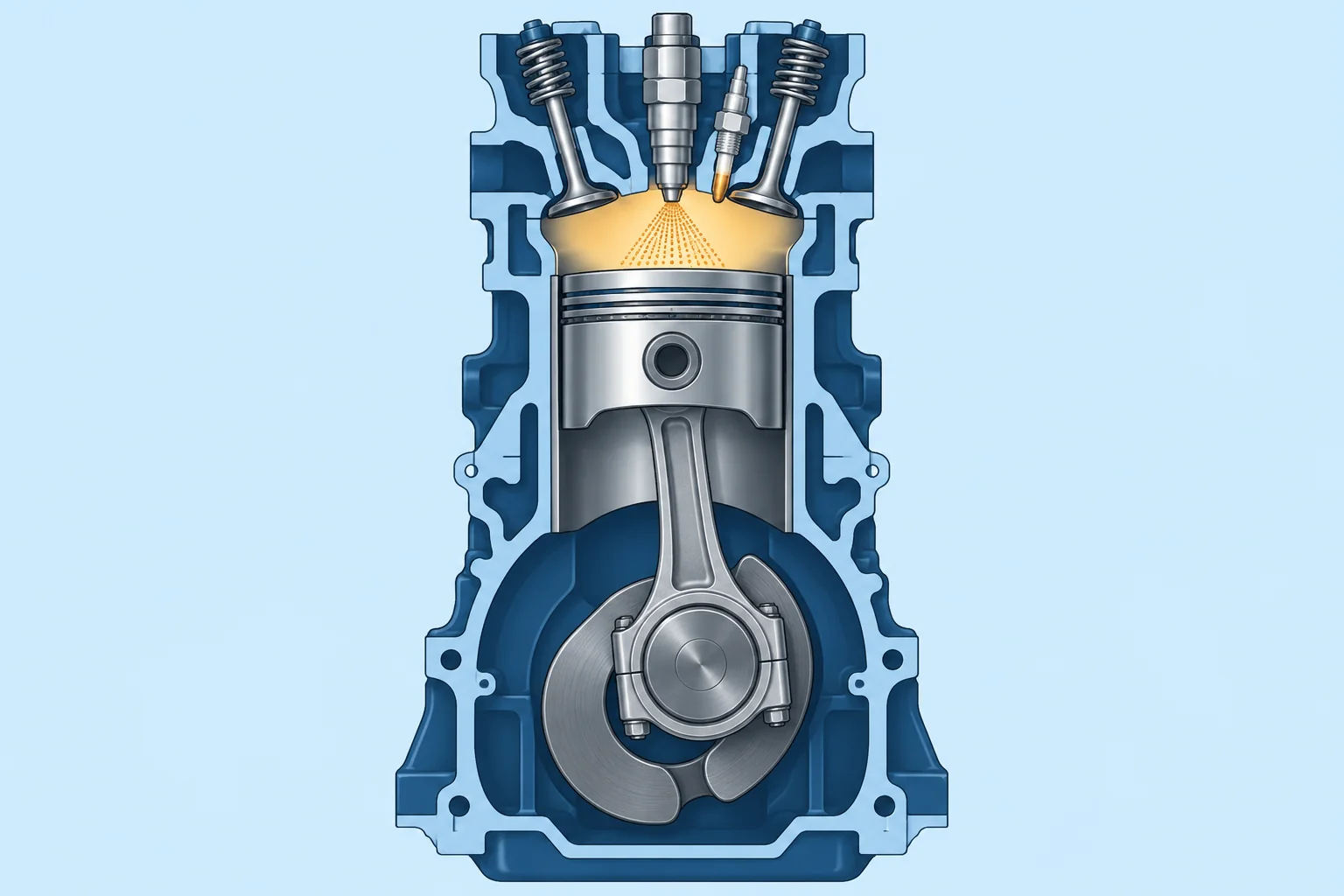
The four-stroke diesel and compression ignition
1The lesson in plain words
A diesel squeezes air until it is hot enough to light the fuel. No spark plug: just air, fuel, compression and a sound electrical start.
Compression ignition
A diesel has no spark plugs. The piston squeezes air to a small fraction of its volume, often 16 to 23 times smaller. The air gets very hot, well over 500 °C. Fuel sprayed in then lights by itself. This is compression ignition.
The four strokes
Induction: the piston goes down and draws in air. Compression: it rises and squeezes the air. Power: fuel is injected, burns and pushes the piston down. Exhaust: it rises again and pushes out the burnt gas. Two turns of the crankshaft give one power stroke per cylinder.
Main parts
A piston moves inside each cylinder, a round bore in the engine block. Connecting rods link the pistons to the crankshaft, turning their movement into rotation. The camshaft opens valves that let air in and exhaust out. The cylinder head closes the cylinders and holds the valves and fuel injectors. The flywheel is a heavy wheel that smooths rotation.
Cold starting
Cold air may not get hot enough to ignite fuel. Use glow plugs or an air heater, if fitted, for the time in the manual. Cranking means turning the engine with the starter. Follow the maker’s cranking and rest limits.
Stopping
A diesel normally stops when fuel injection is cut. A cable or an electrical stop solenoid may do this; electronically controlled engines stop injection through their control system. Know your engine’s normal and emergency stop methods.
2Key data
- Ignition
- Heat of compression: no spark
- Compression ratio
- Often about 16:1 to 23:1 in small diesels
- Four strokes
- Induction, compression, power, exhaust
- Power strokes
- One per cylinder every two crankshaft turns
3Key points
- 1
A diesel lights its fuel by heat of compression.
- 2
Four strokes: induction, compression, power, exhaust.
- 3
Use preheat in the cold; crank in short bursts.
- 4
Normal stopping cuts fuel injection: know your engine’s stop methods.
4Frequent mistakes
Wrong: A diesel that will not start probably has a bad spark plug.
Right: Diesels have no spark plugs. Check fuel, air in the fuel, battery and preheat.
Wrong: Keep cranking until it fires.
Right: Crank in short bursts. Long cranking flattens the battery, overheats the starter and can flood the exhaust with cooling water.
5Practice case & exam keys
On a frosty morning your diesel turns over slowly and will not fire. A crew member suggests holding the starter for a full minute. What do you do instead?
Show the answer
Stop repeated attempts. Check the battery and connections because the engine turns slowly, and check the fuel supply. Use the maker’s preheat, cranking and rest times. Repeated failed starts can fill a wet exhaust: follow the maker’s wet-exhaust starting procedure; see Cooling. Reopen any closed raw-water seacock immediately when the engine fires and check exhaust water.
Exam keys
- Diesel = compression ignition; no spark plugs.
- Four strokes: induction, compression, power, exhaust.
- Cold starts: use preheat and the maker’s maximum cranking time and rest interval.
- Stop by cutting fuel injection: cable, stop solenoid or electronic control.
Finish this unit
When you've read it, answer three questions. Get all three right to finish the unit; opening the page alone doesn't count.
My notes for this unit
No notes