

Cooling and the wet exhaust
1The lesson in plain words
Sea water cools the engine and the exhaust. Lose that flow and the engine overheats; let it siphon back and it floods.
Raw-water circuit
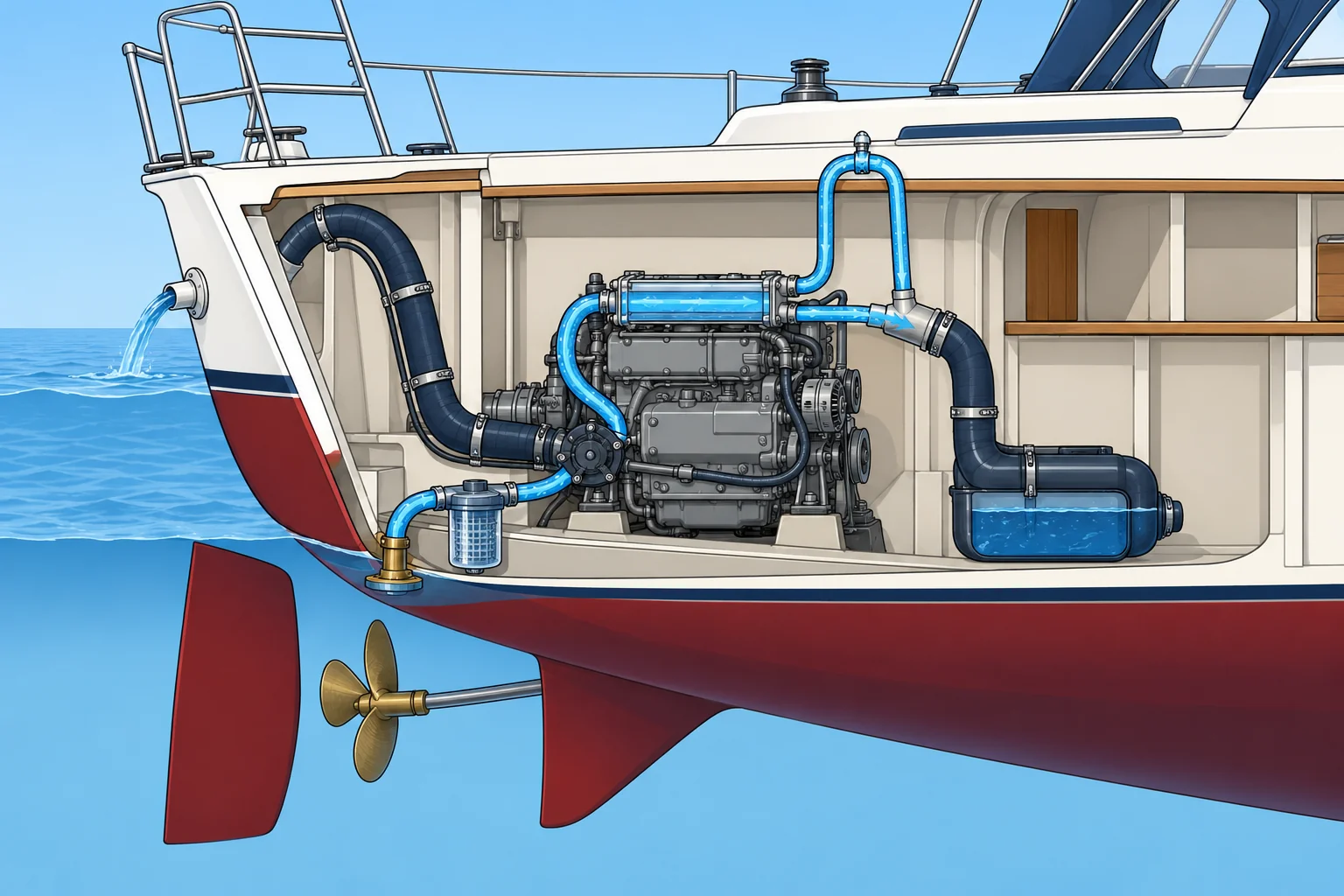
Sea water, called raw water, enters through a seacock (sea-inlet valve) and a strainer (debris filter). An engine-driven pump with a rubber impeller, a rotating wheel with flexible vanes, pushes it through the heat exchanger, where it cools the engine coolant. It then enters the exhaust elbow and leaves with the exhaust. Check for exhaust water at every start.
Fresh-water circuit
Most engines are indirectly cooled: a closed circuit of coolant (fresh water with antifreeze) circulates through the block, a thermostat (temperature-controlled valve) and the heat exchanger. The raw water cools the coolant. Some engines are directly cooled by sea water. Check coolant only when cold; never open a hot cap.
The impeller
The rubber impeller is the weak point. It is destroyed in seconds if it runs dry, for example with the seacock closed. Replace it as the maker says, often each season, and carry a spare. If one breaks, find every missing piece: fragments block the heat exchanger.
Wet exhaust
Cooling water enters the exhaust at the injection elbow. A waterlock collects water draining back when you stop. Where siphoning is possible, a vented loop in the raw-water hose after the pump and before the exhaust injection elbow admits air through an anti-siphon valve to break it. It must stay above the highest operating waterline, including when loaded or heeled, with the maker’s required clearance. Keep its vent clear.
Flooding through the exhaust
Cranking pumps water into the waterlock without enough exhaust to clear it. Water can reach the cylinders. Stop repeated attempts and follow the maker’s wet-exhaust starting procedure. If it requires closing the raw-water intake, reopen it immediately when the engine fires. Do not keep cranking with the intake shut: the impeller runs dry. If water may already have entered the cylinders, do not crank again; get help.
2Key points
- 1
Raw water: seacock → strainer → impeller pump → heat exchanger → exhaust.
- 2
Check for water at the exhaust at every start.
- 3
An impeller dies quickly when dry: carry a spare.
- 4
An anti-siphon valve breaks raw-water siphoning; it does not prevent flooding during repeated failed starts.
- 5
Failed starts: stop and follow the maker’s procedure; reopen any closed seacock immediately on firing and check exhaust water.
3Frequent mistakes
Wrong: Open the coolant cap to see why the engine is overheating.
Right: Let it cool first. Hot coolant under pressure can scald you badly.
Wrong: Without water at the exhaust, rev the engine to get the pump going.
Right: Stop at once. Check the seacock, strainer and impeller; a dry impeller fails in seconds.
4Practice case & exam keys
After starting, you see no water at the exhaust. A crew member suggests waiting for the temperature alarm. What do you do?
Show the answer
Stop immediately; do not wait for the alarm. Check that the raw-water seacock is open. Before opening the strainer or pump, prevent accidental starting and close the seacock. Clear the strainer; if necessary, inspect the impeller and recover missing vanes. Reassemble, reopen the seacock and restart only when the fault is corrected. Confirm exhaust water promptly.
Exam keys
- Raw-water path: seacock, strainer, impeller pump, heat exchanger, exhaust elbow, wet exhaust.
- Indirect cooling: coolant + thermostat + heat exchanger. Direct: sea water through block.
- Waterlock: collects drain-back. Anti-siphon valve: breaks siphoning. Neither prevents flooding during repeated failed starts.
- No exhaust water: stop; check seacock, strainer, impeller.
Finish this unit
When you've read it, answer three questions. Get all three right to finish the unit; opening the page alone doesn't count.
My notes for this unit
No notes