

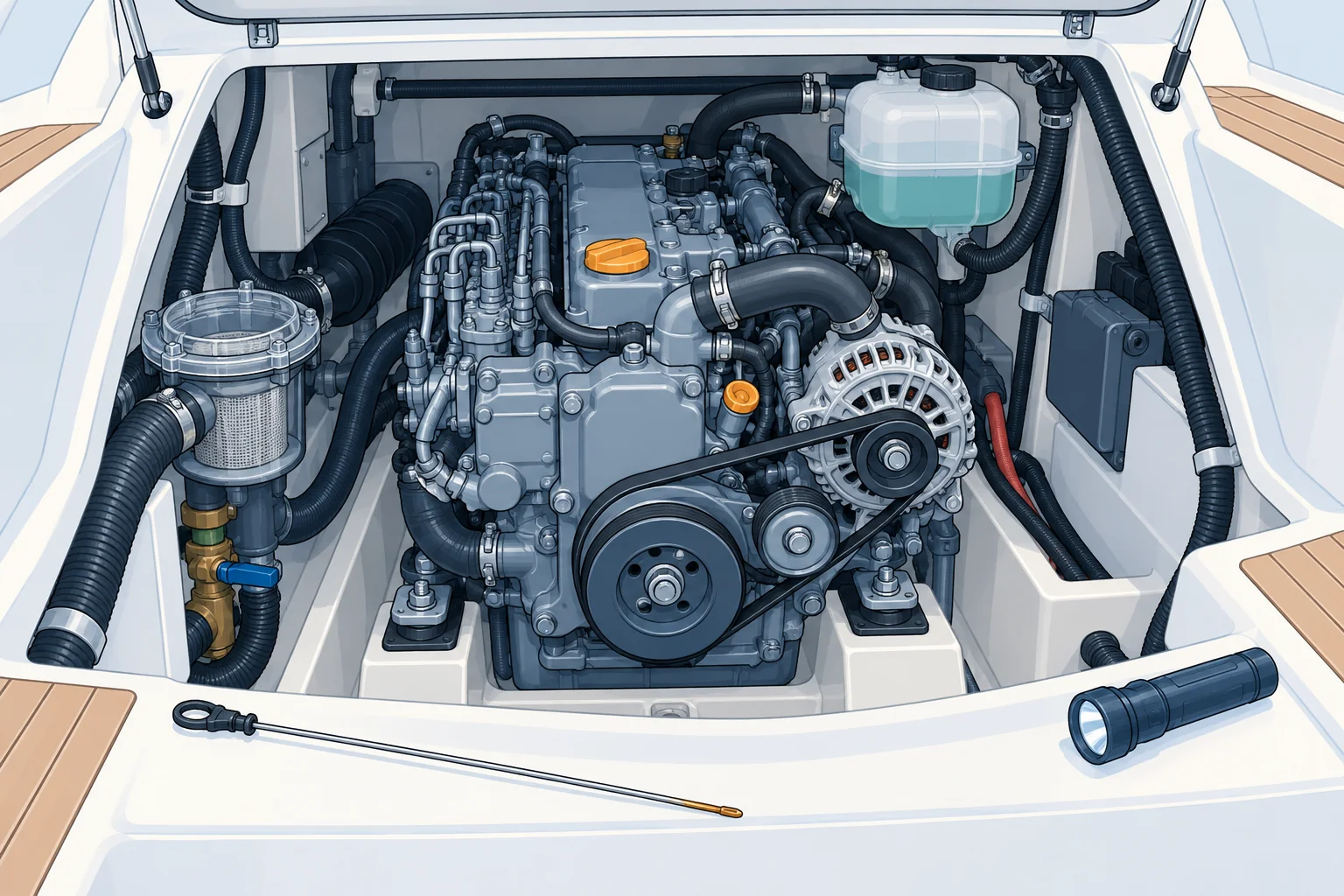
Lubrication and the daily engine checks
1The lesson in plain words
Check water, oil, belts, batteries, leaks and exhaust each day. W-O-B-B-L-E helps you remember.
Lubrication
Oil collects in the sump, the reservoir under the engine. A pump sends it through a filter to bearings, which support moving shafts, and other moving parts. It then drains back to the sump. Oil reduces friction, carries heat and holds dirt for the filter. The oil pressure warning signals pressure below its set limit; stop immediately if it comes on while running. It does not measure oil level.
Reading the dipstick
Check the oil with the engine stopped for a few minutes and the boat as level as possible. Keep the level between the marks. Too low starves the bearings; too high can froth or be burnt. Milky oil means water or coolant is getting in: do not run it, find out why.
Belts and batteries
The belt drives the alternator, which charges the batteries, and often a water pump. With the engine stopped and starting disabled, inspect belts for cracks or fraying. Check tension using the maker’s method: the required deflection and checking force depend on the belt and its span. Make sure the battery switch is on and terminals are tight.
Light running
Long running at very low load, for example only charging batteries, can leave soot and promote bore glazing, a hard, smooth coating on cylinder walls. Use a suitable operating load or another charging source.
2Step by step
W-O-B-B-L-E check before starting
- 1
Water: raw-water seacock open, strainer clear; coolant level correct (engine cold).
No cooling water means overheating within minutes.
- 2
Oil: check engine oil is between the dipstick marks; do not start with milky oil.
Low or milky oil can wreck the engine.
- 3
Belts: with the engine stopped and starting disabled, check belt condition and tension using the maker’s method.
A slack or broken belt stops charging and often cooling.
- 4
Batteries: switch on, terminals tight, voltage normal.
A weak start battery is the commonest reason for not starting.
- 5
Leaks: look under and around the engine for fuel, oil, coolant or water; check the bilge.
A new leak is a warning of a fault to come.
- 6
Exhaust: after starting, check cooling water flows out and observe the smoke. If water is absent, stop immediately.
Confirms cooling and clean combustion before you leave.
3Key points
- 1
Use W-O-B-B-L-E before every first start of the day.
- 2
Check oil with the engine stopped and the boat level.
- 3
Milky oil = water or coolant in the oil: do not run it.
- 4
Avoid prolonged running at very low load; use a suitable operating load or another charging source.
- 5
Record unusual oil use, leaks or exhaust changes.
4Frequent mistakes
Wrong: Check the oil straight after a long run.
Right: Wait a few minutes with the engine stopped so the oil drains back to the sump, then read it level.
Wrong: Charging batteries by idling for hours is good for the engine.
Right: Long light running can promote soot and bore glazing: hard deposits on cylinder walls. Use suitable load, or another charging source.
5Practice case & exam keys
During your morning checks the dipstick shows oil above the maximum mark, and it looks like coffee with milk. The coolant header tank is lower than yesterday.
Show the answer
Do not start. Milky oil and falling coolant suggest coolant is getting into the oil, for example through a failed head gasket or oil cooler. Running it can destroy the bearings. Note the levels, keep the boat safe in harbour and get a marine engineer to diagnose it.
Exam keys
- WOBBLE: water, oil, belts, batteries, leaks, exhaust.
- Oil checked stopped and level; milky oil = water/coolant contamination.
- Inspect belts with the engine stopped; use the maker’s tension method and specification.
- Avoid prolonged light running.
Finish this unit
When you've read it, answer three questions. Get all three right to finish the unit; opening the page alone doesn't count.
My notes for this unit
No notes