

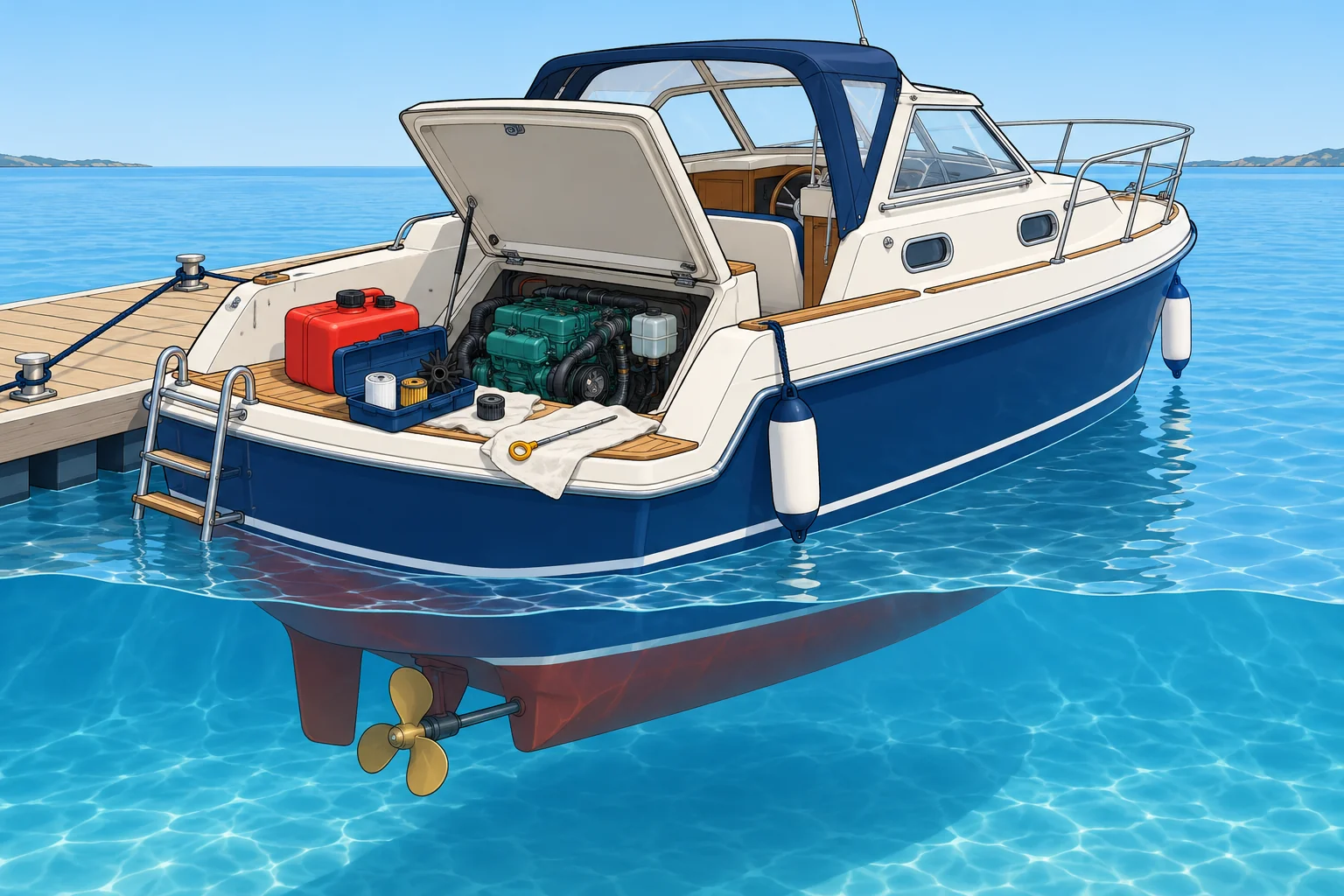
Fuel, battery and a quick look before you leave
1The lesson in plain words
Check fuel, battery, valves and the engine before leaving. A few minutes alongside can reveal a problem before it stops you at sea.
Why it matters
In the UK, machinery failure is the most common reason lifeboats launch to leisure boats, year after year. Common problems include no fuel, dirty fuel, a flat battery, no cooling water. A quick check alongside can reveal problems before you leave. Have any fault put right before departure.
Fuel and range
Check fuel quantity yourself using the tank maker’s approved method, such as a sight gauge (a fuel-level window) or a dipstick (a measuring rod) through a designated measuring point; do not rely on the dashboard gauge alone. Plan with the rule of thirds: one third to get there, one third to come back, one third in reserve for headwinds, a detour or a search. Fuel use rises quickly with speed and with waves.
Battery and switches
Turn the battery switch on. On many boats a separate start battery is used only for the engine. A modern panel shows battery voltage: note it before you start. Loose or corroded terminals can prevent starting even when the battery is charged.
A look at the engine
Open the engine box and look before you start: the oil level on the dipstick (oil-level measuring rod), the coolant (engine-cooling liquid) level if there is a tank, the drive belt, and any fresh drops of fuel, oil or water underneath. The full inboard routine, called W-O-B-B-L-E, is in Ship: the marine diesel engine.
Spares and tools
Carry a small kit: spare fuel filters, a water-pump impeller (the flexible rotor that pumps cooling water), a belt, fuses, a set of spanners and screwdrivers, rags, a torch and the engine manual. On an outboard, add a spare kill cord (engine cut-off lanyard) and spark plugs. Know where the fuel shut-off valve is.
2Step by step
Engine check before casting off
- 1
Check the fuel quantity yourself and work out your range with the rule of thirds.
Running out of fuel is one of the commonest causes of breakdowns.
- 2
Open the fuel valve. On a portable tank, open its manual air vent, if fitted, so air can replace used fuel. Connect the fuel line firmly.
A closed valve or vent lets the engine start, then starve and stop.
- 3
Battery switch on; look at the terminals and note the voltage.
A weak battery or bad connection is the usual reason an engine will not turn.
- 4
Open the inboard cooling-water seacock (the valve admitting seawater). Check the oil and belt.
No cooling water ruins the water-pump impeller in seconds.
- 5
Look for leaks and check the bilge (the lowest space inside the hull) is dry.
A new leak is an early warning of a failure.
- 6
Check spares, tools and the kill cord are aboard.
Small faults are easy to fix only if the parts are with you.
3Key data
- Rule of thirds
- ⅓ out, ⅓ back, ⅓ reserve
- Commonest breakdowns
- No fuel, dirty fuel, flat battery, no cooling water
4Key points
- 1
Check the fuel quantity yourself; plan with one third out, one third back, one third reserve.
- 2
Open the fuel valve, any manual tank vent as instructed, and the inboard cooling-water seacock before starting.
- 3
Battery switch on, terminals clean and tight, voltage noted.
- 4
Carry filters, an impeller, a belt, fuses, tools and the manual.
5Frequent mistakes
Wrong: The fuel gauge says half full, so we have plenty.
Right: Verify the quantity using the tank maker’s approved method, and keep a third in reserve.
Wrong: Spares can stay at home for a short trip.
Right: Breakdowns can happen on short trips too. Carry the basic kit every time.
6Practice case & exam keys
You plan to travel 12 miles out and 12 miles back. Your motorboat burns 1 litre per mile at cruising speed. Its only tank holds 30 litres; the gauge reads three-quarters. Can you make this trip using the rule of thirds?
Show the answer
No. You need 12 litres each way: 24 litres for travel and 12 in reserve, so 36 litres total. The gauge suggests 22.5 litres, which you must verify. Even a full 30-litre tank is too small for this plan. Shorten or postpone the trip; filling this tank alone is not enough.
Exam keys
- Rule of thirds: one third out, one third back, one third reserve.
- In the UK, machinery failure is the commonest reason for lifeboat call-outs to leisure craft.
- Before starting: fuel valve open, manual tank vent set as instructed, battery on, inboard seacock open.
- Carry filters, impeller, belt, fuses, tools and the manual.
Finish this unit
When you've read it, answer three questions. Get all three right to finish the unit; opening the page alone doesn't count.
My notes for this unit
No notes