

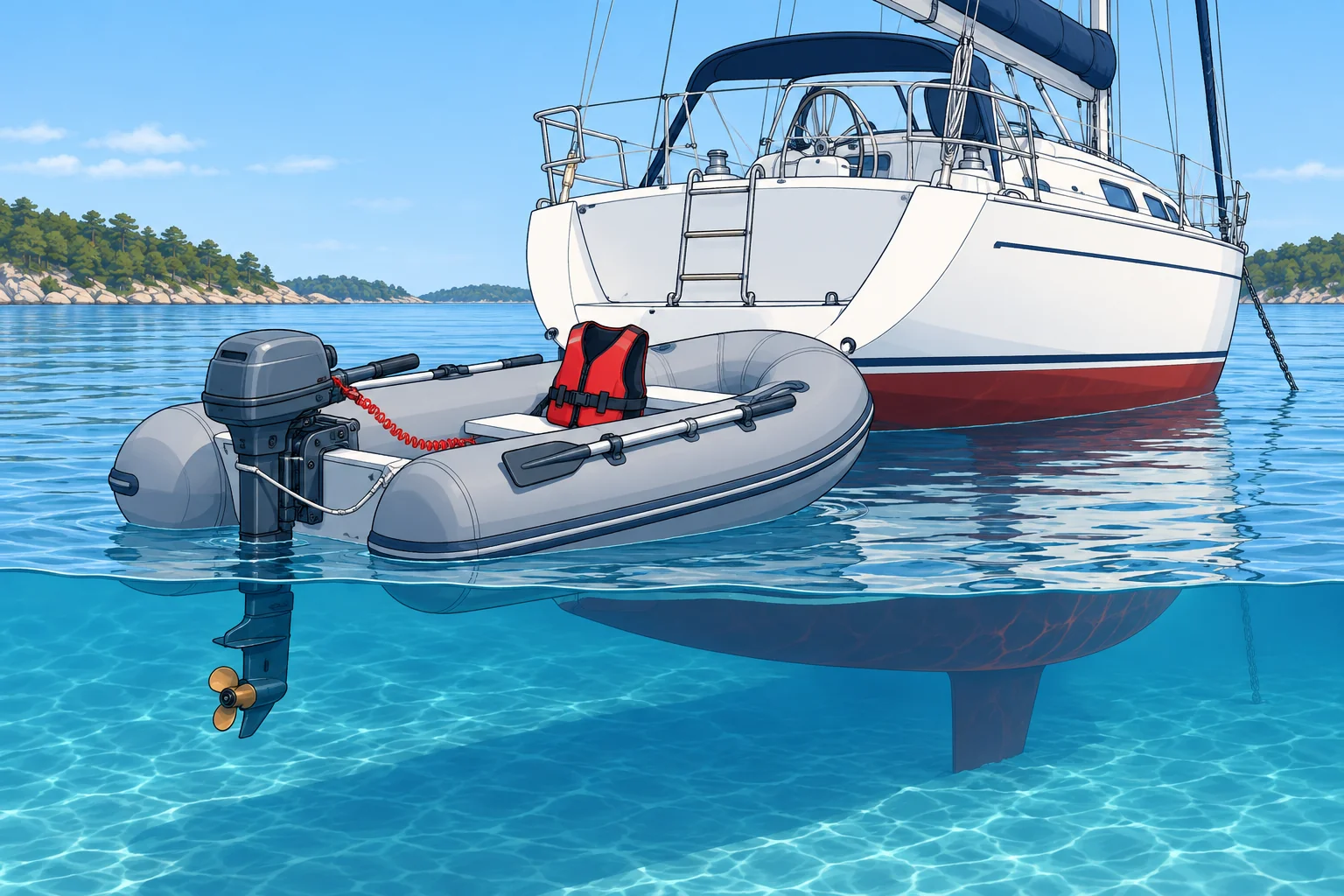
The tender's outboard: fitting, kill cord and safety
1The lesson in plain words
A tender is a small boat used to reach shore or another boat. Secure its outboard, wear the kill cord and carry oars.
Fitting it
Secure the tender alongside. Lower the engine on a suitable line attached to its approved lifting point or a properly fitted engine-lifting harness. Keep people clear beneath it. Centre it on the transom (the flat back of the tender), tighten both clamp screws firmly and attach a safety line from the engine to the tender to retain it if the clamps loosen.
Kill cord
A kill cord links you to the engine cut-off switch. If you fall away, it pulls out and stops the engine. Wear it securely as the maker directs. A wireless version uses a device you wear instead of a cord.
US rule
US federal law requires using a fitted engine cut-off link on recreational boats under 26 ft with at least 115 lb static thrust (push measured while stationary; about 3 horsepower). Use it above displacement speed: when the hull starts rising and skimming over the water, including partial planing. The requirement does not apply if the main helm (steering position) is inside an enclosed cabin.
Propeller danger
A turning propeller causes terrible injuries. Go to neutral and stop the engine before anyone swims near the stern (back of the tender) or climbs in from the water.
Backup
Carry oars or paddles and a bailer (a scoop for removing water); for an inflatable tender, carry its inflation pump too. Small outboards often stop on old fuel or a closed vent. Check fuel before you leave the yacht, and tell someone where you are going, especially at night.
Shallow water and beaching
Slow down before shallows. Use only the shallow-water setting your manual allows, keeping the cooling intakes submerged. Before lifting fully for beaching, select neutral and stop the engine. Use oars to reach shore; keep the propeller and leg (lower engine housing) clear of the bottom.
2Key points
- 1
Secure the tender; lower using an approved lifting point or engine harness. Tighten both clamps; add a safety line.
- 2
Wear the kill cord every time.
- 3
Stop the engine before anyone is near the propeller.
- 4
Carry oars, a bailer and fuel; stop the engine before lifting it fully for beaching.
3Frequent mistakes
Wrong: The kill cord is only for fast boats.
Right: Small tenders flip and throw people out too. Wear it on every boat that has one.
Wrong: Leave the oars on the yacht to save space.
Right: Small outboards do stop. Without oars the tide or wind carries you away.
4Practice case & exam keys
At anchor, a friend wants to swim to the tender while you start its outboard to go ashore. What do you do?
Show the answer
Keep the engine stopped until the swimmer is aboard and clear of the stern. Then clip on the kill cord, check the propeller area, start in neutral and move off slowly. If someone in the water comes near, go to neutral and stop the engine.
Exam keys
- Kill cord: worn every time; it stops the engine if you fall away.
- Stop the engine when people are in the water near the stern.
- Safety line from engine to tender; both clamp screws tight.
- Oars and bailer always aboard the tender.
Finish this unit
When you've read it, answer three questions. Get all three right to finish the unit; opening the page alone doesn't count.
My notes for this unit
No notes