

Looking after an outboard
1The lesson in plain words
Salt, old fuel and knocks are an outboard's enemies. Flush it, use fresh fuel and look at the propeller after every trip.
Flushing
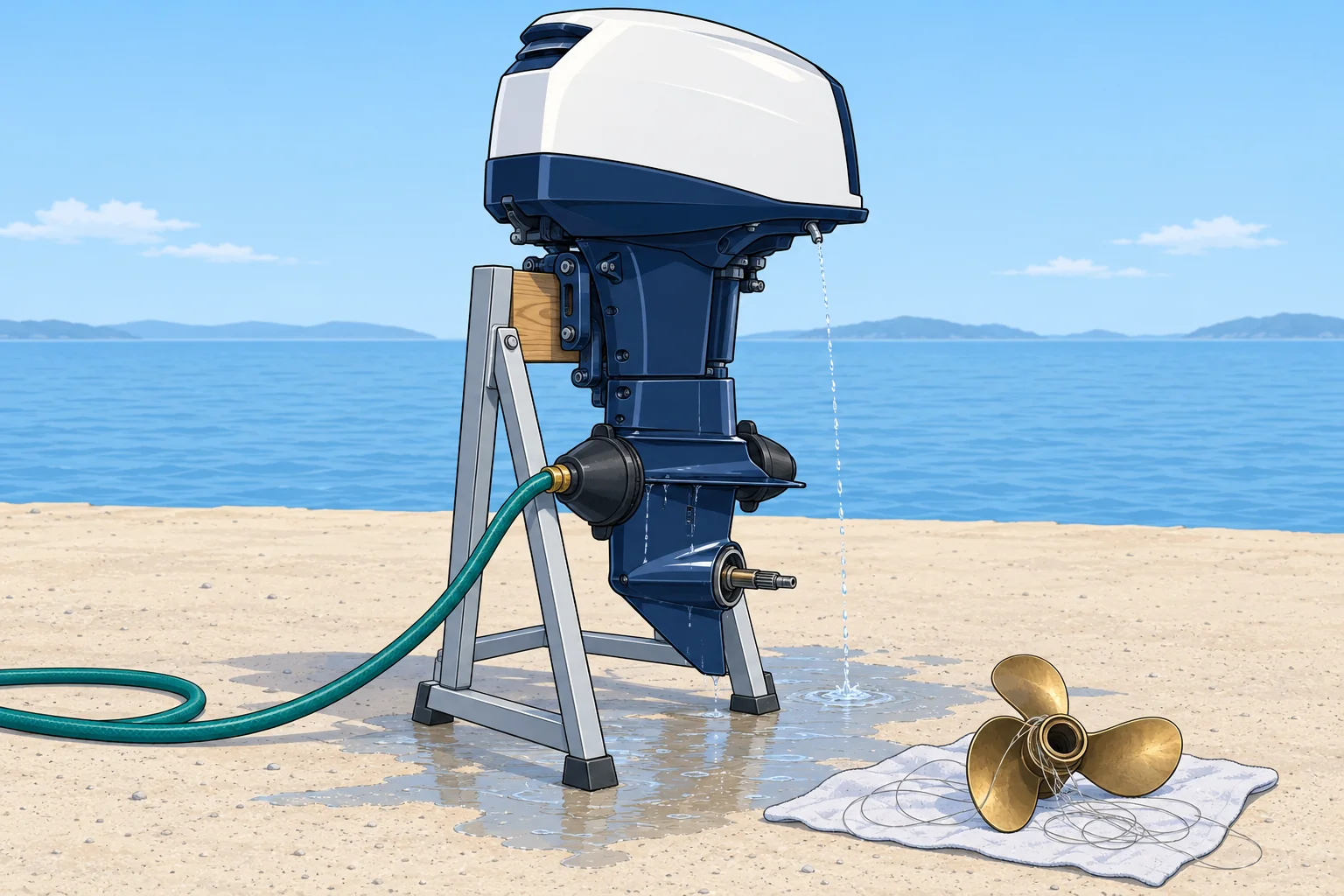
Salt water leaves salt and sand in the cooling passages. After use in salt or dirty water, flush the engine with fresh water: through the built-in flush port, or with flushing muffs (ear-muff cups over the water intakes) on a hose. Follow the manual: with some methods the engine must run, with others it must not.
Fuel
Petrol goes stale and can block carburettor jets (tiny fuel passages). E10 contains up to 10% ethanol, which absorbs water. Use fresh fuel; check the manual’s ethanol limit. Add a suitable fuel stabiliser (an additive that slows ageing) to fresh fuel before storage; it cannot restore stale fuel. Store tanks closed, out of sunlight. For a premix two-stroke, mix the specified oil and petrol at the manual ratio. An oil-injected two-stroke uses a separate oil supply: check its tank. Add oil to its petrol only if instructed.
Propeller and gearbox
Check the propeller for bent or chipped blades and fishing line wound behind it. Line can cut the oil seal on the gearbox (the gears in the lower engine housing). Impact protection may use a shear pin (a pin designed to break) or a rubber hub (an insert inside the propeller that slips on impact). Milky gearbox oil means water has entered.
Anodes and corrosion
Outboards have anodes, blocks of zinc or another metal that corrode instead of the engine. Replace them when about half worn away. Never paint them. Rinse the outside with fresh water after use.
Lifting and storing
Carry the engine upright, or lay it down only on the side the manual shows. A four-stroke laid on the wrong side can let oil run into the cylinder. Store it upright, with the propeller lowest so water drains from the leg (the lower engine housing).
2Step by step
Flushing an outboard after salt water
- 1
Read which flushing method your manual allows and whether the engine may run.
Some flush ports must be used with the engine stopped; muffs usually need it running.
- 2
With the engine stopped, keep everyone clear of the propeller; remove it if the manual requires. Fit the hose or muffs securely.
A loose muff lets the pump run dry.
- 3
Turn on the water, then start the engine only if the manual says so, in neutral at idle.
Water protects the impeller. A propeller may turn even in neutral.
- 4
Maintain clearance and check water flow at the outlet specified for your flushing method.
The expected outlet and flow depend on the engine and flushing method.
- 5
Flush for the time in the manual, often a few minutes.
Gives time to wash salt and sand out.
- 6
Stop the engine first, then the water. Rinse the outside.
Water must flow as long as the engine runs.
3Key points
- 1
Flush with fresh water after salt or dirty water, the way your manual says.
- 2
Use fresh fuel within the manual's ethanol limit; E10 petrol absorbs water and goes stale.
- 3
Check the propeller for damage and fishing line; milky gear oil means water.
- 4
Replace anodes when half worn; never paint them.
4Frequent mistakes
Wrong: Run an outboard on muffs with the water turned off for a quick test.
Right: Never run it without water. The impeller is destroyed in seconds.
Wrong: Lay a four-stroke outboard down on any side in the car.
Right: Use only the side the manual shows, or oil can run into the cylinder.
Wrong: Last season's petrol is fine if it smells normal.
Right: Replace stale or water-contaminated petrol. Add a suitable stabiliser to fresh fuel before storage; it cannot restore old fuel.
5Practice case & exam keys
After a weekend in the tender you notice a tangle of fishing line wound round the propeller shaft behind the propeller. The engine seemed to run normally.
Show the answer
Remove the propeller (engine stopped, kill cord off, as the manual shows) and clear all the line. Line wound tightly there can cut the gearbox oil seal. Check the gearbox oil as the manual directs. Milky oil indicates water contamination; low oil may indicate a leak. Have either fault checked before further use.
Exam keys
- Flush with fresh water after salt water; follow the manual's method.
- Fishing line behind the propeller can cut the gearbox seal.
- Milky gearbox oil: water is getting in.
- Anodes: replace when half worn, never paint.
Finish this unit
When you've read it, answer three questions. Get all three right to finish the unit; opening the page alone doesn't count.
My notes for this unit
No notes