

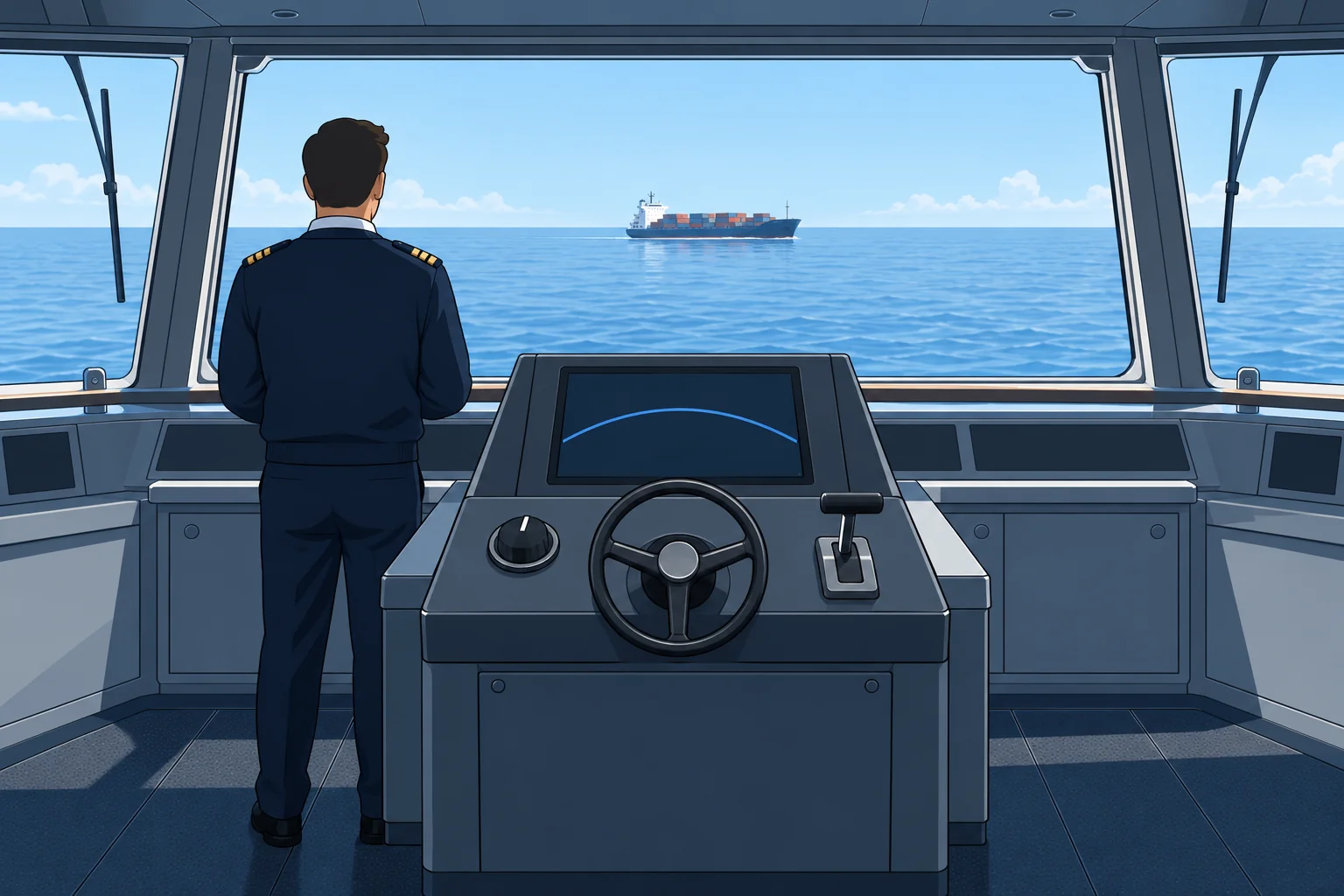
Autopilot: heading and track control, and the rules for using it (SOLAS V/24)
1The lesson in plain words
The autopilot keeps a heading or a track, but it keeps no lookout. SOLAS V/24 says when manual steering must be ready and tested.
Heading and track
A heading control system (HCS), the autopilot, keeps the heading set by the officer, using the gyrocompass or another heading sensor. A track control system (TCS) keeps the ship on a planned track from the electronic chart route, correcting for wind and current. Under SOLAS V/19, ships of 10,000 gross tonnage (GT), a measure of enclosed volume, or more must have one of these, or another automatic means.
Steering modes
The mode selector usually offers hand (follow-up: the wheel or tiller sets a rudder angle and the rudder goes to it), non-follow-up (the rudder moves only while the lever is held), auto (heading) and track. Many consoles have an override tiller that takes control from the autopilot at once.
Settings and alarms
Rudder limit caps the rudder angle used. The weather (yaw) setting reduces corrections for wave-driven heading swings. Counter rudder applies opposite rudder to check a turn; rate of turn sets how quickly heading changes on systems with that function. The off-heading alarm warns of excessive departure from the set heading; a sensor alarm warns of lost or faulty heading input. Low speed, heavy weather and shallow water can limit performance. Keep your lookout.
SOLAS V/24
In high traffic density, restricted visibility and other hazardous situations, it must be possible to switch to manual steering immediately. A qualified helmsperson must be available to the officer of the watch without delay, ready at all times to take over. The change from automatic to manual and back is made by, or under the supervision of, a responsible officer. Manual steering is tested after prolonged use of the autopilot and before entering areas needing special caution.
Two pumps in caution areas
Under SOLAS V/25, in areas where navigation demands special caution, ships run more than one steering gear power unit when the units can work together. This provides redundancy against a power-unit failure; shared hydraulic, control or mechanical faults can still disable steering. How you take the wheel and answer helm orders is covered in Law: watch ratings.
2Key data
- HCS / TCS required
- Ships of 10,000 GT and more (SOLAS V/19)
- Manual steering ready
- Immediately, in traffic, poor visibility and hazards (V/24)
- Change-over auto ↔ manual
- By or under supervision of a responsible officer
- Test manual steering
- After prolonged autopilot use; before caution areas
- Caution areas
- More than one power unit running, where possible (V/25)
3Key points
- 1
Heading control keeps a heading; track control keeps a planned track. Neither keeps a lookout.
- 2
Modes: hand (follow-up), non-follow-up, auto and track; an override tiller takes over at once.
- 3
Off-heading warns of excessive heading difference; a sensor alarm warns of lost or faulty heading data.
- 4
V/24: manual steering immediately available, helmsperson ready, change-over by or under an officer.
- 5
Test manual steering after long autopilot use and before areas needing special caution.
4Frequent mistakes
Wrong: On autopilot the lookout can relax, because the ship holds her course by herself.
Right: The autopilot only holds a heading or track. Lookout and collision avoidance stay fully with the watch.
Wrong: A rating may switch the autopilot to hand steering whenever it seems useful.
Right: The change-over is made by, or under the supervision of, the officer of the watch, who orders it.
Wrong: After ten days on autopilot across an ocean, manual steering can be assumed to work.
Right: Manual steering is tested after prolonged autopilot use and before entering areas needing special caution.
5Practice case & exam keys
After nine days on track control, you approach a busy traffic scheme in fog. The officer suggests leaving manual steering untested because track control has worked well. What should you report, and what must be ready before entry?
Show the answer
Explain that working track control does not prove manual steering works. Ask for the required manual test before entry. A qualified helmsperson must be ready without delay, and manual control must be available immediately. Change over by or under a responsible officer. More than one power unit must run if the units can work together.
Exam keys
- HCS keeps heading; TCS keeps track. Ships ≥ 10,000 GT need one or the other (SOLAS V/19).
- V/24: manual control immediately in high traffic, restricted visibility, hazards; qualified helmsperson ready.
- V/24: change-over by or under a responsible officer; test manual steering after prolonged use and before caution areas.
- V/25: more than one power unit running in caution areas, where the units can run together.
Finish this unit
When you've read it, answer three questions. Get all three right to finish the unit; opening the page alone doesn't count.
My notes for this unit
No notes