

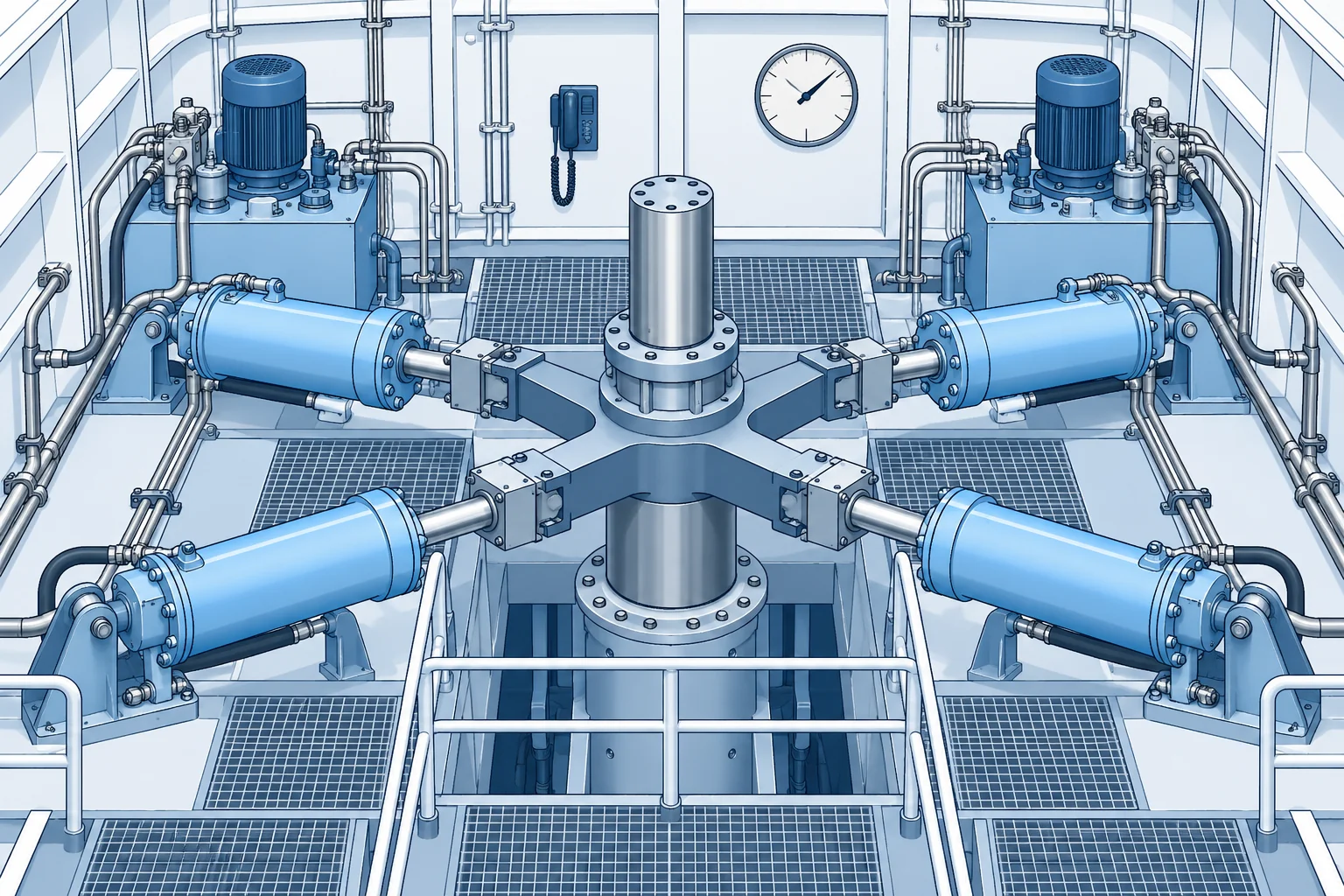
Ship steering gear: rams, rotary vanes and the steering gear room
1The lesson in plain words
Hydraulic power turns the rudder stock through rams or vanes. Know the type on your ship and what is in the steering gear room.
Main parts
The steering gear is the machinery that turns the rudder. A control system carries the order from the bridge, usually electrically. Power units, electric motors driving hydraulic pumps, make oil pressure. An actuator turns that pressure into a turning force on the rudder stock, the shaft that carries the rudder. Many ships have two power units. Backup depends on the fault and your ship’s arrangement. A rudder angle indicator shows the actual rudder angle on the bridge and in the steering gear room.
Ram gear
In electro-hydraulic ram gear, oil pushes pistons called rams. They act on a tiller, an arm fixed to the rudder stock. A Rapson slide lets the ram connection slide along that arm, increasing turning force as rudder angle grows. Two pumps on a two-ram gear provide backup for a pump failure, but not necessarily a damaged ram. On a four-ram gear designed for isolation, one ram pair can be isolated while the other steers at reduced performance.
Rotary vane gear
A rotary vane gear has a rotor with vanes fixed to the rudder stock, turning inside a housing with fixed vanes. Oil pressure turns the rotor directly, without rams or a tiller. Internal seal leakage lets oil bypass between chambers, reducing steering force or response without necessarily lowering the reservoir level. External leaks can lower the level. Report either sign.
What SOLAS asks
SOLAS II-1/29 requires main and auxiliary steering unless an approved redundant arrangement meets the exemption conditions. At deepest seagoing draught (loaded depth) and maximum ahead service speed, main gear must turn the rudder from 35° on either side to 35° opposite, and from 35° to 30° opposite within 28 seconds. At that draught, auxiliary gear must turn it from 15° on either side to 15° opposite within 60 seconds at half maximum ahead service speed or 7 knots, whichever is greater.
The steering gear room
The steering gear compartment is easy to reach and has a means of communication with the bridge, usually a sound-powered telephone, which needs no ship’s power. It has a rudder angle indicator, a heading display for emergency steering, and the posted change-over instructions. Keep it clean, lit and dry: oil on the gratings is a slip hazard and may show a leak. Never reach into the gear while it can move.
2Key data
- Main gear on trials
- 35° to 35°; 35° to 30° on the other side in ≤ 28 s
- Auxiliary gear on trials
- 15° to opposite 15° ≤60 s; ½ max ahead service speed or 7 kn, greater
- Rudder angle shown
- On the bridge and in the steering gear room
- Power units
- Two power units provide backup; shared faults can still stop steering.
3Key points
- 1
Control system, power units and actuator turn the rudder stock; the indicator shows the real rudder angle.
- 2
Ram gears act on a tiller; a Rapson slide gives more turning force at larger rudder angles.
- 3
Rotary vane gear turns the stock directly; internal seal leakage can weaken steering without lowering the oil level.
- 4
Main gear: 35° to 30° in ≤ 28 s. Auxiliary gear: 15° to 15° in ≤ 60 s (SOLAS II-1/29).
- 5
The steering gear room has a phone to the bridge, an angle indicator, heading display and posted instructions.
4Frequent mistakes
Wrong: The rudder angle indicator shows the angle the wheel has ordered.
Right: It shows the actual rudder angle, on the bridge and in the steering gear room. Comparing the two is how you spot a fault.
Wrong: A small oil drip under the gear is normal and can wait for the next refit.
Right: Report every new leak at once. Lost oil means slower steering, then none, and oily gratings cause falls.
5Practice case & exam keys
During a watch round you find the oil level in one power unit’s reservoir lower than at your last round, and a film of oil on the gratings under a ram cylinder. The ship is at sea and steering normally.
Show the answer
Report the falling level and cylinder leak to the officer of the watch immediately. The engineers must assess the affected hydraulic circuit and follow the posted isolation procedure. Stopping one pump may not isolate a cylinder leak. Do not assume the other pump remains usable. Clean the gratings only when told it is safe.
Exam keys
- Steering gear: control system → power units (pumps) → actuator (rams or rotary vane) → rudder stock.
- Rapson slide: turning force grows with rudder angle. Four rams: one pair can be isolated where the fitted isolation arrangement permits.
- SOLAS II-1/29: main 35° to 30° in ≤ 28 s; auxiliary 15° to 15° in ≤ 60 s at ½ maximum ahead service speed or 7 kn, whichever is greater.
- Steering gear room: communication with the bridge, rudder angle indicator, heading display, posted change-over instructions.
Finish this unit
When you've read it, answer three questions. Get all three right to finish the unit; opening the page alone doesn't count.
My notes for this unit
No notes