

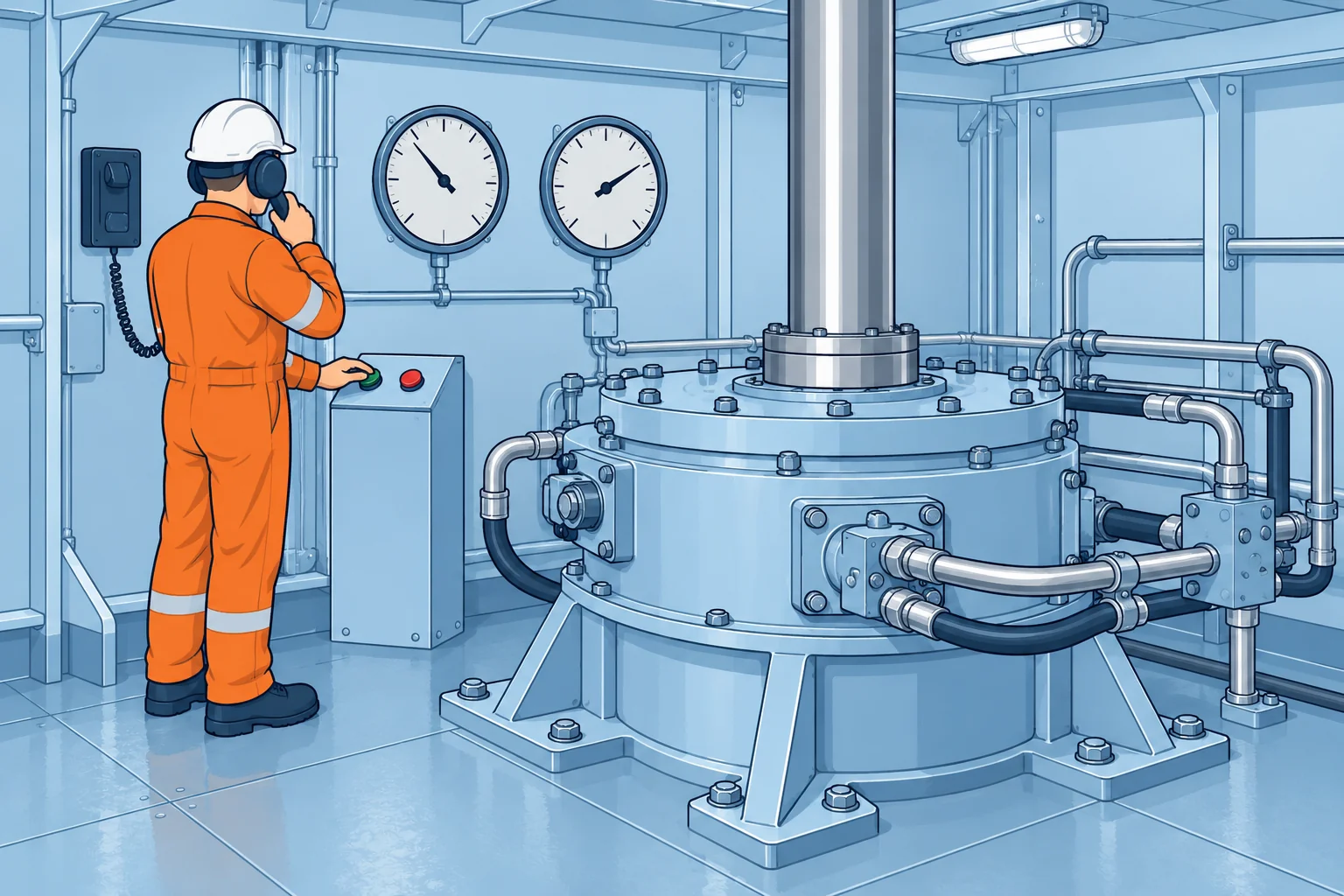
Changing over to local and emergency steering
1The lesson in plain words
If bridge control fails, the ship is steered from the steering gear room on orders from the bridge. Know the posted change-over before you need it.
Control positions
Normally you steer from the bridge: this is remote control. Local control means steering at the gear itself, in the steering gear compartment. Ships do it by a local panel with push-buttons, a non-follow-up lever (the rudder moves only while you hold it), or by operating the hydraulic control valves by hand. Some older ships have a small trick wheel. Your ship’s method is on the posted change-over instructions.
When it is needed
If bridge steering does not answer, report it immediately. The officer follows your ship’s steering-failure procedure. Depending on the fault and fitted system, this may involve another control system, another power unit or local control. Make changes only as ordered and posted. Causes include a control system fault, a power unit failure or loss of the normal steering position. The bridge orders emergency steering from the steering gear room when local control is needed.
Steering blind
You cannot see ahead from the steering gear room. The bridge keeps the lookout and sends steering orders. Repeat every order back before acting. For an ordered rudder angle, use the local rudder angle indicator and report when the rudder reaches it. For an ordered heading, use the heading display and report when the ship reaches it. If an order is unclear, ask again.
Communication and power
Use the fixed phone, often sound-powered, with an agreed radio backup. Where SOLAS II-1/29.14 applies, an alternative supply must be available automatically within 45 seconds for one power unit, its control system and rudder angle indicator. It may come from the emergency electrical source or an independent source in the steering gear compartment. Know your ship’s arrangement.
2Step by step
Changing over to local control (follow your ship’s posted instructions)
- 1
On the bridge’s order, go to the steering gear room with a radio and report arrival.
The bridge must know the position is manned before it hands over control.
- 2
Establish the fixed phone link and agree the radio as backup.
Without communication you cannot receive steering orders.
- 3
Check that a power unit is running, or start the one the bridge names; check oil level.
The rudder cannot move without hydraulic pressure.
- 4
Set local control exactly as posted. Carry out the bridge’s ordered control check and confirm local control is established.
A wrong valve can block the rudder or leave two positions fighting each other.
- 5
Repeat each order before acting. If unclear, ask again. Steer by the appropriate local display and report when the ordered rudder angle or heading is reached.
Closed-loop reports let the bridge know the ship is answering.
- 6
Stay until relieved; change back to remote only on the bridge’s order.
An unannounced change-back leaves the ship with no one steering.
3Key points
- 1
Remote control is from the bridge; local control is at the gear in the steering gear room.
- 2
Follow the posted change-over instructions and block diagram for your ship.
- 3
Steer to orders: rudder angle on the local indicator or heading on the heading display.
- 4
Repeat before acting; report when the ordered rudder angle or heading is reached. The bridge keeps lookout.
- 5
Fixed phone first, radio as backup; know which power unit has the alternative supply.
4Frequent mistakes
Wrong: In the steering gear room, steer by feel until the bridge sees the ship turn.
Right: Repeat each order before acting; ask again if unclear. Steer by the local angle indicator or heading display, then report when the ordered rudder angle or heading is reached.
Wrong: Once things settle, switch back to bridge control yourself to save time.
Right: Change back only on the bridge’s order and confirm it. Otherwise nobody may be steering.
5Practice case & exam keys
Steering from the bridge fails while the ship is in coastal waters. You are sent to the steering gear room. The fixed phone works, but the bridge’s orders are hard to hear over the pump noise.
Show the answer
Report arrival and follow the posted change-over on the bridge’s order. Agree a clear phone or radio link before steering. Use the ship’s hearing protection. Repeat each order before acting and report when the ordered rudder angle or heading is reached. Never guess an unclear order: ask for it again.
Exam keys
- Remote control: bridge. Local control: in the steering gear compartment, by panel, non-follow-up lever or hand-operated valves.
- Emergency steering is ordered by the bridge; the bridge keeps the lookout and gives orders.
- Repeat each order before acting; steer by the local rudder angle indicator or heading display; report when the ordered angle or heading is reached.
- Fixed phone with radio backup. Where II-1/29.14 applies: alternative supply within 45 s to one power unit, its control and rudder angle indicator.
Finish this unit
When you've read it, answer three questions. Get all three right to finish the unit; opening the page alone doesn't count.
My notes for this unit
No notes