

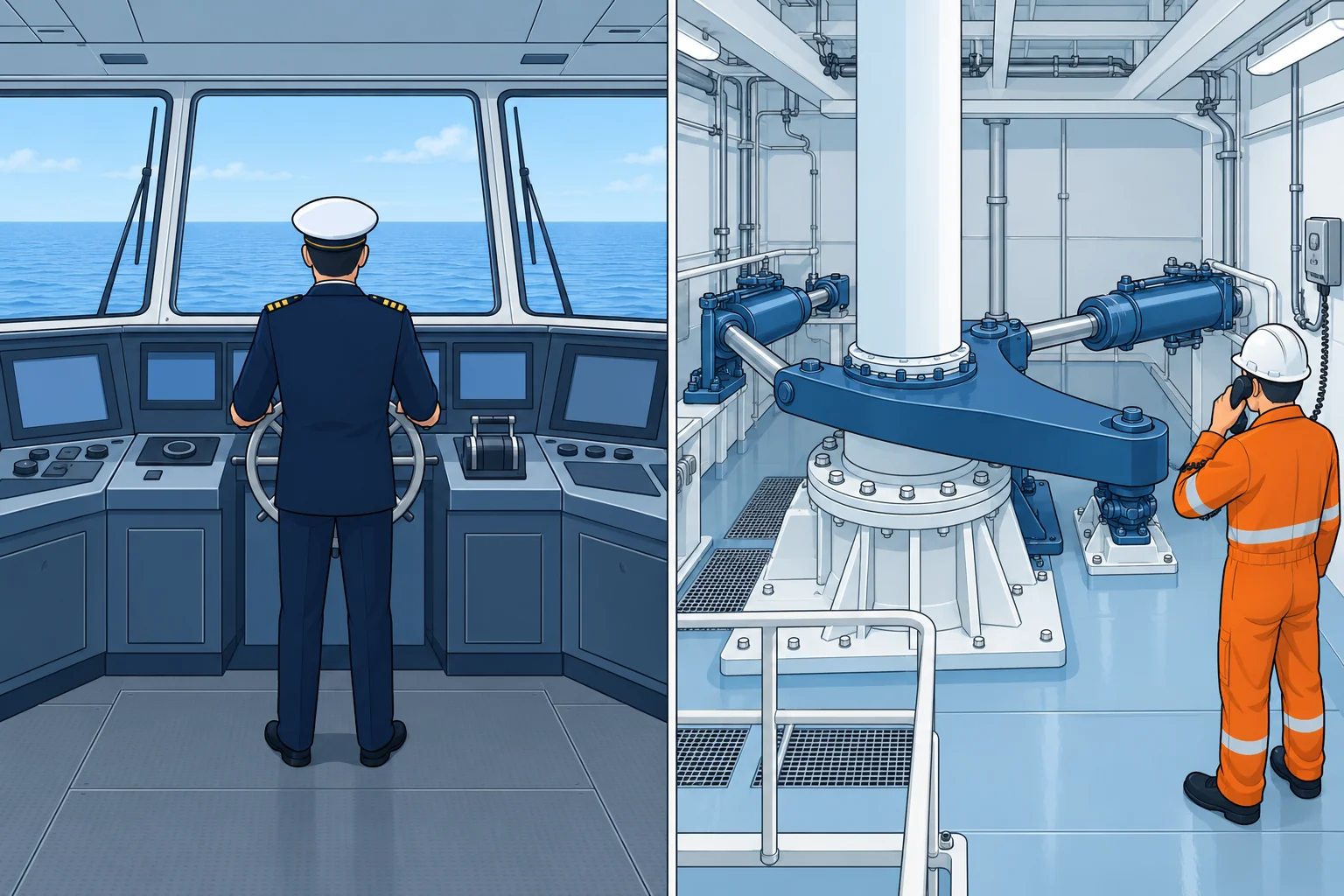
Steering gear tests before departure and emergency steering drills (SOLAS V/26)
1The lesson in plain words
Test the steering gear within 12 hours before departure, drill emergency steering at least every three months and log both.
Within 12 hours of sailing
SOLAS V/26 requires the ship’s crew to check and test the steering gear within 12 hours before departure. An officer runs the test; ratings often man the steering gear room and the phone. The test covers the whole chain, from the bridge controls to the rudder, so a fault is found alongside the berth, not in the channel.
What is tested
Where fitted: the main and auxiliary steering gear, the remote control systems, the bridge steering positions and the emergency power supply. Also the rudder angle indicators against the actual rudder position, the control system power failure alarms, the power unit failure alarms, the automatic isolating arrangements and other automatic equipment. Every test includes full rudder movement, a visual inspection of the gear and its linkage, and the communication between bridge and steering gear room.
Short voyages
A ship regularly on short voyages may be allowed by its flag Administration, the government authority of the flag state, to skip the test before every departure. It must then test at least once every week.
Emergency steering drills
At least once every three months the ship holds an emergency steering drill. It practises direct control from within the steering gear compartment, the communication procedure with the bridge and, where applicable, the operation of alternative power supplies. Officers concerned with the gear must know each system and how to change from one to another.
Instructions and log
Simple operating instructions with a block diagram of the change-over procedures stay permanently displayed on the bridge and in the steering gear compartment. The logbook records the date and time of each check and test, and the date and details of each emergency steering drill.
2Step by step
Your part in the pre-departure steering test
- 1
Tell the bridge you are going to the steering gear room and take a radio.
Someone must know where you are; the radio is a backup to the fixed phone.
- 2
Check the reservoir oil levels and look for leaks before the pumps start.
A low level or leak found now is fixed in port, not at sea.
- 3
Test the fixed phone with the bridge and report ready.
Communication between bridge and gear is itself one of the required checks.
- 4
Keep clear of moving parts and watch the rudder go hard over each way.
Full rudder movement is required; your eyes confirm the gear runs smoothly.
- 5
Compare the local indicator with the actual rudder position and report each reading.
The indicators must agree with the real rudder angle.
- 6
Report alarms heard and anything abnormal, then report complete.
The officer needs your report to log the test and decide whether the ship can sail.
3Key data
- Pre-departure test
- Within 12 h before departure (SOLAS V/26)
- Regular short voyages
- At least once a week, if the Administration allows
- Emergency steering drill
- At least once every 3 months
- Logbook
- Date and time of tests; date and details of drills
- Posted on bridge and in gear room
- Operating instructions with a change-over block diagram
4Key points
- 1
Check and test the steering gear within 12 hours before departure.
- 2
The test runs from bridge controls to rudder: indicators, alarms, power supplies and the bridge phone.
- 3
Ships on regular short voyages may be allowed to test once a week instead.
- 4
Emergency steering drill at least every three months: local control, communications, alternative power.
- 5
Change-over instructions stay posted; the logbook records every test and drill.
5Frequent mistakes
Wrong: If the ship tested the steering yesterday morning, that test covers tonight’s departure.
Right: The test must fall within 12 hours before departure. A test from yesterday morning is too old; test again.
Wrong: An emergency steering drill only needs the bridge to switch to the second power unit.
Right: The drill includes direct control from within the steering gear compartment and the communication procedure with the bridge.
Wrong: The rudder moved, so the test went well; no need to compare indicators.
Right: The rudder angle indicators must be checked against the actual rudder position, and the alarms tested too.
6Practice case & exam keys
The ship sails at 0600. The steering gear was tested at 1500 the day before, during cargo work. The chief officer asks whether that test counts. During the test, the local indicator read 30° to starboard when the rudder was hard over at 35°.
Show the answer
It does not count: 1500 is 15 hours before departure, more than the 12 hours allowed, so the gear must be tested again before sailing. The 5° difference between indicator and rudder is a defect: report it so the engineers can adjust the indicator before departure, and the test is logged with its result.
Exam keys
- SOLAS V/26: steering gear checked and tested within 12 h before departure.
- Checks include full rudder movement, visual inspection of linkage, bridge–steering gear communication, indicators and alarms.
- Emergency steering drill at least every 3 months: local control in the steering gear room, communications, alternative power.
- Logbook: date and time of tests; date and details of drills. Block diagram posted on bridge and in steering gear room.
Finish this unit
When you've read it, answer three questions. Get all three right to finish the unit; opening the page alone doesn't count.
My notes for this unit
No notes