

Steering systems and the emergency tiller
1The lesson in plain words
Tiller, cable, hydraulic or push-pull: know how your steering works, what fails first and how to fit the emergency tiller.
Tiller
A tiller is a lever fixed straight to the top of the rudder stock (the shaft that turns the rudder). It is simple, gives direct feel and rarely fails.
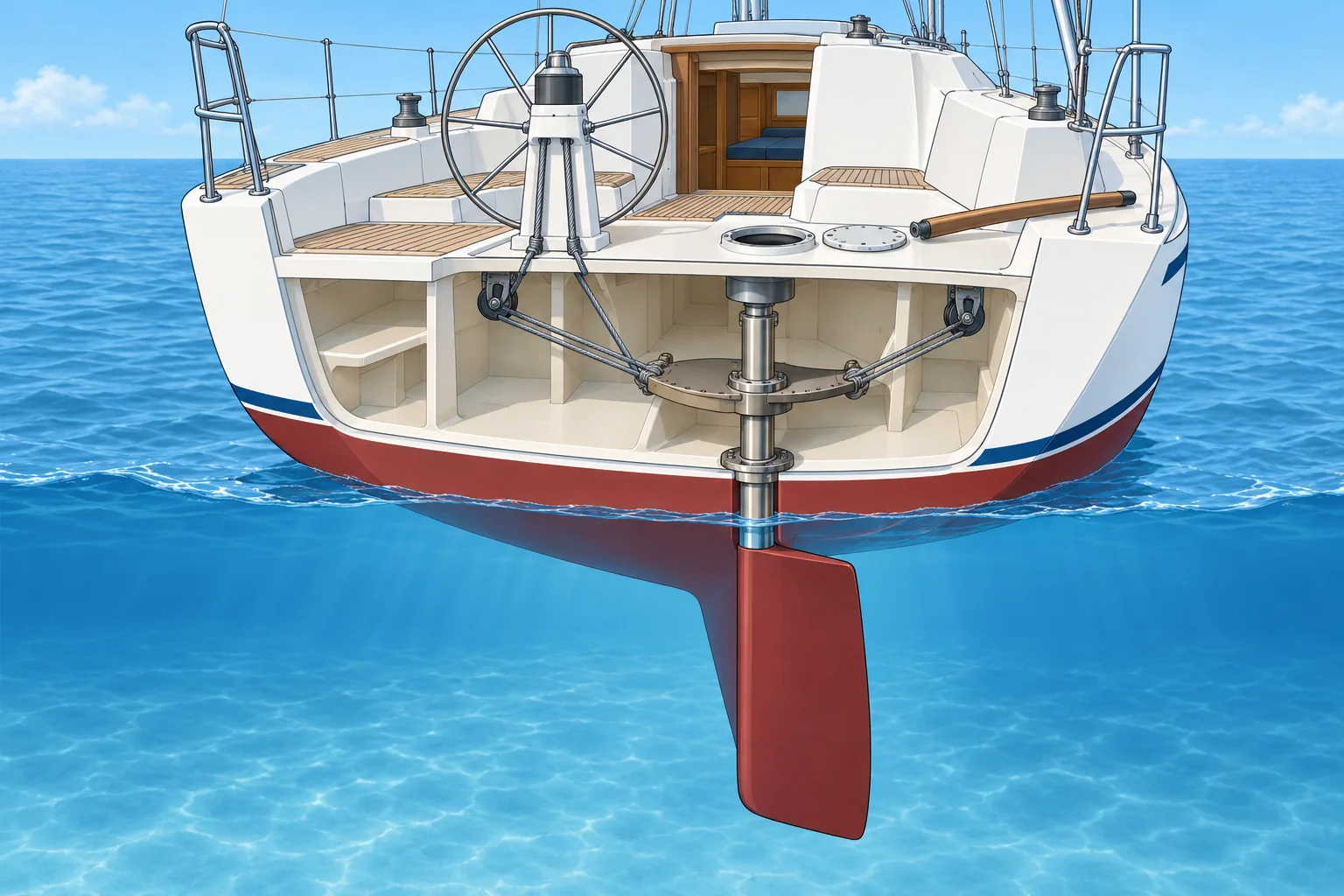
Wheel with cables
The steering wheel turns a sprocket (a toothed wheel) and chain, which pull wire cables. These run over sheaves (pulleys) to a quadrant (a curved arm fixed to the stock). Cables stretch and sheaves wear. Check tension, the clamp bolts and the rudder stops that stop the rudder turning too far.
Hydraulic and push-pull
In hydraulic steering the wheel is a pump that sends oil through pipes to a ram (a hydraulic cylinder) that moves an arm on the rudder stock. A leak or air in the oil makes the wheel feel soft. Check the oil level and look for leaks. Small motorboats often use a single push-pull cable to turn an outboard or sterndrive (a drive unit outside the stern). Follow the maker’s servicing instructions and avoid kinks.
Emergency tiller
An emergency tiller fits on the top of the rudder stock, usually through a deck plate. Know where it is stowed, what opens the plate, and practise fitting it in calm water. Use it only if the rudder and stock are intact and free to turn. Follow the maker’s instructions for disconnecting failed steering. An autopilot that drives the quadrant directly may work after cable failure only if its linkage is intact and nothing obstructs rudder movement.
Rudder checks
At each lift-out, check the rudder bearings for looseness, and the blade for cracks or signs of trapped water. If steering fails, reduce speed and sail load as conditions allow. Check whether the rudder and stock move freely before choosing a backup. Seek help if you cannot restore control.
2Key points
- 1
Tiller: direct and reliable.
- 2
Cable steering: check tension, sheaves, quadrant bolts and stops.
- 3
Hydraulic: oil level, leaks; soft wheel means air or a leak.
- 4
Know and practise the emergency tiller.
- 5
Check rudder bearings and blade at each lift-out.
3Frequent mistakes
Wrong: The emergency tiller is in a locker somewhere; we will find it if needed.
Right: Stow it where you can reach it quickly, keep the deck-plate key with it and practise fitting it.
Wrong: A slightly spongy hydraulic wheel is normal with age.
Right: It usually means air or a leak. Check the oil level and bleed the system as the maker says.
4Practice case & exam keys
Sailing upwind in a fresh breeze (Force 5), the wheel suddenly spins freely and the boat turns towards the wind. You hear a clunk from the aft cabin.
Show the answer
Reduce speed and sail load as conditions allow. Check whether the rudder and stock are intact and move freely. Use the emergency tiller only if they do; follow the maker’s instructions for disconnecting failed steering. A direct-drive autopilot is an option only if its linkage is intact and free, and failed steering does not obstruct movement. Seek help if you cannot restore control.
Exam keys
- Steering: tiller, wheel with chain-and-wire cables and quadrant, hydraulic, push-pull cable.
- Rudder stops limit rudder angle.
- Hydraulic: oil level, leaks, bleed air.
- Emergency tiller fits on rudder stock: know it and practise.
Finish this unit
When you've read it, answer three questions. Get all three right to finish the unit; opening the page alone doesn't count.
My notes for this unit
No notes