

Heads, holding tanks and discharge rules
1The lesson in plain words
Know your toilet’s plumbing, use it correctly and retain sewage wherever discharge is banned.
The marine toilet
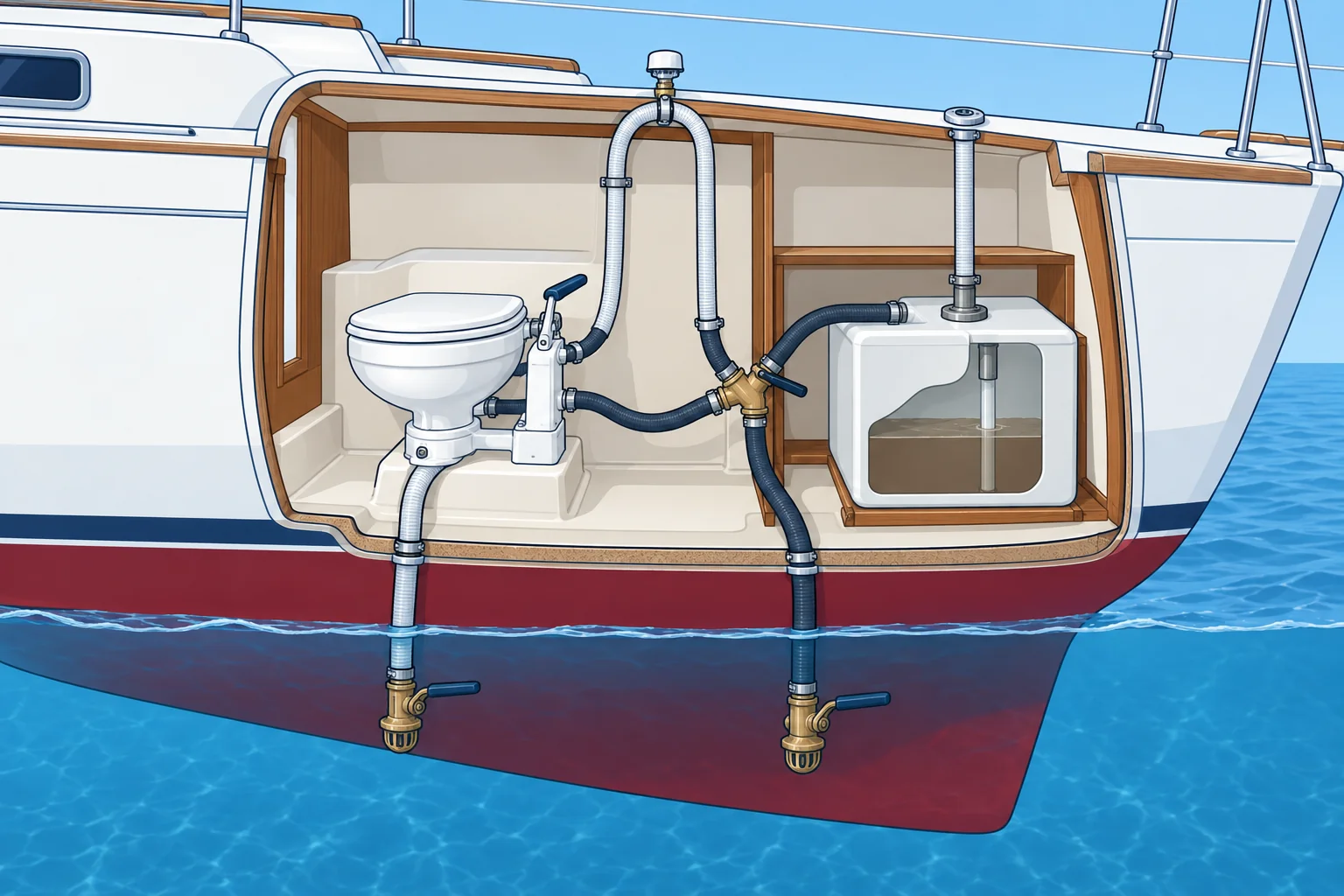
A head is a marine toilet. On a seawater-flushed manual model, an inlet seacock (sea-water shut-off valve) supplies flushing water. A pump and wet/dry lever flush the bowl; waste goes to a holding tank or a permitted overboard outlet. Only human waste and a little suitable toilet paper belong in it. Follow the maker’s pumping instructions.
Siphoning
A siphon can keep sea water flowing into the toilet after flushing. A vented loop is a raised hose bend whose valve admits air to break that flow. Height alone is not enough: keep the valve clear. Follow the maker’s hose layout and minimum height above the waterline when heeled (leaning over). On a manual head, the inlet loop normally goes between pump and bowl, not before the pump; discharge may need a separate loop. Close sea-connected toilet seacocks when unused and before leaving.
Holding tanks
A holding tank stores waste. A Y-valve sends it to the tank or overboard; where discharge is banned, lock it to the tank. Empty the tank through the deck fitting marked WASTE at a pump-out station, or overboard where allowed. A clear tank vent lets air escape during filling and enter during pump-out; an optional filter reduces smells. On craft covered by the current EU Recreational Craft Directive, toilets must connect solely to a holding tank or water-treatment system.
The rules
MARPOL Annex IV generally covers ships on international voyages of at least 400 GT (gross tonnage, a measure of internal volume), or certified for more than 15 people. Approved comminuted (broken up) and disinfected sewage: over 3 nautical miles (nm) from nearest land; untreated sewage: over 12 nm. Stored sewage must also be discharged en route at ≥4 knots, at an approved rate. Approved treatment plants have different conditions. Check national and local rules for your yacht; use pump-out where discharge is banned.
2Key data
- MARPOL Annex IV
- International voyages: ≥400 GT or certified for >15 people
- Comminuted + disinfected
- Approved system: over 3 nm from nearest land; other conditions apply
- Stored sewage
- Treatment sets distance; under way ≥4 knots; approved rate
- Yachts
- National and regional rules: check before you go
3Key points
- 1
Close the toilet’s sea-connected seacocks when not in use.
- 2
A correctly positioned, working vented loop admits air to break a siphon.
- 3
Y-valve to holding tank where discharge is banned.
- 4
MARPOL conditions depend on treatment; check local rules and discharge bans.
4Frequent mistakes
Wrong: Wet wipes and kitchen roll can go down the marine toilet.
Right: Use only human waste and a little suitable toilet paper, following the maker’s guidance. Wipes and kitchen roll can block the pump or pipe.
Wrong: MARPOL distances apply to every yacht.
Right: Annex IV generally covers ships on international voyages of at least 400 GT or certified for more than 15 people. Check national and local rules for your yacht.
5Practice case & exam keys
Returning from a weekend, you find the forward heads bowl full to the rim with sea water and the cabin sole damp. Both seacocks were left open.
Show the answer
Water may be entering through the toilet plumbing; these symptoms do not prove siphoning. Close both toilet seacocks. Inspect hoses and connections as well as the required vented loops, their valves and the maker-specified layout. Keep the toilet out of use until the fault is corrected and the system tested. Close sea-connected toilet seacocks when unused.
Exam keys
- Know your toilet’s sea connections, seacocks, vented loops and pump.
- Holding tank, Y-valve, WASTE pump-out deck fitting.
- MARPOL Annex IV: treatment-dependent conditions; national and local restrictions also apply.
Finish this unit
When you've read it, answer three questions. Get all three right to finish the unit; opening the page alone doesn't count.
My notes for this unit
No notes