

Overheating: find the missing water
1The lesson in plain words
Overheat alarm: reduce load and check exhaust water. Weak or no flow: stop. Some flow does not prove adequate cooling; check coolant, belts and overload too.
First reaction
Bring the throttle back and check water at the exhaust. If flow is weak or absent, or a wet-exhaust alarm sounds, stop the engine. If flow appears normal, reduce load and follow the manual; stop if temperature stays high. Some visible water does not prove that the raw-water supply is adequate.
Weak or no exhaust water
Raw water is water drawn from outside the boat for cooling. Stop and prevent restarting. Check the seacock (intake valve), strainer (debris filter), hull intake, impeller (flexible pump rotor) and hoses. Close the seacock before opening the strainer or pump; reassemble and reopen it before restarting. Check from deck where possible. Get qualified help if underwater access is needed.
Normal flow, still hot
Check for partial restrictions too. Let the engine cool before checking coolant, its cooling liquid; never open a hot cap. Check the belt if it drives the coolant pump. A stuck thermostat (temperature-control valve) or blocked heat exchanger (which transfers coolant heat to raw water) can also cause overheating. So can overload: a fouled propeller or hull makes the engine work harder.
Impeller pieces
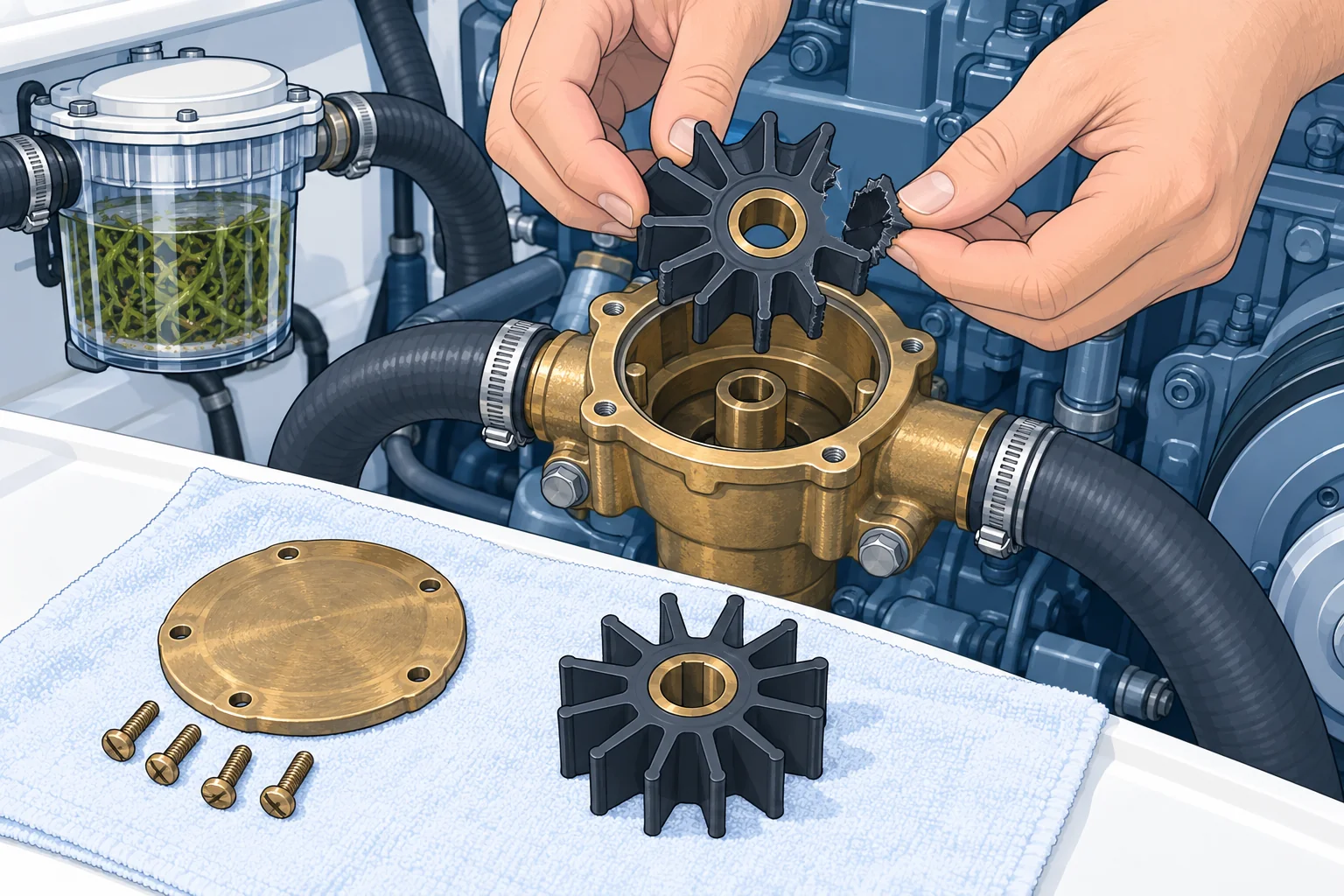
Broken vanes can lodge downstream, often at the heat exchanger inlet. Account for every missing piece: fragments left behind can restrict cooling. Follow the maker’s instructions for inspection and removal; an exchanger end cap may provide access.
Continuing the passage
Resume motoring only if cooling-water flow is restored, temperature returns to the maker’s safe range and the manual permits operation. Monitor both closely. Low revs do not make an unresolved overheat safe. If overheating persists or water flow is lost, stop. Sail, anchor if suitable, or arrange assistance.
2Step by step
Changing a raw-water pump impeller
- 1
Stop the engine, prevent restarting and close the raw-water seacock.
Stops flooding when the pump opens, and an accidental start.
- 2
Remove the cover; retain the screws and identify the specified gasket or O-ring.
The replacement seal must match the pump.
- 3
Pull out the old impeller with pliers or a puller; count its vanes.
Missing vanes must be found downstream.
- 4
Use the lubricant and fitting method specified by the maker. Follow any instructions for vane direction.
The correct fitting method avoids damaging the vanes.
- 5
Refit the cover with the maker’s specified seal, reopen the seacock and check for leaks.
A leaking cover lets air in and the pump loses suction.
- 6
Start and check exhaust-water flow at once; confirm temperature returns to the maker’s safe range.
Stop if flow stays weak or temperature remains high; restored flow alone does not prove the fault is fixed.
3Key data
- Alarm: weak/no water
- Stop; check the raw-water path
- Alarm: flow looks normal
- Check restrictions, coolant, pump belt, thermostat and overload
- Broken impeller
- Recover missing vanes; check downstream, often at the heat exchanger
4Key points
- 1
Temperature alarm: cut the load and look at the exhaust water.
- 2
Weak or no water: stop; check seacock, strainer, intake, impeller and hoses.
- 3
Some water does not prove adequate flow: check restrictions, coolant when cool, pump belt, thermostat, exchanger and overload.
- 4
A broken impeller can leave vanes downstream, often at the heat exchanger: recover the missing pieces.
5Frequent mistakes
Wrong: Open the coolant cap to see if it is low.
Right: Never open a hot cap: scalding coolant sprays out. Wait until the engine is cool.
Wrong: Fit a new impeller and forget the broken one.
Right: Recover missing pieces: fragments left downstream can block cooling passages.
6Practice case & exam keys
Motoring through weed, the temperature alarm sounds and exhaust-water flow is weak. You stop and prevent restarting, close the seacock, clear the strainer, reassemble and reopen it. Flow stays weak on a test start. What next?
Show the answer
Stop and prevent restarting. Check for a remaining intake or hose restriction. Close the seacock before opening the strainer or pump. Inspect the impeller; replace it if damaged and recover missing vanes downstream. Reassemble, reopen the seacock and check for leaks. Restart only after correcting the fault; confirm normal exhaust flow and temperature before proceeding.
Exam keys
- Overheat: cut load, check exhaust water.
- Weak or no exhaust water: stop; check the raw-water path. Some water does not rule out a restriction.
- Never open a hot coolant cap.
- Broken impeller vanes can lodge downstream, often at the heat exchanger.
Finish this unit
When you've read it, answer three questions. Get all three right to finish the unit; opening the page alone doesn't count.
My notes for this unit
No notes