

The engine won't start
1The lesson in plain words
Won’t crank: check the starting circuit first. Cranks but won’t fire: check fuel, intake air and stop control. Stop if the engine seems locked.
Does it crank?
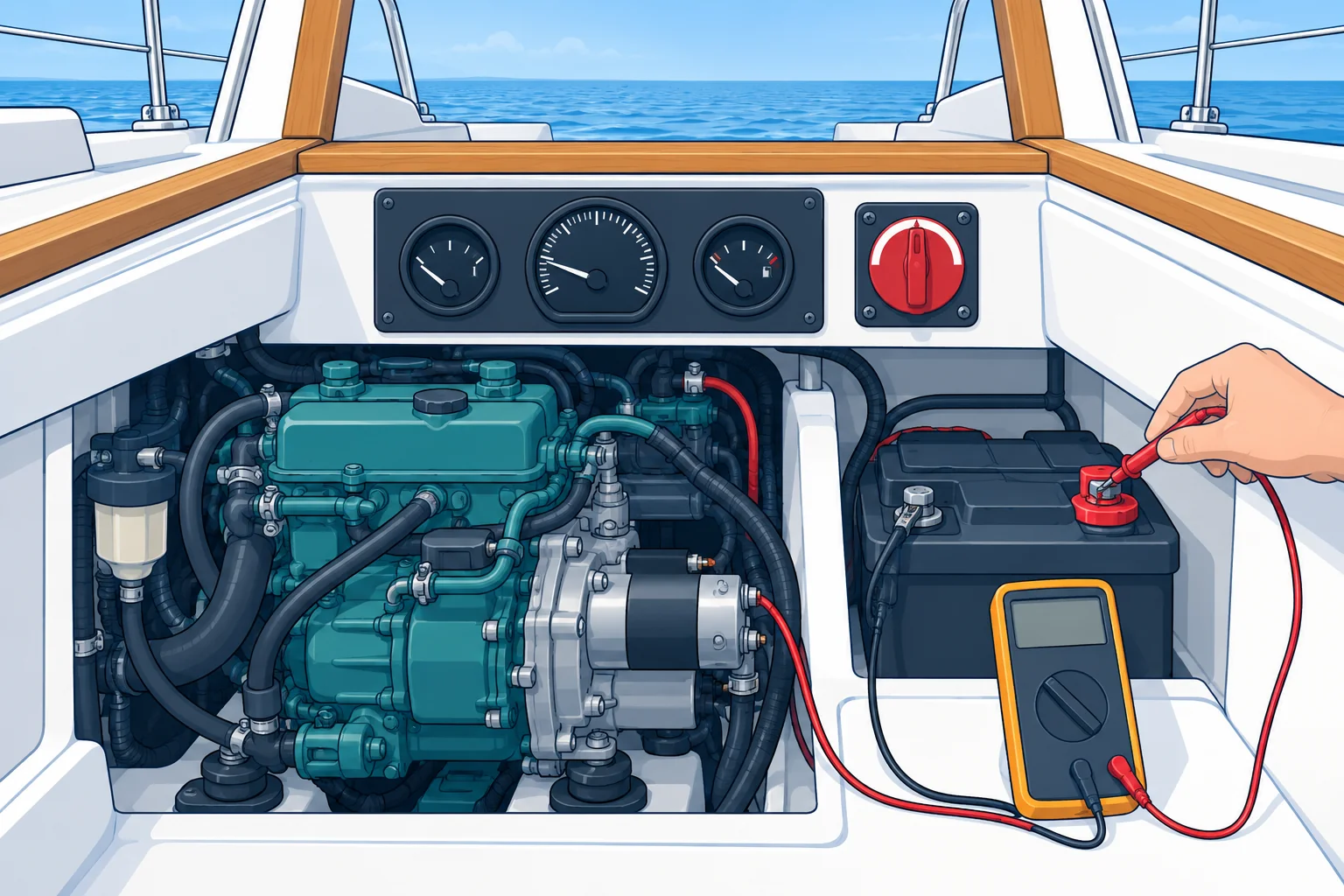
Cranking means the starter turns the engine. If nothing happens, or you hear only a click, check the starting circuit first. Select neutral: a neutral-start interlock prevents starting in gear, but not every boat has one. Check the battery switch, main fuse or breaker, and battery voltage. A rested 12 V lead-acid battery at about 12.0 V is close to flat. If the engine seems mechanically locked, stop attempts and get qualified help.
Electrical clues
Voltage collapsing or lights dimming badly can suggest a weak battery or poor connection. Stop repeated attempts if a connection overheats. With the starting circuit isolated, check for loose or corroded terminals; avoid hot metal. A click with voltage holding at the starter can suggest a faulty starter solenoid (the starter’s heavy-duty switch) or jammed starter. Use a battery-link switch, which connects the house and start batteries, only as the boat’s instructions allow.
Cranks but won't fire
A diesel needs fuel, air and enough heat of compression. Check there is fuel in the tank and the valve is open. Look for water or dirt in the separator bowl. Air in the fuel after a filter change or running dry needs bleeding (Ship: diesel shows how). Check the air intake is not blocked, and that the stop control has returned fully: a stuck stop solenoid or cable cuts the fuel.
Cold engines
Use the glow plugs (cold-start heaters) for the time specified in the manual. If they fail, follow the maker’s alternative starting instructions or repair the fault. Keep cranking attempts and cooling rests within the maker’s limits; do not compensate by cranking longer. Never use ether starting fluid with glow plugs or an intake heater: premature ignition can cause severe engine damage.
Stop cranking when
Stop repeated failed starts: cooling water can collect in a wet exhaust and reach the cylinders. Follow the maker’s wet-exhaust starting procedure. Close the raw-water intake only if that procedure requires it; reopen immediately when the engine fires. Do not prolong cranking with it shut: the impeller, the pump’s flexible rotor, can run dry. If water may have entered the cylinders, do not crank again; get qualified help.
2Key data
- No crank / click
- Check starting circuit first; mechanical locking is possible
- Cranks, won't fire
- Fuel, air in fuel, intake, stop control, glow plugs
- 12 V lead-acid at rest
- About 12.6–12.7 V full; about 12.0 V nearly flat
- Long cranking risk
- Wet exhaust floods; water can reach the cylinders
3Key points
- 1
No cranking: check the starting circuit first; stop if the engine seems locked.
- 2
Cranks but no fire: fuel, air, intake, stop control, glow plugs.
- 3
Local overheating at a terminal suggests excessive resistance.
- 4
Stop long cranking: a wet exhaust can flood the engine.
4Frequent mistakes
Wrong: Spray starting fluid to help a cold diesel.
Right: Ether can ignite prematurely with glow plugs or an intake heater and damage the engine. Use the maker’s cold-start method.
Wrong: Keep cranking; it will catch eventually.
Right: Find the cause. Long cranking flattens the battery and can flood the cylinders through a wet exhaust.
5Practice case & exam keys
You turn the key and hear one click. The panel shows 12.5 V. The lights do not dim. The gear lever is in neutral. What next?
Show the answer
A click and 12.5 V do not prove the battery can supply starting current. Check voltage during the attempt and inspect the starting circuit for poor connections. Switch off and isolate the battery before tightening terminals; avoid hot metal. If voltage holds at the starter but it will not turn, suspect the solenoid or starter. Use a battery-link switch only as the boat’s instructions allow. Do not bridge starter terminals.
Exam keys
- Won’t crank: start with electrical checks; mechanical locking is also possible. Cranks but won’t fire: fuel, air or stop control.
- Select neutral before starting; do not assume an interlock is fitted.
- No ether starting fluid with glow plugs or air heaters.
- Long cranking floods a wet exhaust.
Finish this unit
When you've read it, answer three questions. Get all three right to finish the unit; opening the page alone doesn't count.
My notes for this unit
No notes