

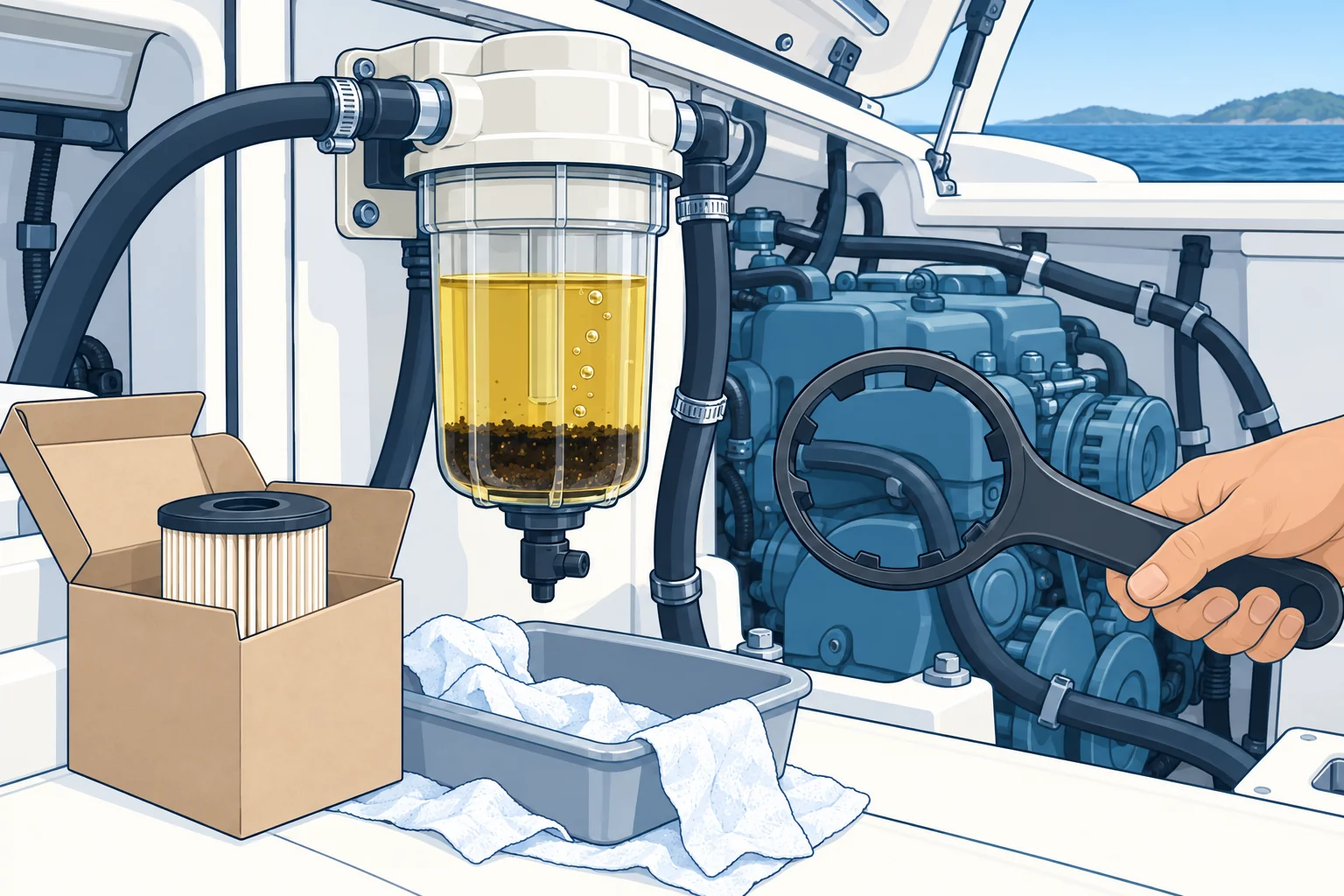
The engine stops or loses power: fuel and air
1The lesson in plain words
Faltering or stopping often points to fuel starvation or air entering the supply. Rough weather can stir tank sediment; loose fittings can admit air.
Starvation
A diesel that loses power slowly, hunts (revs rise and fall) or stops after rough weather may be starved of fuel. Motion stirs up dirt and diesel bug (slime from microbes) from the tank bottom; both can block filters. A clogged filter often shows first at high revs, when flow is greatest.
Where to look
Is there fuel? Gauges lie: dip the tank. Is the tank vent, which lets air into the tank, clear? A blocked vent makes a vacuum and starves the engine. Look into the separator bowl for water or black sludge. Some boats have a vacuum gauge measuring fuel suction. At the same engine speed, rising suction vacuum suggests a restriction in the filter or upstream supply, including the tank vent.
Air in the fuel
Bubbles in the separator bowl or a sudden stop suggest air or gas in the fuel. Air can enter on the suction side, between tank and lift pump: through loose hose clips, cracked bowls or bad seals. A low tank can uncover the pickup when the boat rolls. Excessive suction from a restriction can also produce bubbles. Check fuel level, restrictions, seals and fittings; correct the cause, then bleed as the manual directs.
Water in the fuel
Water in the bowl shows that the separator has trapped water. Stop the engine and drain it into a container as the maker directs. If water returns, keep the engine stopped and isolate the contaminated supply: water reaching the injection equipment can cause serious damage. Use a known-clean tank if fitted; otherwise seek help. Do not restart until the supply is clear of water.
Not fuel?
Check for a blocked air intake or closed engine-space vent, as in ‘The engine won’t start’. Overload means the engine is working too hard. A fouled propeller or hull can cause it, with falling revs and black smoke. See ‘Smoke, vibration and a fouled propeller’.
2Step by step
Changing a primary fuel filter at sea
- 1
Make the boat safe and stable, stop the engine and close the fuel valve.
Limits fuel spillage. Opening the filter still admits air, which must be bled out afterwards.
- 2
Put rags and a container under the filter; drain the bowl.
Keeps diesel out of the bilge and shows you water or dirt.
- 3
Remove the old element and seals. Clean the bowl, housing and seal seats as the manual directs; keep dirt out of the clean-fuel side. Fit the new element and specified seals, lubricated as directed.
Correctly seated seals prevent fuel leaks and air entry.
- 4
Tighten using the maker’s method and torque, then reopen the fuel valve.
Overtightening cracks bowls; undertightening lets air in.
- 5
Bleed the low-pressure system as the manual shows (Ship: diesel).
The engine will not run with air in the fuel.
- 6
Run the engine and look for leaks and bubbles.
Confirms the repair before you rely on it.
3Key points
- 1
Loss of power or stopping after rough weather: think dirty fuel and blocked filters.
- 2
Check fuel quantity, tank vent, separator bowl and vacuum gauge.
- 3
Air enters on the suction side: hose clips, seals, low tank.
- 4
Change the filter with new seals, then bleed.
4Frequent mistakes
Wrong: The engine stopped, so the injectors must be bad.
Right: Injector faults are rare. Fuel supply and air are far more common: check them first.
Wrong: Reuse the old filter seal; it looks fine.
Right: Fit the specified replacement seals. An old seal is a common air leak; kits may include alternatives for other filter assemblies.
Wrong: Run the tank low; it saves weight.
Right: A low tank lets the pickup suck air and sludge in a seaway. Keep it well filled.
5Practice case & exam keys
After six hours of motoring into a rough sea, the diesel starts hunting and then stops. The tank is half full. The separator bowl looks dark, with a black layer at the bottom.
Show the answer
Suspect disturbed tank sludge restricting fuel; black material alone does not prove diesel bug. Make the boat safe, stop the engine and close the fuel valve. Drain the bowl into a container and check for water. If water or sludge returns, isolate that supply and seek help. Replace blocked filters with the specified new seals, reopen the valve and bleed as the manual directs. Restart only with a clean supply; check for leaks and confirm power under load when safe.
Exam keys
- Hunting and stopping after rough weather: suspect clogged filters from tank sludge.
- Blocked tank vent: vacuum, fuel starvation.
- Air enters on the suction side of the lift pump.
- New filter, new seals, then bleed.
Finish this unit
When you've read it, answer three questions. Get all three right to finish the unit; opening the page alone doesn't count.
My notes for this unit
No notes