

Bulk carriers: the BLU Code, the loading plan and SOLAS XII
1The lesson in plain words
Bulk carriers load fast and heavy. The BLU Code and SOLAS chapters VI and XII make master and terminal agree a plan that keeps the hull within limits.
Why bulk carriers are different
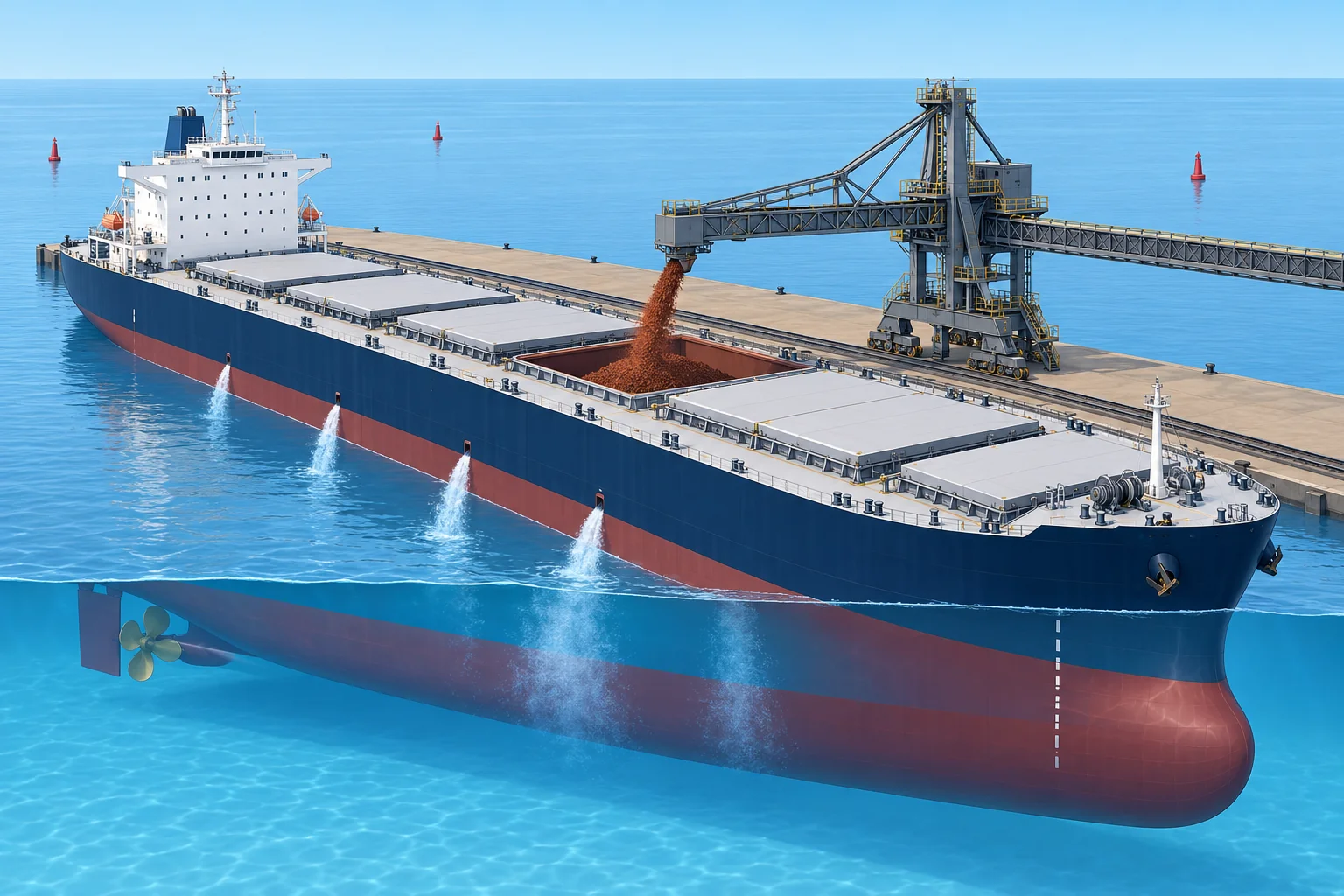
Terminals can load thousands of tonnes an hour. Dense cargoes such as iron ore fill only part of a hold but put large local loads on the tank top. Past losses of bulk carriers, some so sudden that no distress message was sent, led to SOLAS chapter XII, the BLU Code and stricter class rules.
The BLU Code
The BLU Code, the Code of Practice for the Safe Loading and Unloading of Bulk Carriers (IMO resolution A.862(20)), sets out the duties of the master and the terminal representative. Under SOLAS VI/7, before loading they agree a loading or unloading plan: the order of holds, the weight of each pour (one step of loading into a hold) and the ballast stages. The BLU Manual guides terminal staff.
Ship/shore safety checklist
Before operations start, the master and terminal representative complete the ship/shore safety checklist (BLU Code appendix 3): berth depth and air draught, moorings, communications, the agreed plan, ballast rates and the emergency stop procedure. The master may stop loading if the plan is not followed or safety is at risk. Keep the ship upright, or with only the list operations need.
SOLAS XII
Bulk carriers of 150 m and over must have a loading instrument that gives hull-girder shear forces (SF) and bending moments (BM) (XII/11). Every bulk carrier has water level detectors in each hold (XII/12): one alarm at 0.5 m above the inner bottom and a second at 15 % of the hold depth, but not more than 2 m. Ballast tanks forward of the collision bulkhead also alarm at no more than 10 % of tank capacity.
Loading in practice
The last pours trim the ship to the planned departure draughts and trim, so keep some cargo back as trimming pours. Keep each pour within the plan’s tonnage; shore scale figures can be uncertain. Stop if deballasting falls behind.
2Step by step
Agreeing and running a loading plan
- 1
Send the terminal your cargo plan early, with the loading instrument output.
SOLAS VI/7 and the BLU Code require the information in advance.
- 2
Agree the loading plan: order of holds, pour sizes, ballast stages and rates.
Each stage has been checked for SF, BM and tank top loads.
- 3
Complete the ship/shore safety checklist with the terminal representative.
Confirms communications, berth depth, air draught and the stop procedure.
- 4
After each pour, get the tonnage, read the draughts and compare with the plan.
Finds scale errors and drift from the plan early.
- 5
Keep deballasting in step; stop loading if it falls behind.
Cargo ahead of ballast can overstress the hull.
- 6
Finish with the agreed trimming pours; confirm final draughts, trim and tonnage against the plan.
Confirms that the completed condition matches the checked plan.
3Key data
- BLU Code
- IMO resolution A.862(20); duties of master and terminal
- SOLAS VI/7
- Master and terminal agree the loading/unloading plan
- Checklist
- Ship/shore safety checklist, BLU Code appendix 3
- SOLAS XII/11
- Loading instrument on bulk carriers ≥ 150 m
- SOLAS XII/12
- Hold alarms at 0.5 m and 15 % of hold depth (≤ 2 m)
4Key points
- 1
Master and terminal agree a written loading plan: holds, pours and ballast.
- 2
Complete the ship/shore safety checklist before operations start.
- 3
The master can stop loading if the plan is not followed.
- 4
Keep cargo and ballast rates in the agreed ratio, within the checked loading sequence.
5Frequent mistakes
Wrong: The terminal’s plan is the terminal’s responsibility.
Right: The master is responsible for the ship’s stability and strength. Check every pour with the loading instrument before agreeing.
Wrong: Pour sizes don’t matter if the hold total is right.
Right: One large pour can exceed local or hull girder limits at an intermediate stage. Keep to the agreed pour sizes.
6Practice case & exam keys
Iron ore: 12,000 t is planned for No. 4 hold in three pours. The terminal loads at 4,500 t/h and wants one continuous pour to save time. Your plan was checked only for 4,000 t pours. What do you say?
Show the answer
Not until it has been checked. A 12,000 t pour, about 2 h 40 min at 4,500 t/h, may exceed SF or BM limits at an intermediate stage, and deballasting may fall behind. Keep the agreed 4,000 t pours (about 53 minutes each), or re-run the loading instrument for the new sequence and amend the plan in writing first.
Exam keys
- BLU Code A.862(20); SOLAS VI/7 requires the agreed loading plan.
- Ship/shore safety checklist before loading starts.
- XII/11 loading instrument (≥ 150 m); XII/12 water level detectors.
- The master may stop loading; keep cargo and ballast in step.
Finish this unit
When you've read it, answer three questions. Get all three right to finish the unit; opening the page alone doesn't count.
My notes for this unit
No notes