

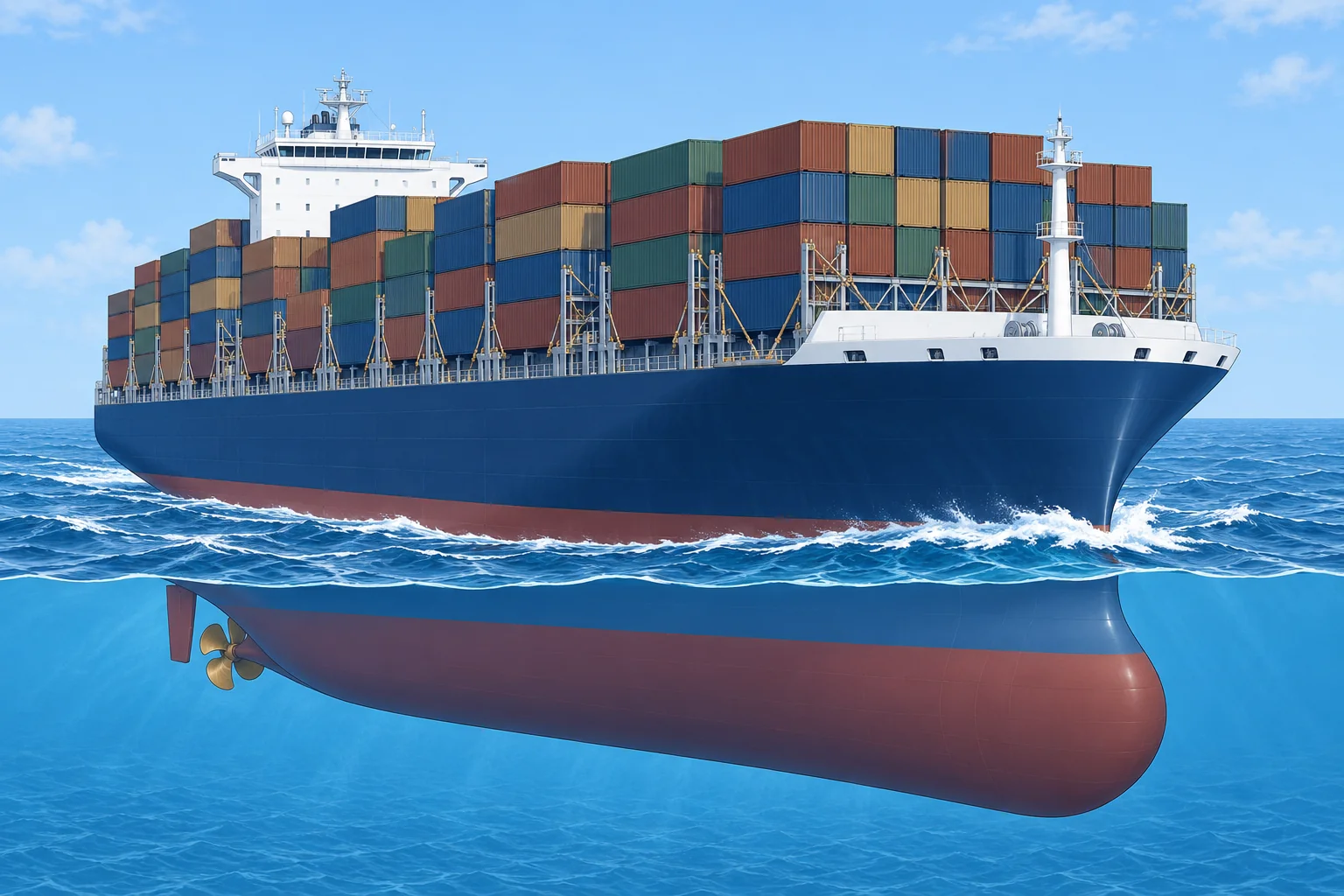
Container ships: stack weights, lashing loads and GM
1The lesson in plain words
On a container ship, stability, lashing strength and visibility pull against each other. Plan the stacks, the GM and the lashing check together.
Stack weights
Each container stack sits on fittings with a maximum stack weight, on deck and in the hold. The Cargo Securing Manual and the ship’s loading program give the limits. Five 20 t boxes make 100 t: too much for a 90 t stack limit. Put heavy boxes low and light boxes high, for GM and for lashing loads alike.
The lashing computer
The lashing computer, usually a module of the loading program, calculates the forces on lashings, twistlocks and corner posts bay by bay. It uses the ship’s GM, roll period and the class rules for accelerations. Change the GM or the stack heights and the forces change: a stack that passes at one GM can fail at another.
GM and roll
For the same roll amplitude, higher GM shortens the natural roll period and increases accelerations. Low GM does not guarantee gentle rolling or adequate large-angle stability. Estimate T ≈ 2CB/√GM, with T in seconds and GM corrected for free surface. B is moulded breadth, d mean moulded draught and LWL waterline length, all in metres; calculate C below. With B = 32.2 m and C = 0.333 for this example, GM 0.8 m gives about 24 s; GM 3.2 m about 12 s.
Visibility
SOLAS V/22 limits how much deck cargo may block the view ahead. From the conning position, the sea surface must not be hidden for more than two ship lengths or 500 m, whichever is less, ahead of the bow and 10° on each side. Check it when planning high stacks forward, for every draught and trim.
Losing containers
Heavy rolling can overload stacks near their limits. Keep lashing forces within the computer’s limits for expected conditions and check lashings before bad weather.
2Key data
- Roll period (IS Code)
- T ≈ 2CB ÷ √GM
- C (B: moulded breadth; d: mean moulded draught; LWL: waterline length, m)
- 0.373 + 0.023(B/d) − 0.043(LWL/100)
- Example (B 32.2 m)
- GM 0.8 m → 24 s; 2.0 m → 15 s; 3.2 m → 12 s
- SOLAS V/22
- Hidden sea ahead ≤ 2 ship lengths or 500 m, if less
- Stack check
- Sum of box weights ≤ maximum stack weight
3Key points
- 1
Keep each stack within its maximum stack weight; heavy boxes low.
- 2
Lashing forces depend on GM: re-run the check when GM changes.
- 3
Too much GM means a violent roll and high lashing forces.
- 4
Check the SOLAS V/22 blind zone for every draught and trim.
4Frequent mistakes
Wrong: More GM is always safer for a container ship.
Right: Large GM shortens the roll and raises accelerations, so lashings can fail. Aim for adequate, not maximum, GM.
Wrong: The lashing check done at the first port covers the voyage.
Right: Re-run it whenever GM, stack weights or the expected weather change.
5Practice case & exam keys
A container ship with waterline length 250 m (moulded breadth 32.2 m, mean moulded draught 11 m) has free-surface-corrected GM 3.2 m after a late change. The lashing computer shows several deck bays at 105 %. The plan at GM 2.0 m passed. Why, and what do you do?
Show the answer
With C ≈ 0.333, the roll period falls from about 15 s to 12 s, raising lashing forces for the same roll amplitude. Reduce GM only within approved stability and strength limits, or reduce upper-tier weights. Lowering heavy boxes raises GM, so accept any restow only after both stability and lashing checks pass.
Exam keys
- Stack weight limits apply per stack; heavy low, light high.
- Lashing forces depend on GM and roll period.
- T ≈ 2CB ÷ √GM; four times the GM halves T.
- SOLAS V/22: blind zone ≤ 2 ship lengths or 500 m, 10° each side.
Finish this unit
When you've read it, answer three questions. Get all three right to finish the unit; opening the page alone doesn't count.
My notes for this unit
No notes