

Managing stability and stresses at sea: GM, timber, ice and heavy weather
1The lesson in plain words
Stability is managed, not just calculated. Keep GM in the right band, watch what changes on passage, and record your decisions.
Too little, too much
Small positive GM makes the ship tender, with weak initial righting ability. Negative initial GM can produce an angle of loll, a heel caused by unstable upright equilibrium. Too much GM makes her stiff: a quick, jerky roll that strains lashings, shifts cargo and injures crew. Aim for a GM comfortably above the booklet minimum and not far beyond what the cargo and lashings need.
Timber deck cargo
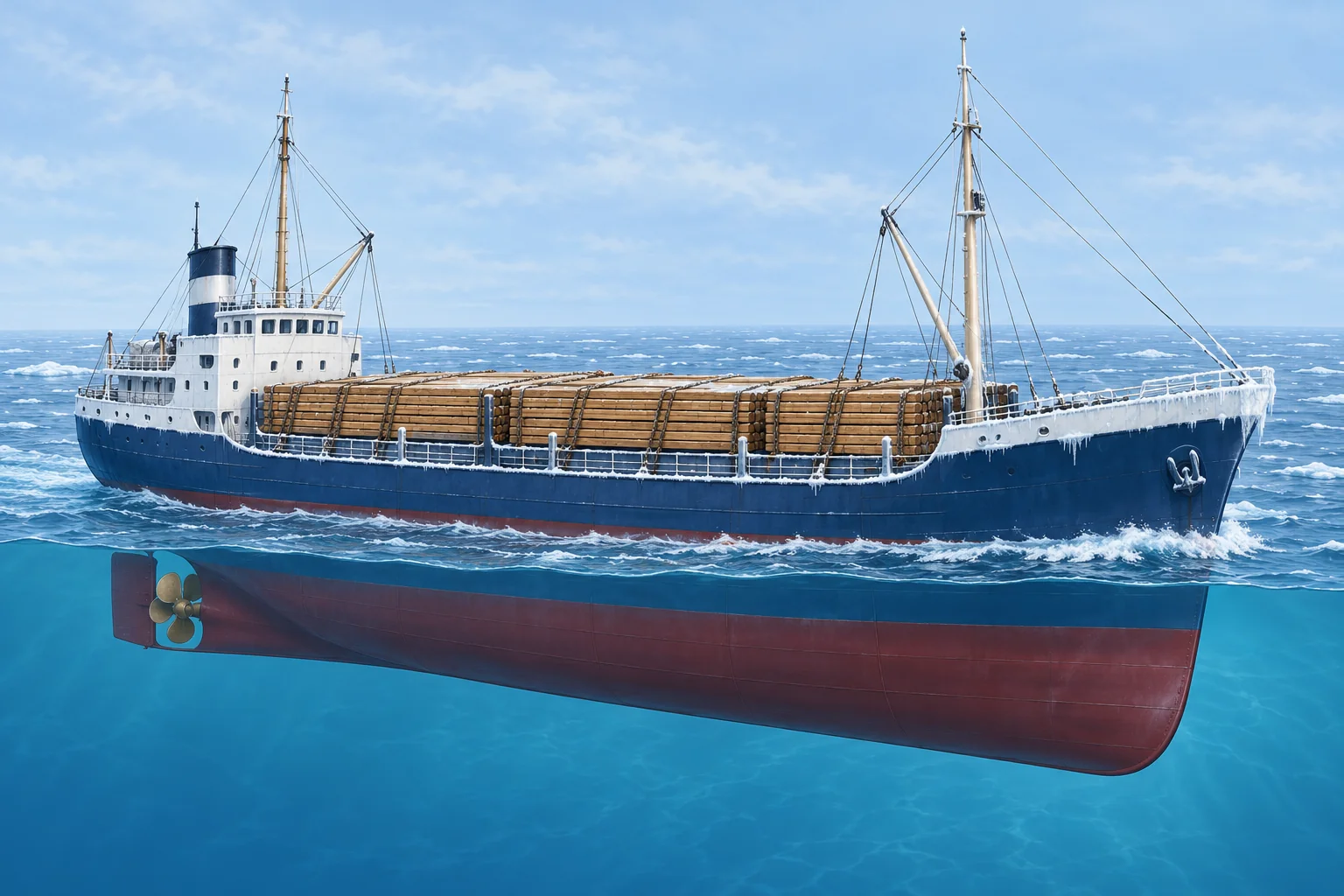
Use Part A 3.3.2 only with flag State approval for qualifying stowage specified in your approved stability booklet. Require GZ area ≥ 0.08 m·rad to 40° or the downflooding angle, whichever is less; GZmax ≥ 0.25 m; free-surface-corrected GM ≥ 0.10 m throughout. Other applicable criteria, including the weather criterion with its timber modification, still apply. At standard arrival, add 10 % to deck timber weight for water absorption; allow for ice.
Icing
Ice raises G and adds windage. For fishing vessels, IS Code B 6.3.1 gives 30 kg/m² on exposed weather decks and gangways and 7.5 kg/m² on projected lateral area above the waterline, per side: the side-on silhouette. For other ships, use the approved icing assumptions for the vessel and operating area. Remove ice early where safe, starting high up, and reduce speed or alter course to cut spray.
Heavy weather
Before bad weather, press up or empty slack tanks where possible, secure cargo, check lashings, close weathertight openings and review GM and roll period. In heavy head seas, reduce speed to limit slamming and bending loads. A noticeably slower roll or lingering near maximum heel may warn of reduced GM; check the loading condition promptly. Observed rolling also depends on the waves.
Records and the ISM Code
The International Safety Management (ISM) Code requires documented procedures for cargo and stability work. Keep each calculated condition, the loading instrument printouts, soundings, draught readings and ballast changes with their reasons. Report damage, unusual behaviour and near misses through the safety management system.
2Key data
- Timber: area to 40° or earlier downflooding
- ≥ 0.08 m·rad; GZmax ≥ 0.25 m; corrected GM ≥ 0.10 m
- Water absorption
- Deck timber weight +10 % in the arrival condition
- Fishing-vessel icing (IS Code B 6.3.1)
- Decks 30 kg/m²; projected lateral area 7.5 kg/m² per side
- Stiff ship
- Large GM: short, violent roll
- Tender ship
- Small positive GM: weak initial righting and a long natural period
3Key points
- 1
Keep GM in a band: above the minimum, but not excessive.
- 2
Allow for water absorption and ice on timber deck cargo.
- 3
Ice raises G and windage: remove it early.
- 4
Record conditions and decisions as the ISM Code expects.
4Frequent mistakes
Wrong: A long, easy roll means she is safe.
Right: A longer natural roll period may indicate lower GM; observed rolling also depends on waves. Investigate changes and verify the complete stability condition.
Wrong: Ice removal can wait until the weather improves.
Right: Ice can build quickly and raise G. Start removing it early where safe, high up first, and reduce spray.
5Practice case & exam keys
Your approved arrival condition includes an icing allowance. Freezing spray continues, ice is growing high up and the roll has slowed. The watch proposes waiting for calmer weather before removing ice. What do you do?
Show the answer
Do not treat the allowance as a cap on actual ice growth or proof of safety. Reassess the complete stability condition using the best available ice estimate. Reduce spray by adjusting course or speed, and remove ice early where safe, starting high up. Protect the crew during removal. Keep monitoring ice and rolling, and record conditions, decisions and actions.
Exam keys
- Small positive GM: tender; negative GM: loll risk; excessive GM: high accelerations.
- Approved timber alternative: area 0.08 m·rad to 40° or earlier downflooding; GZmax 0.25 m; corrected GM ≥ 0.10 m; +10 % absorption.
- Fishing vessels, IS Code B 6.3.1: decks 30 kg/m²; projected lateral area 7.5 kg/m² per side.
- ISM Code: documented procedures and records.
Finish this unit
When you've read it, answer three questions. Get all three right to finish the unit; opening the page alone doesn't count.
My notes for this unit
No notes