

Parametric rolling and dangerous following seas
1The lesson in plain words
In some waves a ship’s stability rises and falls with each wave, and the roll can build to 30° or more in a few cycles. Know the conditions and how to break them.
What it is
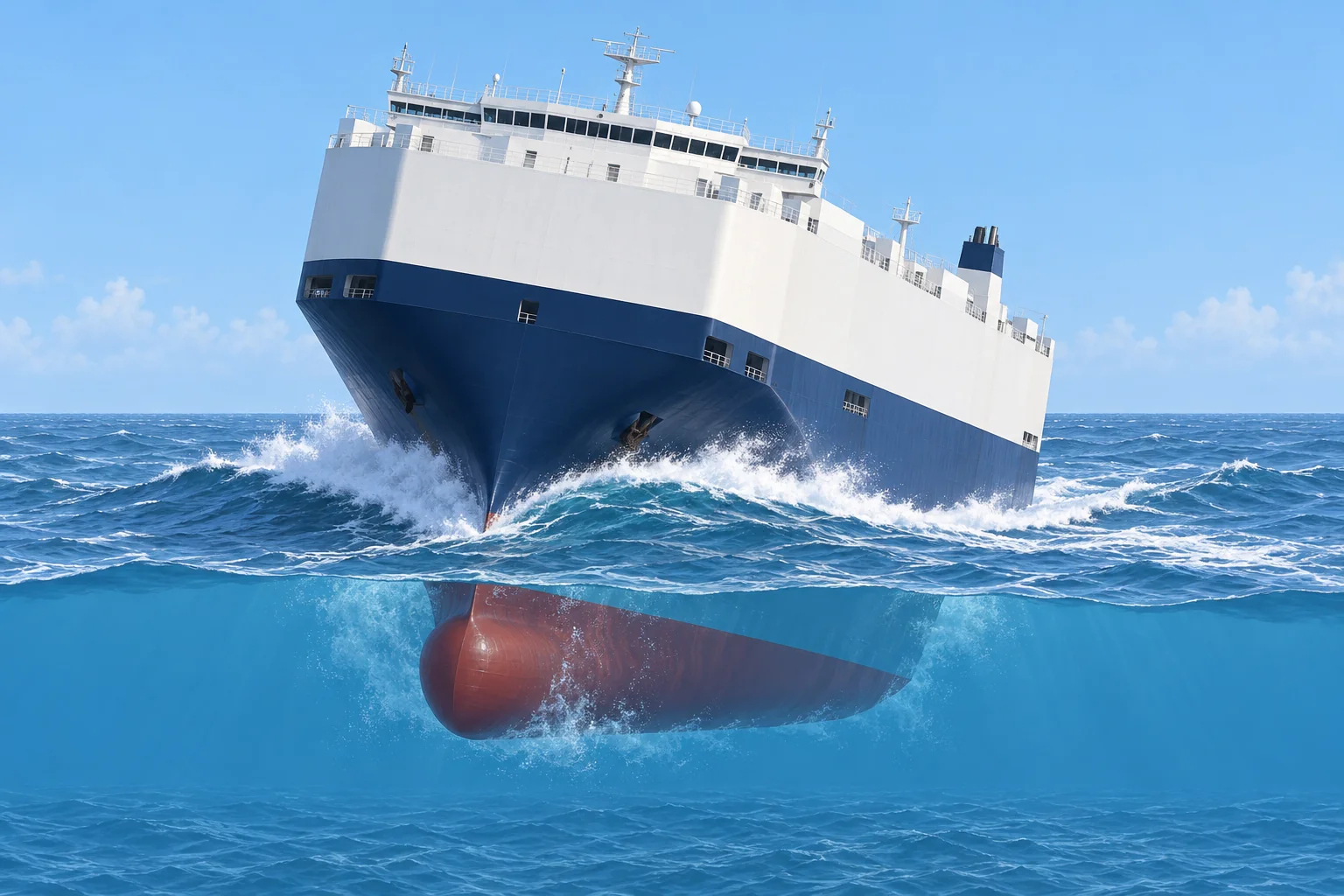
When a wave crest is amidships, the waterplane narrows at the ends and GM falls. With the trough amidships, the flared bow and stern are deeply immersed and GM rises. This regular change of stability is parametric excitation. If this stability change repeats once or twice per natural roll, rolling can grow rapidly. Container ships and car carriers, with fine hulls and wide flare, are most at risk.
The danger window
MSC.1/Circ.1228 warns of parametric rolling when the encounter period TE, the time between waves meeting the ship, is close to the ship’s roll period TR, or close to half of it: TE ≈ TR or TE ≈ 0.5 TR. Wavelengths close to the ship’s length are the worst. It can happen in head, following, bow or quartering seas, even in moderate weather.
Finding the encounter period
For deep-water wavelength λ in metres, wave speed c ≈ 1.25√λ m/s and period TW ≈ 0.8√λ s. Use ship speed through the water V in m/s; convert knots by multiplying by 0.5144. Use TE = λ/(c + V) for seas directly ahead and TE = λ/|c − V| for seas directly astern. At equal following speeds, there is no finite encounter period. For oblique seas, use the Circ.1228 diagram.
Breaking the resonance
Change course, speed or both to move TE well away from TR and from 0.5 TR, then recompute. A small speed change may not be enough; a course change also alters the encounter angle. In synchronous rolling, successive waves push in time with the ship’s natural roll (TE ≈ TR). This is direct wave forcing; parametric rolling comes from changing restoring stability.
Surf-riding and new criteria
Surf-riding means a following wave accelerates and carries the ship. Broaching is a sudden loss of heading control, often with dangerous heel. For seas directly astern, Circ.1228 gives an indicative danger boundary of about 1.8√L knots, with L the length between perpendiculars in metres. Ships can be unsafe outside this zone. MSC.1/Circ.1627 gives interim, non-mandatory second-generation intact stability guidelines and operational guidance.
2Step by step
Worked example: is she in the danger window?
- 1
Roll period TR 22 s. Head sea with a wavelength of 300 m; speed 12 knots (6.17 m/s).
Take TR from a roll test or the loading program.
- 2
Wave speed ≈ 1.25 × √300 = 21.6 m/s; wave period ≈ 0.8 × √300 = 13.9 s.
Deep-water wave relations.
- 3
Head seas: TE = 300 ÷ (21.6 + 6.2) = 10.8 s.
Ship and waves approach each other, so their speeds add.
- 4
Compare: 0.5 TR = 11 s, so TE ≈ 0.5 TR.
Danger: parametric rolling can build within a few cycles.
- 5
Alter course and, if needed, speed, then recompute TE.
Move TE well away from 11 s and from 22 s.
3Key data
- Danger (Circ.1228)
- TE ≈ TR or TE ≈ 0.5 TR
- Wave period
- TW ≈ 0.8 √λ s (λ in m)
- Wave speed
- ≈ 1.25 √λ m/s in deep water
- Directly ahead (c and V in m/s; λ in m)
- TE = λ/(c + V)
- Surf-riding guidance (L: length between perpendiculars, m)
- Indicative dead-astern boundary: V > 1.8√L knots
- MSC.1/Circ.1627
- Interim intact-stability guidelines; operational guidance
4Key points
- 1
Parametric rolling comes from stability rising and falling with each wave.
- 2
Danger when TE ≈ TR or TE ≈ 0.5 TR, with wavelength near the ship’s length.
- 3
Change course and speed to move TE away from both, then recompute.
- 4
Circ.1627 gives interim intact-stability guidelines and operational guidance; it is not mandatory.
5Frequent mistakes
Wrong: Parametric rolling only happens in beam seas.
Right: It is typical of head and following seas, where the waterplane changes most along the hull.
Wrong: It needs very big seas.
Right: Moderate waves of the right length and period can trigger it when TE is in the danger window.
6Practice case & exam keys
A ship of length 200 m between perpendiculars runs at 18 knots with waves dead astern. Wavelength is 200 m and natural roll period TR is 24 s. What does the surf-riding guidance tell you, and is she in the parametric-roll danger window?
Show the answer
The general Circ.1228 dead-astern boundary is 1.8 × √200 = 25.5 knots. At 18 knots you are outside that zone; this does not rule out surf-riding or broaching. Wave speed ≈ 1.25 × √200 = 17.68 m/s, ship speed 9.26 m/s, so TE = 200 ÷ |17.68 − 9.26| ≈ 23.8 s. This is close to TR = 24 s: alter course or speed and recompute to move away from TR and 0.5 TR.
Exam keys
- TE ≈ TR or 0.5 TR → risk of parametric rolling.
- Deep water: TW ≈ 0.8√λ; c ≈ 1.25√λ. Directly ahead: TE = λ/(c + V); astern: TE = λ/|c − V| (λ in m, c and V in m/s).
- Circ.1228 indicative dead-astern boundary: V > 1.8√L knots (L: length between perpendiculars, m); outside it does not prove safety.
- MSC.1/Circ.1228 guidance; MSC.1/Circ.1627 interim second generation criteria.
Finish this unit
When you've read it, answer three questions. Get all three right to finish the unit; opening the page alone doesn't count.
My notes for this unit
No notes