

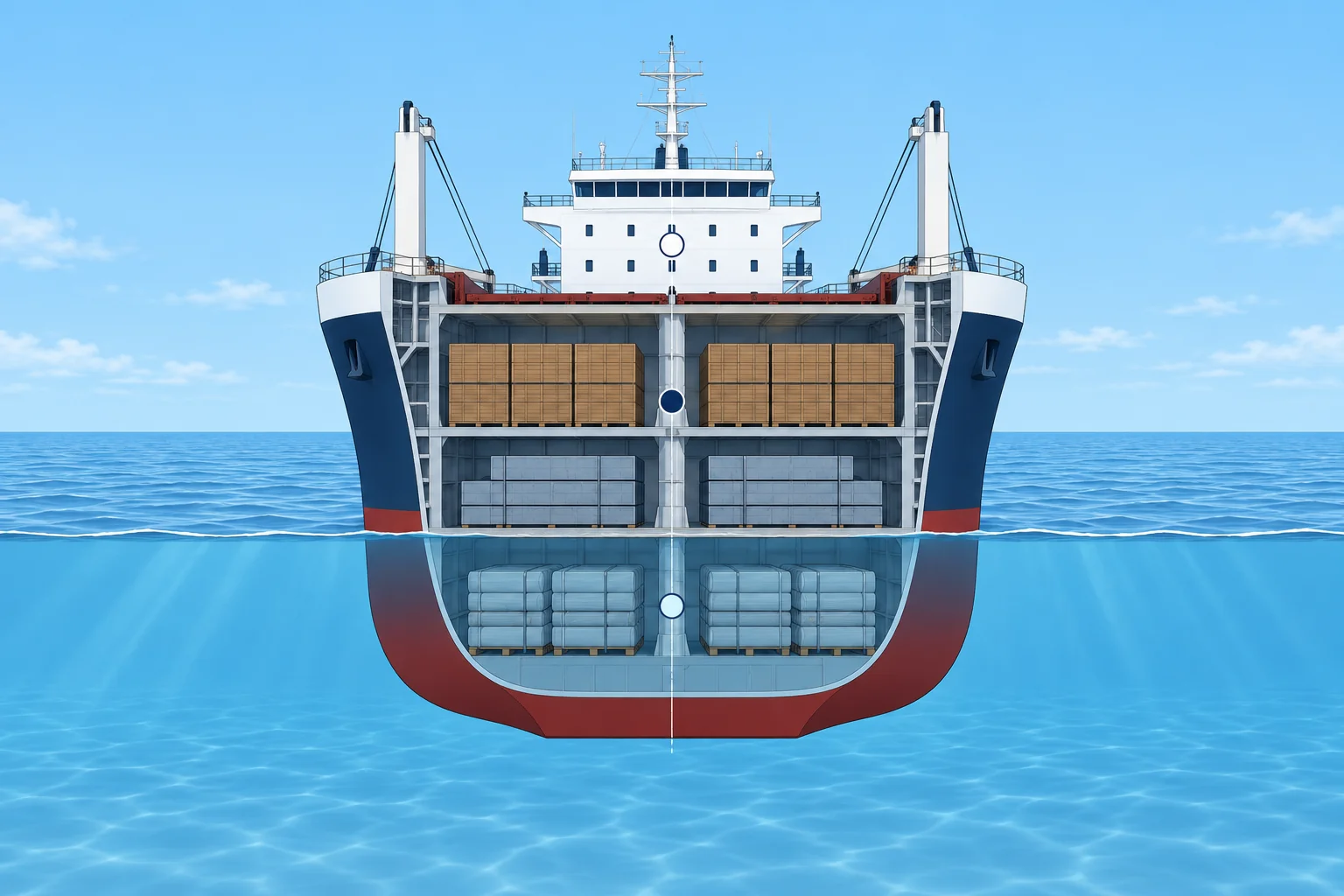
KG, KM and GM on a ship
1The lesson in plain words
KM comes from hull shape and draught, KG from loading. Correct for free surface, then follow the booklet’s instructions to compare with its limits.
Three heights
All heights are measured from the keel, K. KM, the height of the metacentre M, comes from the hydrostatic table at the ship's draught. KG, the height of the centre of gravity G, comes from your loading calculation. GM = KM − KG. You met them in yacht stability; on a ship you work them out from tables and moments.
Solid and fluid
GM from the weights alone is solid GM. A slack tank is partly full. Its liquid reduces effective GM. Read its free surface moment (FSM), in t·m, from the tank table. Σ means add the tank values; Δ is displacement in tonnes. The free surface correction is FSC = ΣFSM ÷ Δ. KG fluid = KG + FSC; GM fluid = KM − KG fluid. Follow the booklet’s instructions when comparing these values with its limits.
Is it enough?
Read the booklet instructions for its minimum GM or maximum KG curve. Check whether the limits include free surface or require your corrected value. Compare like with like, within the approved operating range. Never apply free surface twice. These examples use limits requiring fluid values. The general IS Code GM minimum of 0.15 m is only one requirement, not your sailing target.
Can it be too much?
A large GM makes the ship stiff, with a short, violent roll. That strains lashings, can shift cargo and wears out the crew. Ore-loaded bulk carriers can have several metres of GM. Some booklets give a maximum GM too, for example for containers or timber deck cargo.
Where errors come from
Lightship includes fixed ballast, machinery operating fluids and fixed firefighting agents. It excludes cargo, consumable liquids, ballast water, stores, people and effects. A wrong lightship KG, a forgotten weight or a missed FSM can each move KG by many centimetres. The ship’s constant is the difference between measured displacement and accounted-for weights. Include its documented weight at a justified height. Check tank soundings and densities, and compare your answer with the last similar voyage and the loading computer.
2Step by step
Worked example: GM in the departure condition
- 1
Data: Δ 15,000 t at 8.00 m. Table KM = 8.40 m. Loading table KG = 7.70 m.
KM from the hull, KG from the weights.
- 2
Solid GM = 8.40 − 7.70 = 0.70 m.
Before free surface.
- 3
Slack tanks: ΣFSM = 2,231 t·m. FSC = 2,231 ÷ 15,000 = 0.149 m.
From the tank tables.
- 4
KG fluid = 7.849 m; GM fluid = 8.40 − 7.849 = 0.551 m, say 0.55 m.
Fluid value for these examples.
- 5
The booklet’s minimum fluid GM at 8.00 m is 0.35 m: margin 0.20 m.
Read the curve at this draught, not a fixed value.
3Key data
- GM
- KM − KG
- Free surface correction
- FSC = ΣFSM ÷ Δ
- Fluid GM
- KM − (KG + FSC)
- IS Code minimum
- GM0 ≥ 0.15 m, together with all other criteria
4Key points
- 1
GM = KM − KG: KM from the table at the draught, KG from the moments.
- 2
Calculate KG fluid = KG + ΣFSM ÷ Δ; use the booklet’s stated comparison basis.
- 3
Read the booklet’s GM or KG limit at the actual draught; check its free-surface allowance and operating range.
- 4
Too much GM is a problem too: violent rolling and high lashing loads.
5Frequent mistakes
Wrong: GM 0.15 m is enough because it meets the IS Code.
Right: 0.15 m is only one criterion. The booklet's limit curve covers all of them and is usually higher.
Wrong: KM stays the same however you load.
Right: KM depends on draught. After loading or discharging, read KM again at the new draught.
6Practice case & exam keys
After loading, KG is 7.95 m and ΣFSM is 1,500 t·m at Δ 15,000 t, draught 8.00 m, KM 8.40 m. The booklet’s maximum fluid KG at this draught is 8.05 m. Can you sail?
Show the answer
FSC = 0.10 m, so fluid KG = 8.05 m and fluid GM = 0.35 m. This meets the stated departure limit exactly, with no margin. Seek more margin and recalculate displacement, KM, KG and FSC after any loading or tank change. Sailing still requires all other checks. Calculate arrival and intermediate conditions too: fuel use changes KG, KM and free surface, so arrival can improve or worsen.
Exam keys
- GM = KM − KG; GM fluid = KM − (KG + ΣFSM ÷ Δ).
- Read KM from the hydrostatics at the actual draught.
- Follow the booklet’s comparison basis for its minimum GM or maximum KG curve; avoid double free-surface correction.
Finish this unit
When you've read it, answer three questions. Get all three right to finish the unit; opening the page alone doesn't count.
My notes for this unit
No notes