

Shifting weights: vertical, transverse and both at once
1The lesson in plain words
Moving a weight already aboard moves G parallel to the move by w × d ÷ Δ. Vertical moves change GM; transverse moves cause a list.
The rule
GG′ = w × d ÷ Δ, parallel to the move. For the small transverse and vertical shifts here, with no fore-and-aft move, treat mean draught and upright KM as unchanged. Δ stays constant. A fore-and-aft shift needs a separate trim check. Ballast transfers also change free surface while tanks are slack.
Vertical moves
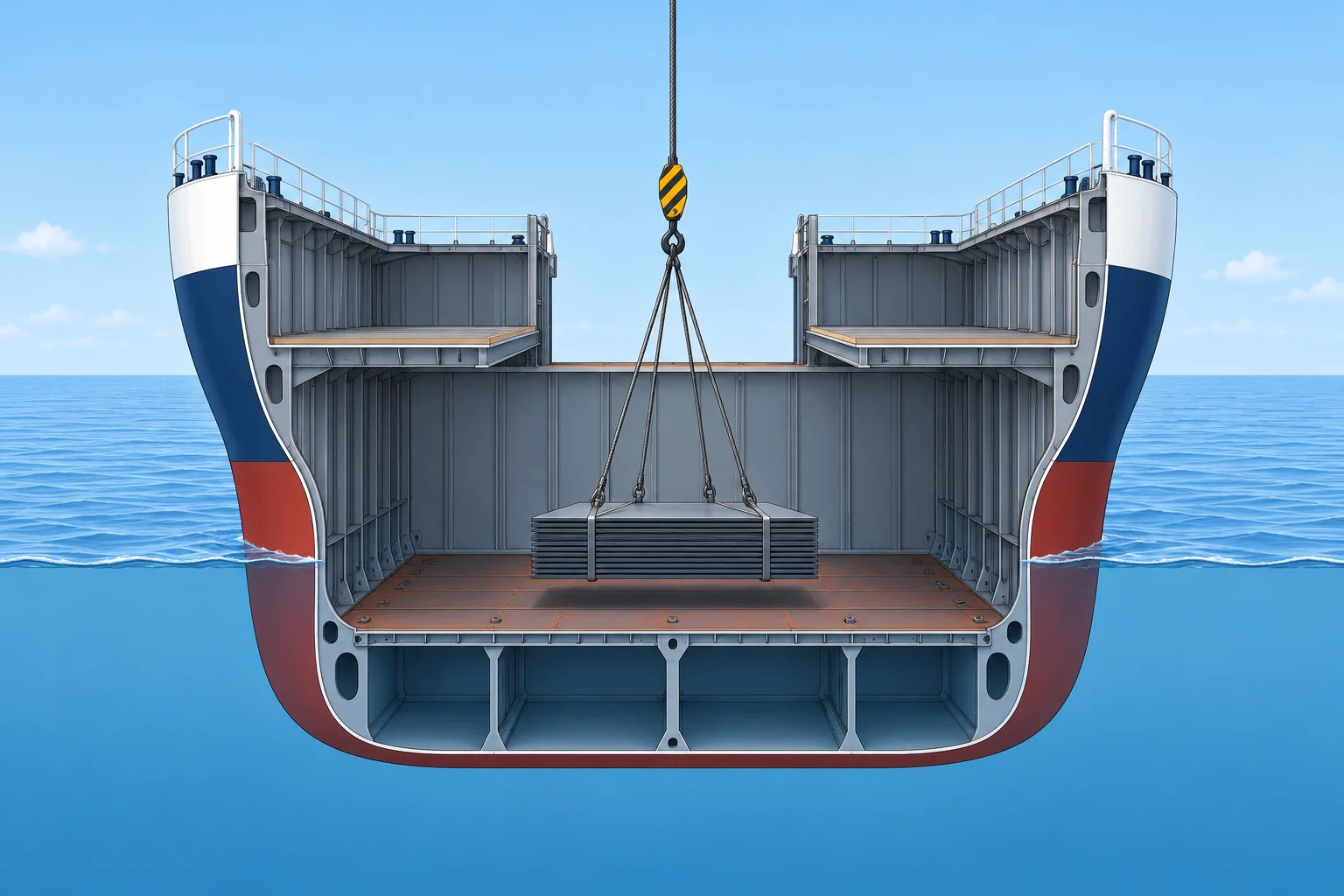
Moving weight up raises G by w × d ÷ Δ and cuts GM by the same amount. Moving it down does the opposite. Shifting cargo from a tween deck to the lower hold, or landing a heavy lift on the tank top, the floor above the bottom tanks, instead of on deck, gains GM without changing Δ.
Transverse moves
Moving weight across moves G off the centreline by GGH = w × d ÷ Δ. With positive GM she lists until B, the centre of buoyancy, lies vertically below G: tan θ = GGH ÷ GM fluid, for small angles. Finding and correcting a list in detail belongs to the Trim unit.
Diagonal moves
A weight moved up and across moves G both ways. Split the move into its vertical and horizontal parts and apply the rule to each. Find the new GM from the vertical part first, then use it to find the list from the horizontal part.
Pumping ballast
Transferring ballast is a shift of weight, but the tanks pass through slack stages. During the transfer both may be slack, adding FSM. Transfer when GM has a margin, and keep the number of slack tanks small.
2Step by step
Worked example: a diagonal shift
- 1
Data: Δ 15,000 t, GM fluid 0.55 m, upright. In one hold, 150 t moves 4 m up and 6 m to port, with no fore-and-aft move or free-surface change.
One move, two components.
- 2
Vertical: GG′ = 150 × 4 ÷ 15,000 = 0.04 m. New GM fluid = 0.51 m.
G rises; GM falls by the same amount.
- 3
Horizontal: GGH = 150 × 6 ÷ 15,000 = 0.06 m to port.
G moves off the centreline.
- 4
tan θ = 0.06 ÷ 0.51 = 0.118, so θ ≈ 6.7° to port.
Use the new GM.
- 5
With the old GM of 0.55 m you would get only 6.2°.
The rise of G makes the same shift list her more.
3Key data
- Shift of G
- GG′ = w × d ÷ Δ, parallel to the move
- Vertical shift
- Change of GM = w × d ÷ Δ
- List from a transverse shift
- tan θ = GGH ÷ GM fluid (small angles)
- Diagonal shift
- Vertical part first, then the list
4Key points
- 1
GG′ = w × d ÷ Δ. Here, no fore-and-aft move; Δ, mean draught and upright KM stay unchanged.
- 2
Moving weight up costs GM one for one.
- 3
List: tan θ = GGH ÷ GM fluid.
- 4
Diagonal shifts: vertical part first, then the list with the new GM.
5Frequent mistakes
Wrong: A ballast transfer between tanks is just a shift, so stability cannot drop.
Right: During the transfer the tanks are slack: free surface lowers GM until each is full or empty again.
Wrong: Use the original GM to find the list after a diagonal shift.
Right: Apply the vertical part first. Moving up reduces GM; moving down increases it. Use that new GM to calculate the list.
6Practice case & exam keys
You can move 200 t of steel from Kg 10.0 m to Kg 4.0 m within the same hold, on the centreline, with no free-surface change. Δ is 15,000 t and fluid GM is 0.47 m; the booklet requires 0.60 m. Does this shift make the condition acceptable?
Show the answer
G falls by 200 × 6 ÷ 15,000 = 0.08 m, so fluid GM rises to 0.55 m. That still misses the 0.60 m limit by 0.05 m: the move helps but is insufficient. Plan another suitable change and recheck the condition before sailing. Secure the steel in its new position.
Exam keys
- Shifted weight: GG′ = w × d ÷ Δ, parallel to the shift.
- tan θ = GGH ÷ GM fluid at small angles.
- Diagonal shifts: split into vertical and horizontal parts.
Finish this unit
When you've read it, answer three questions. Get all three right to finish the unit; opening the page alone doesn't count.
My notes for this unit
No notes