

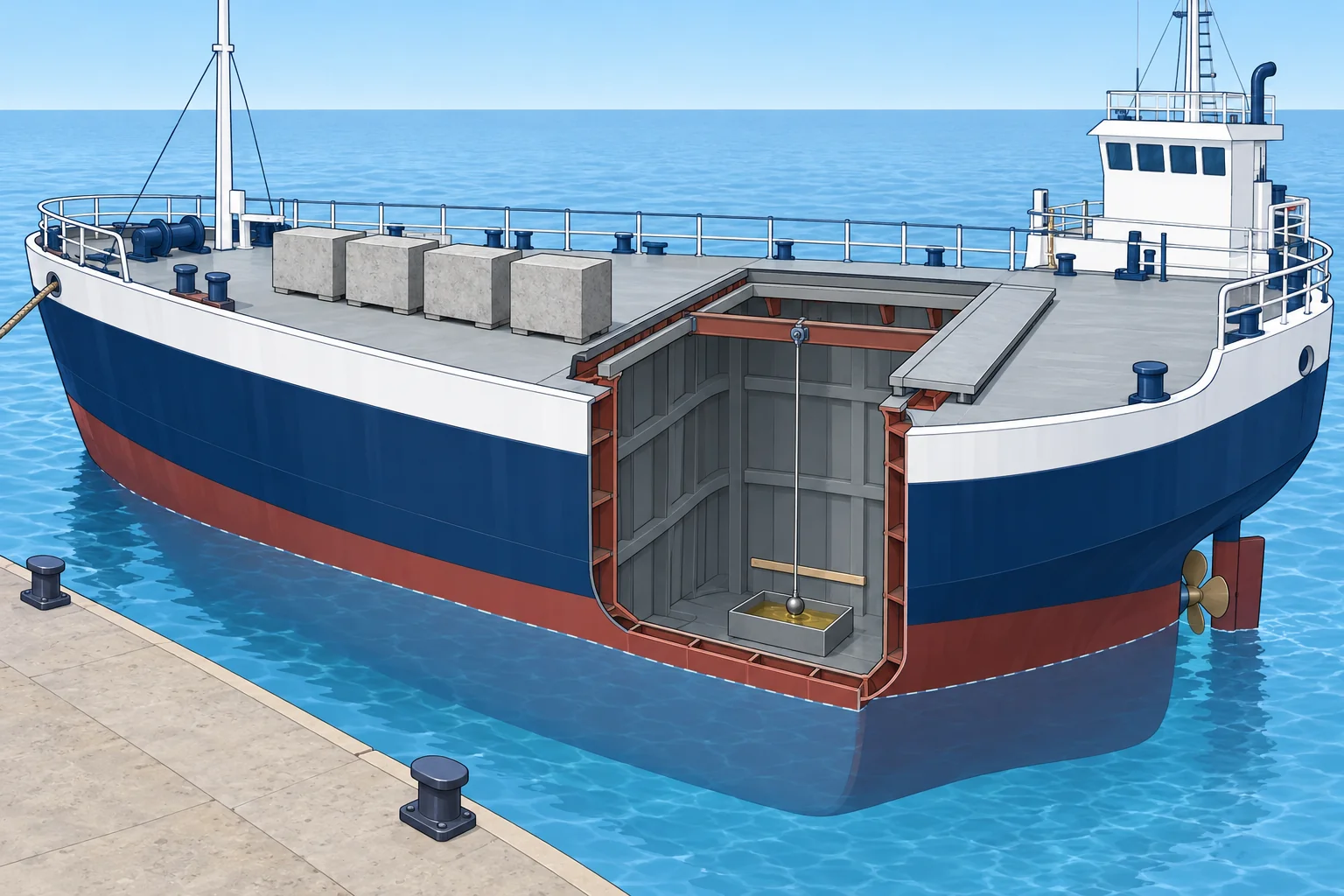
The inclining experiment: finding lightship KG
1The lesson in plain words
Move known weights across, measure the heel and work out GM. From that comes the lightship KG that starts every loading calculation.
Why
Passenger ships and cargo ships of 24 m or longer are normally inclined on completion; the Administration, the flag-state authority, may permit exemptions. After corrections, the test gives lightship displacement and KG. Passenger ships need a lightweight survey, a check of lightship weight and centres, at least every five years. Re-incline if lightship displacement changes by more than 2% or its fore-and-aft centre of gravity (LCG) by more than 1% of the applicable defined length L. Material alterations require updated stability information and re-inclining where necessary.
The principle
Moving a known weight w across distance d gives GM measured = w × d ÷ (Δ × tan θ). This is fluid GM if tanks are slack. Add FSC = ΣFSM ÷ Δ to obtain solid GM, then KG = KM − GM solid. Read KM from hydrostatics for the test draught and actual trim. With no free surface, measured and solid GM are equal.
Measuring the heel
Pendulums, at least two and preferably three, hang in sheltered places: tan θ = deflection ÷ pendulum length. Each should deflect at least 15 cm to each side, which usually needs 3 m or more of wire. The weights should heel her between 1° and 4° each side. The Administration may approve alternative heel-measuring instruments.
Conditions
The ship should be nearly complete, in calm water, clear of the bottom and quay, with slack moorings and everyone at recorded stations. Keep tanks empty or pressed up (completely full); quantify any remaining free surface. Read draughts on both sides and measure dock-water density to establish Δ; use hydrostatics for the actual trim. The standard test uses eight weight movements. Plot readings to check consistency; investigate departures from a straight line.
From test to lightship
Lightship includes fixed ballast, machinery operating fluids and fixed firefighting agents. It excludes cargo, consumable liquids, ballast water, stores, people and effects. The test condition includes test weights, people and items not part of lightship, and may lack items still to be fitted. The lightweight survey lists them. Find solid test KG first. Remove extra items or add missing ones by moments to obtain lightship weight and KG for the booklet.
2Step by step
Worked example: the inclining result
- 1
Test displacement 4,520 t includes 20 t of test weights at Kg 12.0 m. Move them 15 m across. Free surface is zero; the test weights are the only difference from lightship.
w × d = 300 t·m.
- 2
A 5.0 m pendulum deflects 0.255 m: tan θ = 0.255 ÷ 5.0 = 0.051 (θ ≈ 2.9°).
Within 1–4°, more than 15 cm of deflection.
- 3
Measured GM = 20 × 15 ÷ (4,520 × 0.051) = 1.30 m. FSC = 0, so solid GM = 1.30 m.
Measured and solid GM are equal in this test condition.
- 4
KM at the test draught is 9.45 m: solid test KG = 9.45 − 1.30 = 8.15 m.
Use solid GM to find the actual test-condition KG.
- 5
Remove the test weights at Kg 12.0 m: KG = (4,520 × 8.15 − 20 × 12.0) ÷ 4,500 = 8.13 m.
Lightship 4,500 t, KG 8.13 m: the first line of every loading table.
3Key data
- Measured GM
- w × d ÷ (Δ × tan θ)
- Pendulum
- tan θ = deflection ÷ length; ≥ 15 cm each side
- Heel in the test
- 1° to 4° each side
- Inclined on completion: normally; exemptions apply
- Passenger ships; cargo ships of 24 m and over
- Passenger ships
- Survey ≤5 years; re-incline: Δ change >2%, LCG change >1% of L
4Key points
- 1
GM measured = w × d ÷ (Δ × tan θ). Add FSC for solid GM; KG = KM − GM solid.
- 2
At least two pendulums, 15 cm or more of deflection, 1–4° each side.
- 3
Tanks empty or pressed up, calm water, slack moorings, nobody moving.
- 4
Correct to lightship by moments for items aboard or missing.
5Frequent mistakes
Wrong: The test KG is the lightship KG.
Right: The test condition includes weights and items that are not lightship. Correct them out by moments.
Wrong: A tiny heel, half a degree, is more accurate.
Right: Small angles give small, error-prone deflections. Aim for 1–4° each side.
6Practice case & exam keys
During an inclining test a fuel tank turns out to be one-third full, not empty, and a crew member walks across the deck while a reading is taken.
Show the answer
Stop readings and return everyone to their recorded positions. Ask the test supervisor to confirm that the tank’s weight, centre and free-surface correction are reliable throughout the test heel range. If accepted, add FSC to measured GM before finding test KG and correct to lightship by moments; repeat the disturbed movement. Otherwise empty or press up the tank, re-establish displacement and centres, then restart the measurement series.
Exam keys
- Inclining: GM measured = w × d ÷ (Δ × tan θ); solid KG = KM − GM measured − FSC. Pendulum: tan θ = deflection ÷ length.
- IS Code Part B ch. 8: passenger ships and cargo ships of 24 m and over are normally inclined on completion; permitted Administration exemptions apply.
- Passenger ships: lightweight survey at least every 5 years; re-incline if lightship Δ changes > 2% or LCG changes > 1% of L. For SOLAS ships, L is subdivision length (SOLAS II-1/2.1); otherwise use the length in IS Code Introduction §2.12.
Finish this unit
When you've read it, answer three questions. Get all three right to finish the unit; opening the page alone doesn't count.
My notes for this unit
No notes