

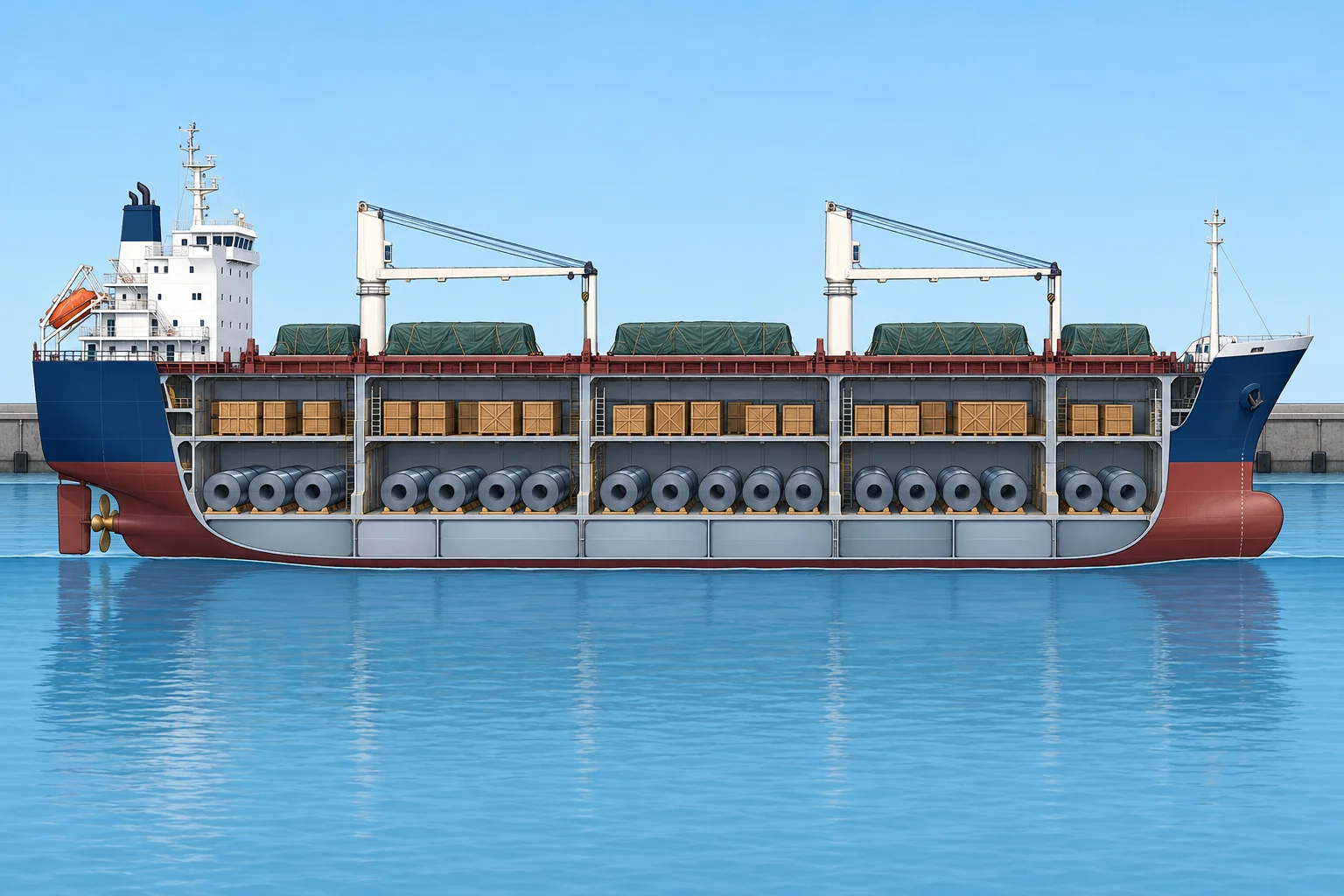
Loading and discharging: moments about the keel
1The lesson in plain words
List every weight with its height above the keel, add up weights and moments, and divide. That gives KG for any loading condition.
The method
Each weight w has its own centre at a height Kg above the keel. Its vertical moment is w × Kg, in t·m. Add all the weights to get Δ and all the moments to get the total moment: KG = Σ(w × Kg) ÷ Σw. Start with lightship from the booklet, then add cargo, fuel, water, stores, ballast and the constant.
Loading and discharging
To load, add a line with the new weight and its moment. To discharge, enter the weight and its moment as negative values. The totals give the new Δ and KG. G moves towards a weight you load and away from a weight you discharge.
Then the hydrostatics
The new Δ gives a new draught, and so a new KM from the table. GM = new KM − new KG. Do not assume KM is unchanged: it can change by several centimetres between draughts.
Free surface
Add the free surface effect at the end. Many forms add ΣFSM to the total moment, then divide by Δ: KG fluid = (Σ moments + ΣFSM) ÷ Δ. That is the same as KG + ΣFSM ÷ Δ. Use the FSM of every tank that is slack in that condition.
Checking your work
A capacity plan gives the centre of the full space, not necessarily the centre of your cargo. Use the actual stowage distribution for cargo and the tank tables at the actual filling level for liquids. A partly filled hold need not be filled evenly from the bottom. Compare your answer with a similar past voyage and the loading computer.
2Step by step
Worked example: the loading table
- 1
Lightship 4,500 t × 8.13 m = 36,585 t·m. Fuel, water and stores 950 t × 3.10 m = 2,945 t·m.
Lightship from the booklet's inclining result.
- 2
Lower holds 6,600 t × 6.52 m = 43,032 t·m; intermediate cargo decks ('tween decks) 2,500 t × 10.40 m = 26,000 t·m; deck 450 t × 15.40 m = 6,930 t·m.
Each cargo at its own centre.
- 3
Totals 15,000 t and 115,492 t·m: KG = 115,492 ÷ 15,000 = 7.70 m.
Moments divided by weights.
- 4
Load 500 t of deck cargo at Kg 11.00 m: 15,500 t and 120,992 t·m, KG = 7.806 m.
G rises towards the new weight.
- 5
At Δ 15,500 t, the supplied hydrostatic data give draught 8.20 m and KM 8.38 m. Solid GM = 8.38 − 7.806 = 0.574 m.
Read KM again at the new draught.
- 6
FSC = 2,231 ÷ 15,500 = 0.144 m. GM fluid = 0.574 − 0.144 = 0.43 m.
Down from 0.55 m: deck cargo is costly.
3Key data
- Vertical moment
- w × Kg (t·m)
- KG
- Σ(w × Kg) ÷ Σw
- Discharging
- Negative weight and negative moment
- Fluid KG
- (Σ moments + ΣFSM) ÷ Δ
4Key points
- 1
KG = Σ(w × Kg) ÷ Σw, starting from lightship.
- 2
Discharged weights go in as negative weights and moments.
- 3
Read KM at the new draught, then add the free surface effect.
- 4
Use actual cargo centres and tank centres at the measured filling level.
5Frequent mistakes
Wrong: When discharging, subtract the weight from Δ but keep the total moment.
Right: Subtract its moment too, w × Kg, or KG comes out wrong.
Wrong: The capacity plan centre fits any amount of cargo in a hold.
Right: The full-space centre need not match the cargo centre. Calculate from the actual stowage.
6Practice case & exam keys
From 15,000 t and 115,492 t·m, you discharge 300 t at Kg 6.30 m. A colleague says the lighter ship must now have more GM. Do you agree?
Show the answer
New Δ = 14,700 t. New moment = 115,492 − 300 × 6.30 = 113,602 t·m. KG = 113,602 ÷ 14,700 = 7.728 m. KG rises because the removed cargo was below G. Less displacement does not prove more GM. Read KM at the new draught, recalculate FSC and compare fluid GM with the booklet limit on its stated basis.
Exam keys
- KG = Σ(w × Kg) ÷ Σw; discharges go in as negative entries.
- New draught → new KM from the hydrostatics → GM = KM − KG.
- KG fluid = (Σ moments + ΣFSM) ÷ Δ.
Finish this unit
When you've read it, answer three questions. Get all three right to finish the unit; opening the page alone doesn't count.
My notes for this unit
No notes