

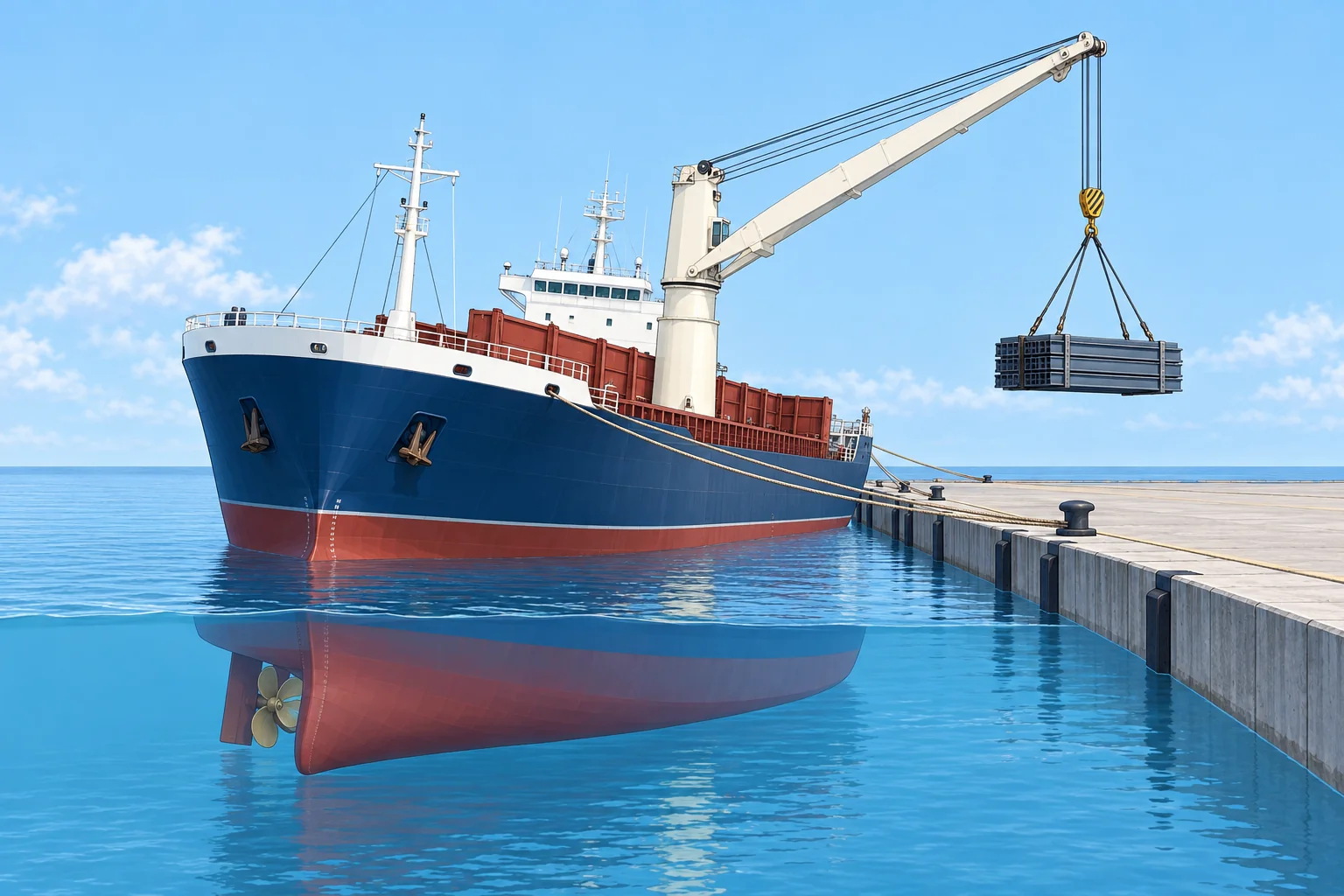
Suspended weights and heavy lifts with ship's gear
1The lesson in plain words
Lifted weight acts at the suspension point. Check heel and GM throughout the lift; head height, outreach and ballast can change the worst stage.
Where it acts
For a load already aboard, its weight acts at the point of suspension, the crane or derrick head, as soon as it hangs clear of the deck or tank top. G rises by w × (head height − load’s Kg) ÷ Δ. This onboard-shift formula applies whether the load hangs 1 m or 10 m above the deck.
Two effects
The rise of G reduces GM. For a load already aboard, G moves transversely by w × (head position − original load position) ÷ Δ. Measure both positions from the centreline, with a consistent sign for each side. Crane outreach, the radius from its pedestal, may differ. Check every stage for head height, offset, ballast and movement of the crane’s own G. Include changes in the crane’s own weight moments.
Lifting from the quay
Loading from shore adds the weight at the head: Δ grows by w. Use the loading-by-moments method with the new displacement and added moments. The already-aboard shift formulas do not apply. For discharge, calculate the hanging condition, then remove the load’s weight and moment when it is released ashore. Check the whole sequence before you start.
Preparing
The IS Code added lifting provisions in 2020, with ship-date and operation thresholds. Confirm applicability with your flag-state authority and classification society (class). Use your approved booklet and crane-manual limits. Deal with slack tanks, plan any counter-ballast, and tend the moorings so a sudden heel cannot part them. This list formula is a small-angle estimate with positive fluid GM; use the approved lifting assessment for acceptance.
During the lift
Lift slowly, stop the load swinging and keep people clear. Watch the inclinometer, which shows the heel angle. If she lists more than planned, stop and land the load safely. Do not improvise ballast changes; follow the approved lift and ballast sequence.
2Step by step
Worked example: lifting a package out of the hold
- 1
Data: Δ 15,000 t, GM fluid 0.55 m, initially upright. A 60 t package starts on the centreline at Kg 3.0 m. The crane head stays 25.0 m above the keel; ballast is unchanged.
The package is already included; initially centred. Assume the crane’s own moments stay unchanged in this simplified example.
- 2
Rise of G = 60 × (25.0 − 3.0) ÷ 15,000 = 0.088 m. GM = 0.55 − 0.088 = 0.462 m.
As soon as it leaves the tank top.
- 3
At maximum head offset, 15 m from the centreline: GGH = 60 × (15 − 0) ÷ 15,000 = 0.060 m.
G moves towards the head.
- 4
Small-angle estimate: tan θ ≈ 0.060 ÷ 0.462 = 0.130, θ ≈ 7.4°.
The worst list here: fixed head height, unchanged ballast and crane moments, maximum head offset.
- 5
Compare with the crane manual and booklet limits. If excessive, revise the lift or approved counter-ballast plan and recalculate every stage before lifting.
Check intermediate stages and both end conditions.
3Key data
- Rise of G: load already aboard
- w × (head height − load Kg) ÷ Δ
- Transverse shift: load already aboard
- w × (xhead − xload) ÷ Δ; positions from centreline
- List
- tan θ ≈ GGH ÷ GM fluid; small angles, positive GM
- Worst stage
- Worst calculated stage, including full outreach
4Key points
- 1
A suspended load acts at the point of suspension as soon as it leaves the deck.
- 2
Check every lift stage; full outreach and minimum GM may occur at different stages.
- 3
Prepare: slack tanks dealt with, counter-ballast planned, moorings tended.
- 4
Stop and land the load if the list goes beyond the plan.
5Frequent mistakes
Wrong: While the load is only just above the deck it barely affects stability.
Right: Its weight acts at the head the moment it leaves the deck. The rise of G is the same at 1 m or 10 m.
Wrong: Improvise ballast changes to chase an unexpected list while the load hangs.
Right: Counter-ballast can heel the ship the other way when the load is released or suddenly lost. Use the approved sequence and verify that failure condition.
6Practice case & exam keys
Using the example values, the lift gives about 7.4° but the plan allows 5°. Can you proceed unchanged? Estimate the opposing ballast moment and say what must be checked before lifting.
Show the answer
Small-angle estimate, ignoring changes in the crane’s own moments: the lift gives 900 t·m. At 5°, 15,000 × 0.462 × tan 5° allows about 606 t·m: 294 t·m opposing, say 300. Shifting 25 t through 12 m supplies this only if KG and FSC stay unchanged. Check tank centres, FSC, all stages and both end conditions. Also verify sudden hook-load loss with counter-ballast still in place.
Exam keys
- A suspended weight acts at the point of suspension.
- Load already aboard: rise = w × (head height − Kg) ÷ Δ; GGH = w × (xhead − xload) ÷ Δ, positions from centreline. Small-angle list estimate with positive fluid GM: tan θ ≈ GGH ÷ GM fluid.
- Check all planned lift stages against the crane manual and booklet; shore loading needs new displacement and moments.
Finish this unit
When you've read it, answer three questions. Get all three right to finish the unit; opening the page alone doesn't count.
My notes for this unit
No notes