

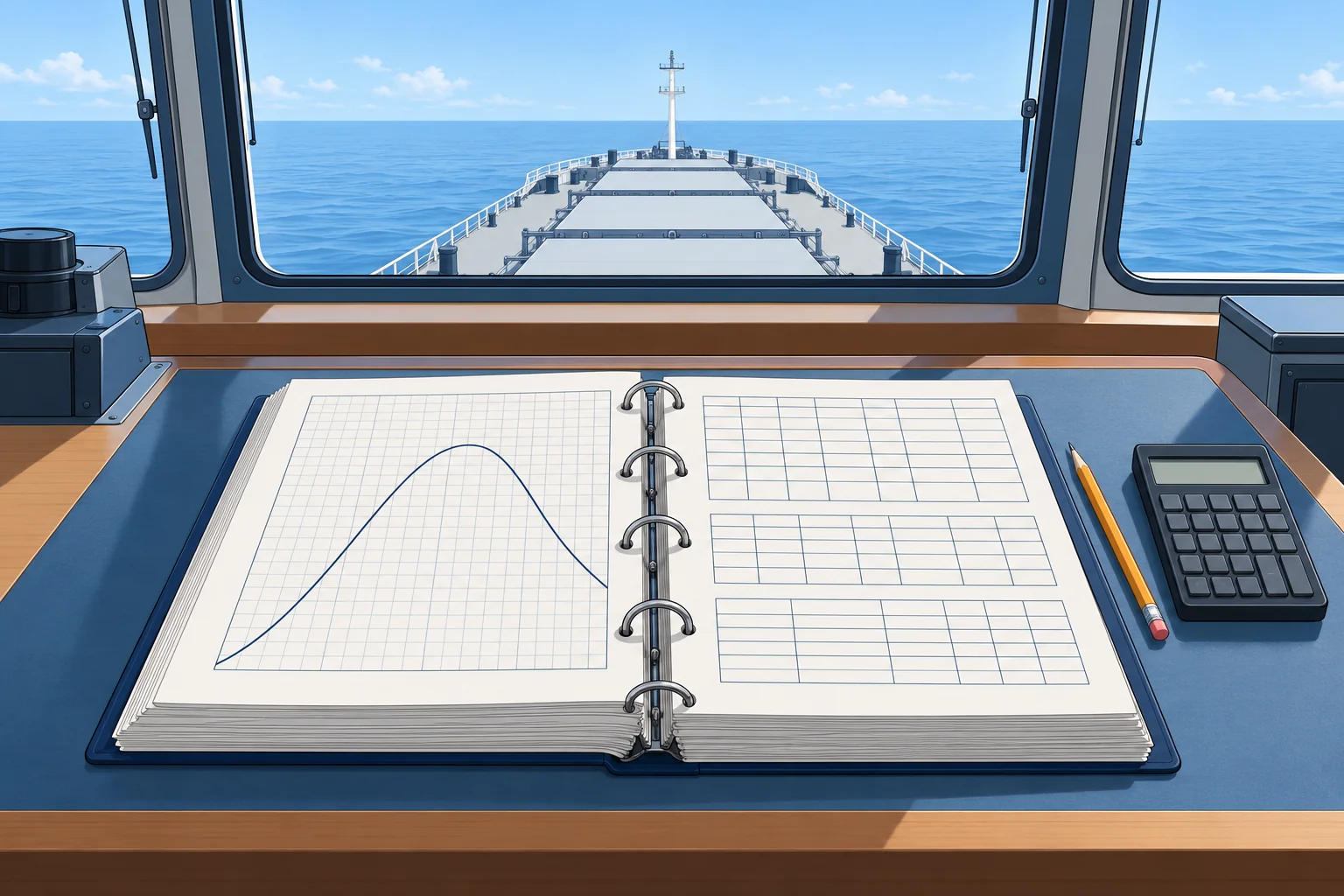
The stability booklet and approved loading conditions
1The lesson in plain words
Your ship's approved stability booklet tells you how she may be loaded. Know what is in it, and check every departure against it.
What it is
The stability booklet, or stability information, is approved by the flag Administration or by a recognised organization (RO), usually a classification society, acting for it. SOLAS II-1/5-1 requires it on ships under SOLAS; national rules require similar information on smaller ships. It must let the master judge stability quickly and simply, and it is written in the ship's working language.
What it holds
Expect instructions; plans of watertight spaces, closures, vents and downflooding openings (where water enters as she heels); hydrostatic tables linking draught to displacement (total weight); cross curves used to find righting levers; tank tables with capacities, weight centres and free surface data for liquids that can shift; worked loading conditions; and loading limits. The inclining-test report gives the lightship weight and centre of gravity, before voyage loads are added.
The limit curve
The approved maximum KG/minimum GM curve gives your limit at the actual draught and trim. KG is the height of G, the centre of gravity, above the keel; GM measures initial stability. Fluid KG = solid KG + FSC; fluid GM = solid GM − FSC, where FSC is the free surface correction. For limits expressed as fluid values, fluid KG must not exceed maximum KG; fluid GM must not fall below minimum GM. Follow the booklet's correction convention to avoid double-counting FSC. Keep required closures secured.
Using the conditions
The booklet shows standard conditions, such as full-load departure, arrival with 10 % of stores and fuel, and ballast. If your loading really matches one, use it. If not, calculate a new condition by the booklet's method or with an approved loading computer. Check the worst point of the voyage, usually arrival, when tanks are low and slack.
Which rules apply
The 2008 IS Code (Intact Stability Code) gives general criteria for cargo and passenger ships of 24 m and over. Part A is mandatory where SOLAS or Load Line provisions require it; applicability depends on convention coverage, construction date and flag rules. Part B gives recommendations. For fishing vessels of 24 m and over, it recommends these criteria with GM at least 0.35 m for single-deck vessels. Smaller vessels follow national rules. Use your approved booklet.
2Step by step
Checking a departure against the booklet
- 1
List every weight aboard: cargo, fuel, water, stores, ballast, catch and gear.
Lightship is the start; everything else is added to it.
- 2
Work out displacement, KG, draught and trim by moments, or with the approved computer.
Check the approved curve at your actual draught and trim.
- 3
Apply the booklet's free-surface correction convention for every slack tank.
Compare values using the same convention as the approved limit.
- 4
Compare corrected KG with the applicable maximum KG at your draught and trim; secure required closures.
The comparison is valid only within the curve's approved operating conditions.
- 5
Repeat for arrival, with consumables low.
Stability usually gets worse as tanks empty.
- 6
Record the result before sailing.
It shows the check was made, and on which data.
3Key data
- Required by
- SOLAS II-1/5-1; national codes for small ships
- General Part A ship categories
- Cargo and passenger ships of 24 m and over
- Fishing vessels ≥ 24 m
- GM ≥ 0.35 m single-deck (IS Code Part B 2.1)
- Limit curve
- Maximum KG or minimum GM against draught
- Standard arrival condition
- 10 % of stores and fuel remaining
4Key points
- 1
The approved stability booklet is the basis for loading your ship.
- 2
Use the applicable KG / GM limit at your draught and trim, with the booklet's free-surface convention.
- 3
Check departure and arrival: low consumables and slack tanks can reduce stability.
- 4
Use the IS Code requirements or national rules applicable to your ship, as recorded in the approved booklet.
5Frequent mistakes
Wrong: If she sits upright and steady, the booklet check can wait.
Right: A ship can float upright with too little stability. Calculate before sailing; heel and roll show the problem late.
Wrong: Any loading close to a booklet condition is fine.
Right: Only if the weights, their heights and the slack tanks really match. Otherwise calculate a new condition.
6Practice case & exam keys
Your 60 m coaster's booklet has a full-load departure condition with nothing on deck. Today the charterer wants 25 t of steel pipes on the hatch covers, with the holds full as usual. What do you do?
Show the answer
The standard condition no longer applies: deck cargo raises KG. Calculate a new condition with the pipes at their real height and the booklet's free-surface convention. Use the applicable KG limit at the new draught and trim, within its operating conditions. Check arrival stability, the hatch-cover structural limit and required closures. If the margin is too small, reduce deck cargo or lower other weights.
Exam keys
- SOLAS II-1/5-1: approved stability information that lets the master judge stability quickly and simply.
- Booklet: hydrostatics, cross curves, tank tables with FSM, loading conditions, limit curves, inclining report.
- Compare corrected KG with the applicable approved limit at your draught and trim, within its operating conditions, for departure and arrival.
Finish this unit
When you've read it, answer three questions. Get all three right to finish the unit; opening the page alone doesn't count.
My notes for this unit
No notes