

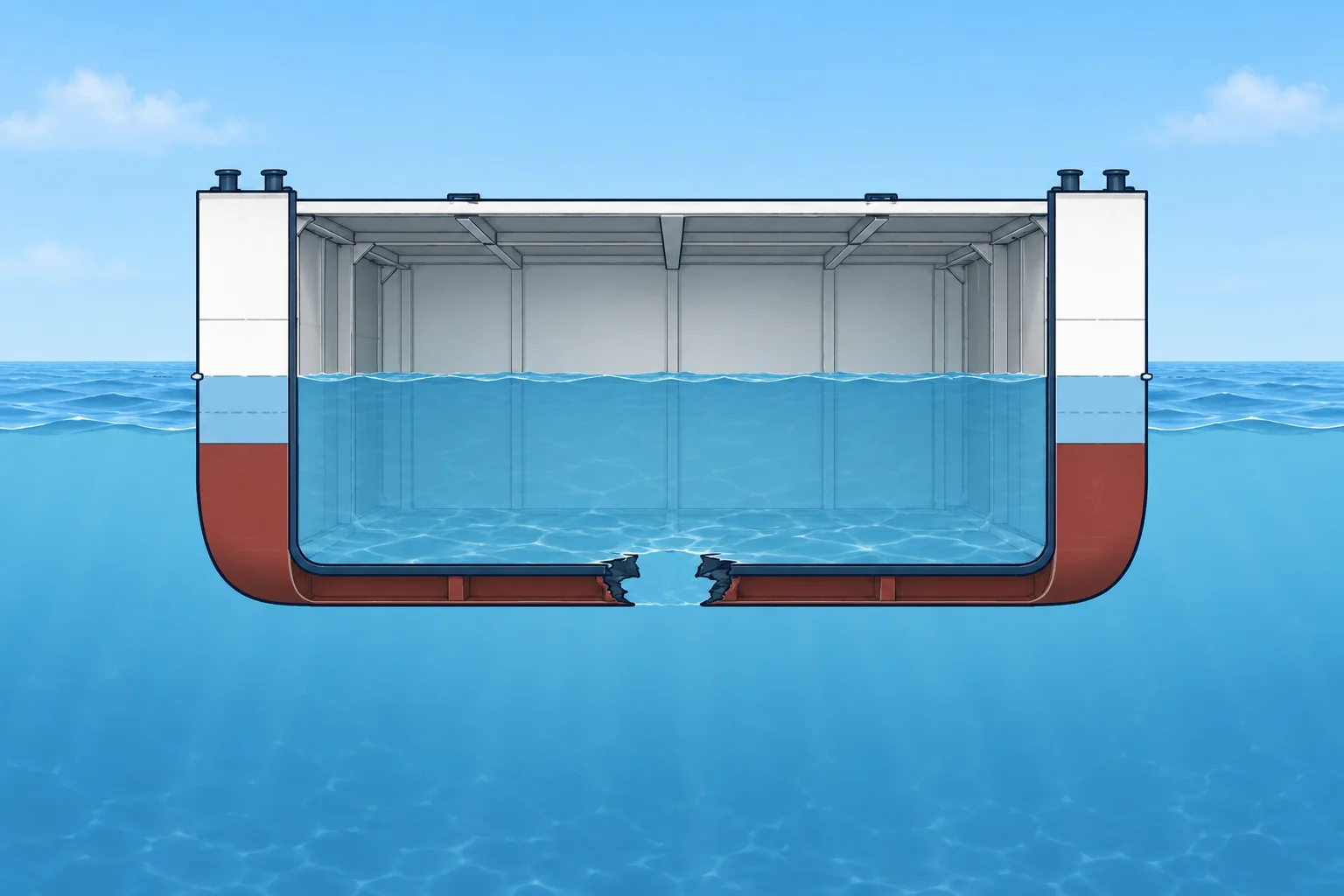
Bilging a midships compartment: a worked example
1The lesson in plain words
Work through a bilged midships compartment in a box-shaped vessel: sinkage, new draught, KB, BM and GM, with permeability.
The model
Use an initially upright, untrimmed box-shaped vessel with vertical sides and a flat bottom. Assume freely vented flooding and uniformly spread obstructions, so the same μ applies to volume, waterplane area and waterplane inertia. The compartment runs the full breadth, is centred at the centre of flotation, and extends from the bottom to a watertight deck above the final waterline. Under these assumptions she sinks without list or trim. Real hulls and non-uniform spaces need their own buoyancy geometry.
Sinkage
Lost volume = μ × l × B × d, where L is ship length, l compartment length, B breadth and d initial draught. The intact waterplane = (L − μl) × B. Sinkage = lost volume ÷ intact waterplane = μ × l × d ÷ (L − μl). The waterplane shrinks too: the flooded part no longer provides waterplane area.
New KB and BM
The intact underwater shape is still a box section, so new KB = new draught ÷ 2. Volume of displacement V is unchanged in the lost buoyancy method. The waterplane’s second moment of area, I, measures how its area is spread across the centreline: I = (L − μl) × B³ ÷ 12. New BM = I ÷ V. Then KM = KB + BM and GM = KM − KG, with KG unchanged.
Reading the result
In this example GM falls because BM drops by more than KB rises. In another box vessel, KB’s rise can outweigh BM’s fall, so calculate the result rather than assume its direction. Freeboard falls by the sinkage. Check that the new waterline stays below openings that could let water spread, and that the ship is still within her damage stability limits.
Off-centre and end compartments
A side compartment also causes a list; one away from the centre of flotation also causes trim. Those cases move the centre of flotation and need more steps. The damage stability rules for ships are in the set on damage stability, strength and the draught survey.
2Step by step
Worked example: box vessel bilged amidships
- 1
Intact vessel: L 100 m, B 15 m, d 5.00 m, KG 5.00 m. V = 7,500 m³, Δ = 7,687.5 t. KB 2.50, BM = 15² ÷ (12 × 5) = 3.75, KM 6.25, GM 1.25 m.
This is the baseline to compare with.
- 2
A 15 m compartment amidships floods, μ 0.85. Lost volume = 0.85 × 15 × 15 × 5 = 956.25 m³. Intact waterplane = (100 − 12.75) × 15 = 1,308.75 m².
Only 85 % of the space floods, and that part leaves the waterplane.
- 3
Sinkage = 956.25 ÷ 1,308.75 = 0.731 m. New draught = 5.731 m.
The intact volume must replace the lost buoyancy.
- 4
New KB = 5.731 ÷ 2 = 2.865 m.
The intact underwater shape is still a box section.
- 5
I = 87.25 × 15³ ÷ 12 = 24,539 m⁴. BM = 24,539 ÷ 7,500 = 3.272 m.
V stays 7,500 m³: displacement is unchanged.
- 6
KM = 2.865 + 3.272 = 6.137 m. GM = 6.137 − 5.00 = 1.137 m.
GM falls by 0.113 m and freeboard by 0.731 m.
3Key data
- Sinkage (box, midships)
- μ × l × d ÷ (L − μl)
- New KB (box)
- New draught ÷ 2
- New BM
- (L − μl) × B³ ÷ 12 ÷ V, with V unchanged
- GM after bilging
- New KM − original KG (lost buoyancy method)
- Worked example
- Sinkage 0.731 m; GM 1.25 m → 1.137 m
4Key points
- 1
Lost volume = μlBd; intact waterplane = (L − μl)B. Divide these to find sinkage.
- 2
In a box, the new KB is half the new draught; V and KG do not change.
- 3
BM falls because the flooded part no longer adds waterplane inertia.
- 4
A full-breadth compartment centred at the box’s flotation centre causes sinkage only; side/end spaces add list/trim.
5Frequent mistakes
Wrong: Divide the lost volume by the full waterplane area.
Right: The flooded part has no waterplane. Use (L − μl) × B, or you understate sinkage: 0.638 m instead of 0.731 m here.
Wrong: Ignore permeability for a machinery space.
Right: Use 0.85. Taking 1.0 gives 0.882 m of sinkage instead of 0.731 m.
Wrong: Use a new, larger displacement to find BM.
Right: In the lost buoyancy method V and Δ do not change. Use the original 7,500 m³.
6Practice case & exam keys
A box-shaped barge 120 m long and 20 m wide floats at 6.00 m. A full-breadth midships compartment 12 m long, cargo permeability 0.60, is bilged. An unprotected opening to another space is 6.30 m above the keel. Can the one-compartment result describe the final condition?
Show the answer
The model gives lost volume 864 m³ and intact waterplane 2,256 m²: sinkage 0.383 m, draught 6.383 m. This is above the opening at 6.30 m. Water can spread, so the one-compartment calculation cannot establish the final condition.
Exam keys
- Sinkage = μ l d ÷ (L − μl) for a box with a midships compartment.
- New KB = new d ÷ 2; new BM = (L − μl) B³ ÷ 12 ÷ V.
- V, Δ and KG are unchanged in the lost buoyancy method.
- Full-breadth, centred at flotation centre: sinkage only. Side space: list. Away from flotation centre: trim.
Finish this unit
When you've read it, answer three questions. Get all three right to finish the unit; opening the page alone doesn't count.
My notes for this unit
No notes