

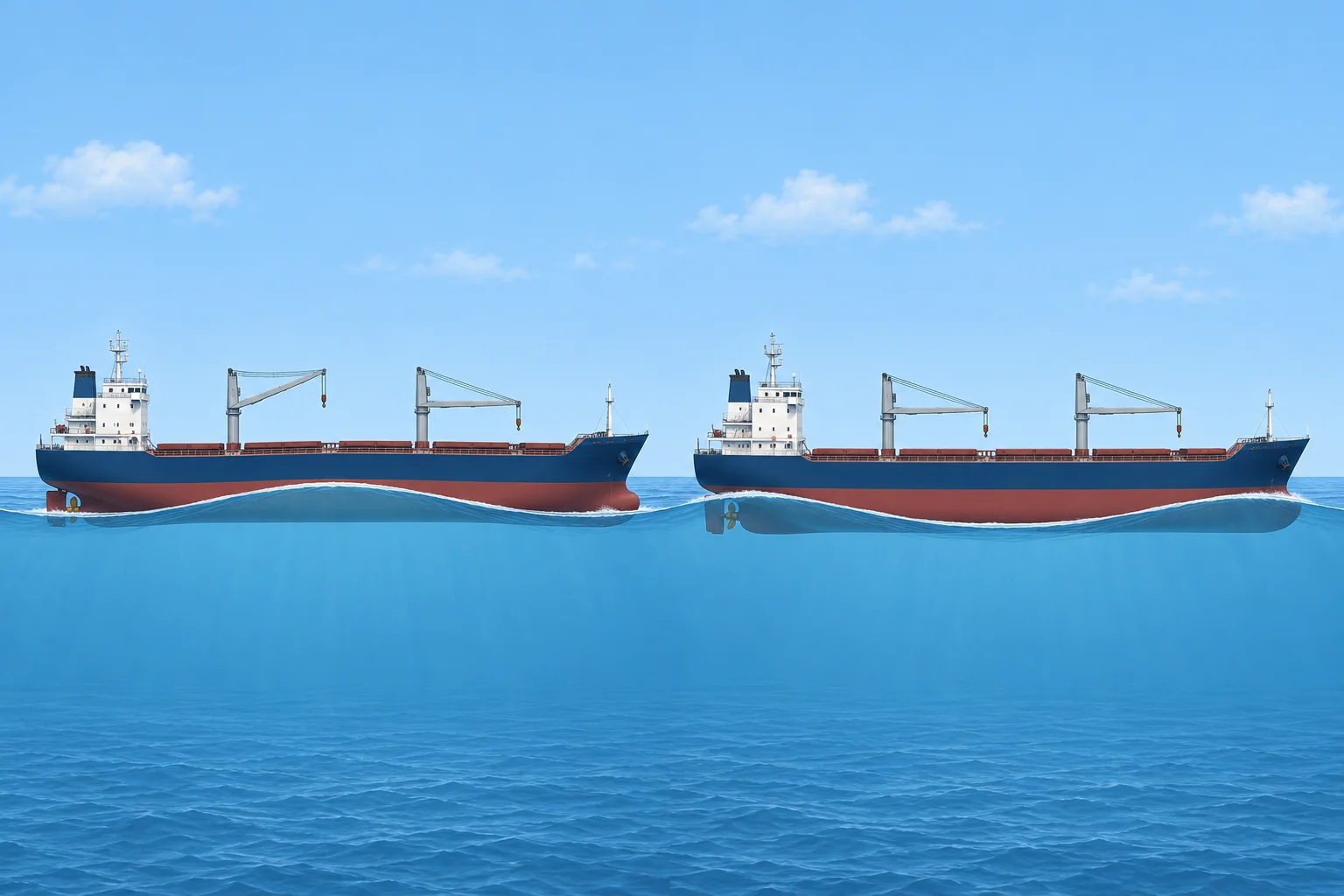
Hogging and sagging: still water, waves and the draught marks
1The lesson in plain words
A hull bends even in calm water, and waves add more. Learn to tell hogging from sagging and to measure the bend from the draught marks.
Hogging
In hogging the middle of the ship rises relative to the ends, like an upturned banana. The deck is stretched (tension) and the bottom is squeezed (compression). It happens with heavy ends and light midship holds, or in a wave with its crest amidships and troughs at the ends.
Sagging
In sagging the middle drops relative to the ends. The deck is in compression and the bottom in tension. It happens with heavy midship holds and light ends, or with wave crests at bow and stern and a trough amidships. Compressed plating can buckle, so sagging limits matter for deck plating and hatch coamings, the raised sides around hatch openings.
Still water and waves
The still water bending moment (SWBM) comes from your loading alone. At sea a wave bending moment is added on top, swinging between hog and sag as waves pass. It is largest when the wavelength is close to the ship’s length. The hull is designed for both, so the loading you control must leave room for the wave part.
Reading deflection
Average port and starboard readings at each position. Correct the end readings to the perpendiculars (the ship’s forward and aft reference lines) and the middle reading to true midships before comparing them. Compare the midships mean with the mean of the forward and aft draughts. Midships deeper than the mean of the ends means sagging; shallower means hogging. The difference is the deflection, usually given in centimetres.
Why deflection matters
Hydrostatic tables assume a straight keel. On a sagging ship the mean of the ends understates displacement; on a hogging ship it overstates it. The draught survey’s quarter mean, (F + A + 6M) ÷ 8, corrects for this. A deflection that grows during loading also warns that the plan is bending the hull hard.
2Step by step
Worked example: deflection from the draught marks
- 1
Use end draughts corrected to the perpendiculars and middle readings at true midships: forward 7.80 m, aft 8.40 m, midships port 8.24 m and starboard 8.26 m, so midships 8.25 m.
Averaging both sides removes the effect of list from the draught reading.
- 2
Mean of forward and aft = (7.80 + 8.40) ÷ 2 = 8.10 m.
This is where midships would float if the keel were straight.
- 3
Deflection = 8.25 − 8.10 = 0.15 m = 15 cm, midships deeper.
Midships deeper than the mean of the ends means sagging.
- 4
Quarter mean = (7.80 + 8.40 + 6 × 8.25) ÷ 8 = 8.2125 m.
This is the conventional quarter-mean approximation for hull deflection.
- 5
With tonnes per centimetre immersion (TPC) = 32 t/cm: (8.2125 − 8.10) × 100 × 32 = 360 t.
Using 8.10 m would understate displacement by about 360 t.
3Key data
- Hogging
- Middle up: deck in tension, bottom in compression
- Sagging
- Middle down: deck in compression, bottom in tension
- Deflection
- Midships mean − mean of forward and aft draughts
- Sign
- Positive = sagging; negative = hogging
- Quarter mean
- (F + A + 6 × M) ÷ 8
- Largest wave BM
- Wavelength about equal to the ship’s length
4Key points
- 1
Hogging: middle up, deck in tension. Sagging: middle down, deck in compression.
- 2
Still water BM comes from your loading; wave BM is added at sea and alternates.
- 3
Compare the midships draught with the mean of forward and aft to find hog or sag.
- 4
Use the quarter mean, not the mean of the ends, when the keel is bent.
5Frequent mistakes
Wrong: A wave crest amidships causes sagging.
Right: A crest amidships supports the middle and leaves the ends unsupported: hogging. Crests at bow and stern with a trough amidships cause sagging.
Wrong: Deflection is only a problem in heavy weather.
Right: Still water loading alone can bend the hull. Keep the still water BM within limits so there is margin for the wave BM.
6Practice case & exam keys
In port, end draughts corrected to the perpendiculars are forward 6.10 m and aft 7.30 m. At true midships, both sides read 6.62 m. Is the ship hogging or sagging, by how much, and which draught do you use for displacement?
Show the answer
Mean of the ends = (6.10 + 7.30) ÷ 2 = 6.70 m. Midships, at 6.62 m, is 8 cm shallower: hogging 8 cm. Quarter mean = (6.10 + 7.30 + 6 × 6.62) ÷ 8 = 6.64 m. Enter the hydrostatic table with 6.64 m (plus the trim corrections in a draught survey), not 6.70 m.
Exam keys
- Hog: middle up, deck in tension. Sag: middle down, deck in compression.
- Crest amidships → hogging; crests at the ends → sagging.
- Deflection = midships mean − mean of the ends; positive is sag.
- Quarter mean (F + A + 6M) ÷ 8 corrects for deflection.
Finish this unit
When you've read it, answer three questions. Get all three right to finish the unit; opening the page alone doesn't count.
My notes for this unit
No notes