

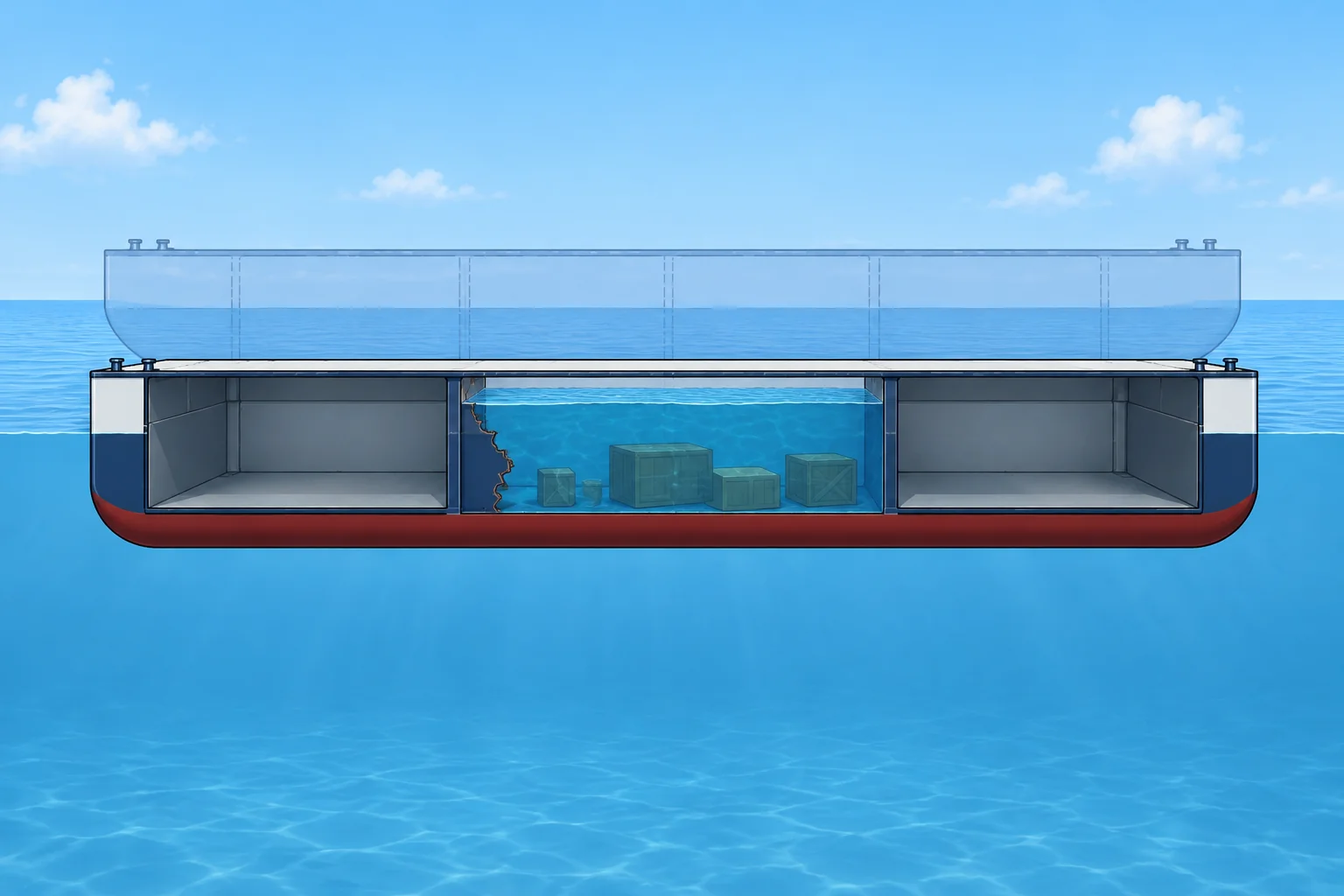
Partial loss of intact buoyancy: two ways to calculate
1The lesson in plain words
When a compartment floods, you can treat it as lost buoyancy or as added weight. Both give the same Δ × GM, with different numbers on the way.
What happens
Open a compartment to the sea below the waterline and water fills it to the outside level. The ship loses the buoyancy that space gave. She sinks until the remaining intact volume replaces it. She also trims or lists if the space is off-centre or away from the centre of flotation, the point she trims about. Flooding a compartment like this is called bilging.
Permeability
Permeability, μ (mu), is the fraction of a space’s volume water can fill. SOLAS II-1/7-3 uses 0.60 for stores, 0.95 for accommodation and voids, and 0.85 for machinery. Dry cargo and container spaces take 0.70, 0.80 or 0.95, from the deepest to the lightest draught. An empty geometric volume approaches 1; statutory void-space calculations use 0.95. For liquid spaces, use 0 or 0.95, whichever is more severe.
Lost buoyancy method
Also called the constant displacement method. The flooded space no longer counts as part of the ship. Displacement and KG stay the same. Recalculate the intact hull’s buoyancy geometry and hydrostatic values. For a wall-sided box sinking upright without trim, sinkage = original lost volume ÷ intact waterplane area. The recalculated geometry already accounts for flooding. Do not add a second free-surface correction for flood water: it is part of the sea. Retain free-surface corrections for other slack tanks.
Added weight method
The flood water is treated as weight added to the ship. Displacement rises, KG moves towards the water’s centre, and the flood water’s free surface counts. Hydrostatics come from the tables at the new displacement. It suits spaces that are only partly flooded and is how many flooding computers work. It takes several steps, because the water level inside depends on the new draught.
Same answer, different GM
Both methods give the same final draught and initial righting stiffness, Δ × GM. At small heel angle θ, righting moment ≈ Δ × GM × sin θ. With positive GM, added weight gives a smaller GM because Δ is larger. Keep each method’s Δ, KG, KM and free-surface treatment together. For practical leak control, see Emergencies: flooding.
2Key data
- Permeability μ
- Fraction of a space’s volume that flood water can fill
- SOLAS II-1/7-3
- Stores 0.60; machinery 0.85; accommodation and voids 0.95
- Cargo spaces (7-3)
- Dry cargo 0.70 / 0.80 / 0.95 at deepest / partial / light draught
- Sinkage: wall-sided box
- Original lost volume ÷ intact waterplane area; upright, no trim
- Lost buoyancy method
- Δ and KG constant; no extra flood-water free-surface correction
- Both methods
- Same draught and initial righting stiffness, Δ × GM
3Key points
- 1
Bilging: the ship sinks until intact volume replaces the lost buoyancy.
- 2
Permeability is the fraction of a space that water can fill.
- 3
Lost buoyancy: Δ and KG unchanged, geometry recalculated, no extra flood-water free-surface correction.
- 4
Added weight: Δ rises, KG changes and the flood water’s free surface counts.
- 5
Both give the same draught and the same Δ × GM; never mix their figures.
4Frequent mistakes
Wrong: A flooded hold full of cargo loses its whole volume of buoyancy.
Right: Only the permeable part floods. Multiply the volume by its permeability, e.g. 0.70 for dry cargo at the deepest draught.
Wrong: The two methods give different GMs, so one must be wrong.
Right: Different GMs alone do not show an error. Compare final draught and initial righting stiffness, Δ × GM; keep each method’s figures together.
Wrong: Add another free-surface correction for flood water in the lost buoyancy method.
Right: The flood water belongs to the sea. Recalculated geometry accounts for it; another correction for this water counts it twice. Retain corrections for other slack tanks.
5Practice case & exam keys
A box-shaped vessel is bilged amidships. Added weight gives GM 0.992 m at Δ 8,811 t; lost buoyancy gives GM 1.137 m at Δ 7,688 t. Do the different GMs alone show that one calculation is wrong?
Show the answer
No. Initial righting stiffness is Δ × GM: 7,688 × 1.137 ≈ 8,741 t·m and 8,811 × 0.992 ≈ 8,741 t·m. The products are consistent; this alone does not validate either complete calculation. They predict approximately the same heel under the same small heeling moment. Keep each method’s Δ, KG, KM and free-surface treatment together.
Exam keys
- Permeability μ = fraction of a space that water can fill.
- SOLAS 7-3: stores 0.60, machinery 0.85, accommodation and voids 0.95.
- Lost buoyancy keeps Δ and KG constant; the simple sinkage formula assumes an upright wall-sided box without trim.
- Added weight: Δ and KG change, free surface counts; Δ × GM is the same.
Finish this unit
When you've read it, answer three questions. Get all three right to finish the unit; opening the page alone doesn't count.
My notes for this unit
No notes