Decide
Four situations at sea. Decide first, then read why.
A VHF DSC distress alert arrives from a yacht 8 miles away. Your finger is on 'acknowledge'. Do you press it?
Key points
- The call menuChoose the type (individual, group, all ships, area), the category and the follow-on channel.
- Categories: distress, urgency, safety, routine.
- Area calls only on MF/HF.
- What the distress alert carriesMMSI, nature, position and UTC time, follow-on mode.
- Only on the master's authority.
- Undesignated is better than late.
- Follow it with MAYDAY by voice.
- Receiving an alertTell the master, listen five minutes on the voice frequency, let the coast station acknowledge.
- VHF/MF: acknowledge by voice if appropriate.
- HF: no acknowledgement; relay to a coast station if nobody answers.
- DSC acknowledgement to stop repeats: only after asking the RCC.
- Bands and propagationVHF line of sight, MF ground wave, HF off the ionosphere.
- Day: higher HF bands for distance.
- Night: lower HF bands.
Check what you have read
Which DSC address can only be used on MF/HF?
Worked case: A distress relay on HF
Mid-afternoon, 700 miles from the nearest coast. Your HF DSC receiver alarms: a distress alert on 8414.5 kHz from a fishing vessel 300 miles away, nature 'flooding'. No coast station acknowledgement appears. The master is on the bridge.
Before you read the solution: what would you do?
True or false?
Decide each statement before you see the answer.
Tell the master, listen five minutes on the voice frequency, let the coast station acknowledge.
The highest HF band is always best.
VHF line of sight, MF ground wave, HF off the ionosphere.
MMSI, nature, position and UTC time, follow-on mode.
Choose the type (individual, group, all ships, area), the category and the follow-on channel.
A DSC distress alert is enough; no voice is needed.
On HF, acknowledge the alert so the casualty knows someone heard.
A ship should acknowledge a DSC distress alert by DSC as soon as it hears it.
Use HF DSC to alert ships nearby.
Exercise: Handle a received DSC alert
You are on watch in sea area A1. A DSC distress alert arrives on channel 70 from a yacht about 8 miles away.
Step by step
What do you do first?
For how many minutes do you listen on channel 16 before deciding what to do?
The yacht calls MAYDAY on channel 16 and no coast station answers. How do you acknowledge?
Put the voice acknowledgement in order.
- 1MAYDAY
- 2Your ship's name or call sign ×3
- 3RECEIVED
- 4THIS IS
- 5MAYDAY
- 6Yacht's name or call sign ×3
Now on your own
Now an alert arrives on 2187.5 kHz MF from a ship 60 miles away.
Which voice frequency do you watch?
May you send a DSC distress relay to all ships on MF straight away?
The same alert keeps repeating. When may you send a DSC acknowledgement to stop it?
Check: 10 questions
Questions from this subject, explained after each answer.
Free: lesson + 10 questions · Exam Pass: all 26 questions, unlimited practice tests, your mistakes retrained
The full explanation and the lessons for each programme item
Topic 1 of 4
A DSC call is a short digital message
Digital selective calling is the doorbell; voice is the conversation. A DSC call tells the receiving station who is calling, how urgent it is and where the follow-on communication will be. It is sent on a DSC frequency: channel 70 on VHF, 2187.5 kHz on MF, and 4207.5, 6312, 8414.5, 12577 or 16804.5 kHz on HF.
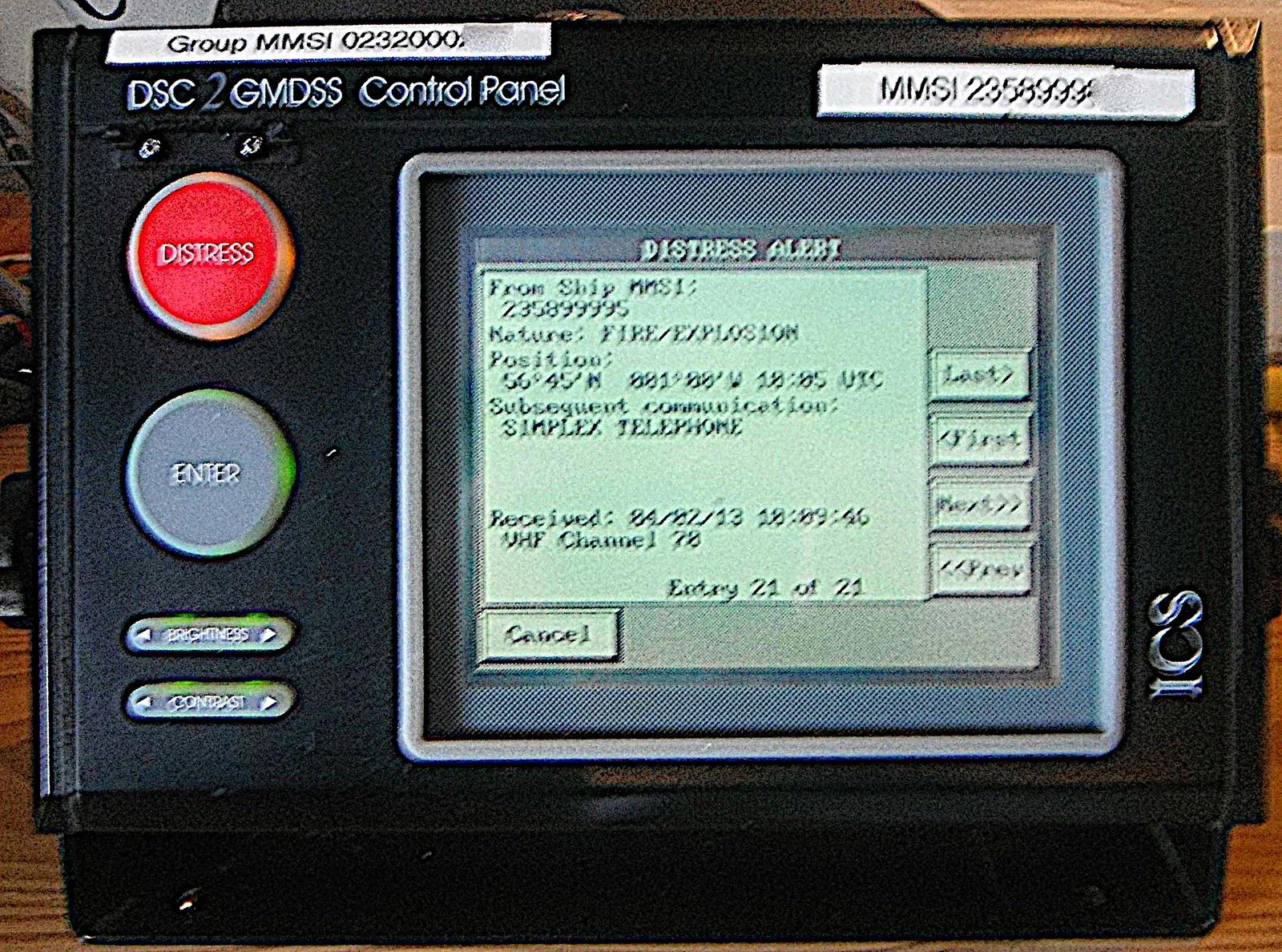
A distress alert carries your MMSI, the nature of distress, your position and the UTC time of that position, and the type of follow-on communication, normally radiotelephony (CEPT GOC B2 2.3). Choose the nature if you have time; if not, an undesignated alert is still an alert.
Other calls carry an address (one station's MMSI, a group, all ships or, on MF/HF, a geographical area), a category (urgency, safety or routine), the follow-on mode and, where needed, the working channel or frequency (B2 2.4).
- Send a distress alert only on the authority of the master or the person responsible for the ship (47 CFR 80.1111(c)).
- Hold the distress button for its full count: the cover and the delay are there to stop false alerts.
- A DSC distress alert repeats automatically until it is acknowledged. After an alert on VHF or MF, go to the matching voice frequency (channel 16 or 2182 kHz) and send your MAYDAY.
Topic 2 of 4
Receiving a distress alert: listen before you press
Coast stations acknowledge DSC distress alerts by DSC; ships normally do not. Ships delay any acknowledgement to give the coast station time (47 CFR 80.1117(a)).
Tell the master at once (80.1121(a)).
VHF and MF: stop any transmission that could interfere, keep watch on the DSC channel and set watch on the associated voice frequency (channel 16 or 2182 kHz) for five minutes. If appropriate, acknowledge to the ship in distress by voice, and inform the coast station or RCC. Do not transmit a DSC distress relay on these bands unless you know the ship in distress cannot alert for itself and the master decides further help is necessary (80.1121(b)).
HF: do not acknowledge. Listen on the associated voice frequency for five minutes. If no distress traffic is heard and no coast station has acknowledged, send a distress alert relay to the coast station on HF and inform the RCC (80.1121(c)).
If the same alert keeps arriving, you may send a DSC acknowledgement to stop it, but only after consulting the RCC (80.1121(d)).
- Ship-to-ship alerts use VHF and MF DSC. HF should not be used to alert nearby ships unless nobody answers on VHF or MF within five minutes (80.1113(d)).
- A distress alert relay always says that the sending station is not itself in distress (80.1115(b)).
Topic 3 of 4
Bands and propagation
VHF (30–300 MHz) travels by line of sight: tens of miles at best between ships.
MF (300 kHz–3 MHz) travels by ground wave, about a couple of hundred miles by day. HF (3–30 MHz) reaches far by bouncing off the ionosphere (CEPT GOC A1 1.3–1.4).
On HF the right band depends on time of day and distance. By day the ionosphere supports the higher bands (12 and 16 MHz) for long distances; at night lower bands (4, 6 or 8 MHz) work better because high frequencies pass through the ionosphere and skip over the station.
That is why the HF DSC watch keeps 8414.5 kHz plus one more band chosen for the time and position, and why a multi-frequency HF distress alert uses several bands.
- Frequency × wavelength = speed of light: 156 MHz is about 2 m, 2 MHz about 150 m.
- Units: Hz, kHz, MHz, GHz. Bands: LF, MF, HF, VHF, UHF, SHF.
Topic 4 of 4
Practise and go further
The best places to practise this subject. When you finish, one tap brings you back to the course.
- Radio station: Choose the HF band by day / at nightSimulator
- Module 4: MF/HF DSC and propagationLesson
- Module 3: VHF and DSCLesson
- Module 11: distress proceduresLesson
All lessons by programme item
- A1.3 Frequency bands and propagation: line of sight, ground wave, ionospheric (A1 1.3–1.4)
- B2.1 DSC set-up and call menus: types of call (B2 2.1–2.2)
- B2.3 The parts of a DSC distress alert: MMSI, nature, position and time, follow-on communication (B2 2.3)
- B2.4 The parts of other DSC calls: address, category, follow-on, frequency or position (B2 2.4)
- C1.1 Distress communications by DSC: alert, relay, receipt and acknowledgement (C1 1.1)
Sources
- US 47 CFR Part 80 subpart W: GMDSS operating procedures for distress, urgency and safety (the ITU procedures in US law) · checked
- CEPT ERC Decision (99)01: harmonised examination syllabi for the GOC and ROC (amended 8 March 2024) · checked
- IMO resolution MSC.496(105): SOLAS chapter IV in force from 1 January 2024 (Hong Kong Marine Department copy) · checked
Checked against SOLAS, IMO, CEPT and ITU-based sources on .