Decide
Four situations at sea. Decide first, then read why.
You are talking to a pilot boat half a mile away on a working channel. Which power do you use?
Key points
- VHF controlsChannel, power, squelch, dual watch, and a separate DSC watch on channel 70.
- Channels 70, 16, 13 and 6 are required.
- Low power for short range.
- Dual watch does not replace the DSC watch.
- MF/HF controlsChannel or frequency, mode, ATU tuning, RF/AF gain and AGC.
- Voice: 2182, 4125, 6215, 8291, 12290, 16420 kHz.
- An ATU alarm means diagnose, not retry.
- Emissions and channelsJ3E for MF/HF voice, G3E for VHF voice, F1B/J2B and G2B for DSC.
- Simplex: one frequency. Duplex: two.
- HF channels: paired or unpaired.
- AntennasVHF range is antenna height; MF/HF antennas depend on insulators, cables and the ATU.
- Satellite antennas need a clear sky view.
- Mark every installation with the GMDSS identities.
- The reserve sourceIndependent of the ship's power: at least 1 hour (6 hours without a compliant emergency source).
- Charger: back to minimum capacity in 10 hours.
- Capacity check: at most every 12 months, not at sea.
- Keep the GNSS position input alive on reserve power.
Check what you have read
Which VHF channel is used for DSC?
Worked case: Blackout on the bridge
At 0215 the ship loses main power, and the emergency generator fails to start. The bridge lights go out. Your VHF and MF/HF sets stay on. The master asks: how long do we have, and what do we do with the radios?
Before you read the solution: what would you do?
True or false?
Decide each statement before you see the answer.
Independent of the ship's power: at least 1 hour (6 hours without a compliant emergency source).
VHF range is antenna height; MF/HF antennas depend on insulators, cables and the ATU.
MF/HF voice is the same emission as VHF voice.
Channel or frequency, mode, ATU tuning, RF/AF gain and AGC.
Battery capacity is checked by a test at sea every month.
The reserve source of energy is the ship's emergency generator.
J3E for MF/HF voice, G3E for VHF voice, F1B/J2B and G2B for DSC.
Channel, power, squelch, dual watch, and a separate DSC watch on channel 70.
More power always gives more VHF range.
Dual watch on channel 16 replaces the DSC watch on channel 70.
Exercise: Pick the right setting
You are preparing the station for a passage. Choose settings and reasons.
Step by step
Which emission class does MF/HF single-sideband voice use?
You will talk to a ship 2 miles away on channel 13. Which power?
Your ship has no emergency source complying with SOLAS II-1/42 or 43. For how many hours must the reserve source run the radios?
Within how many hours must the automatic charger bring the batteries back to minimum capacity?
Now on your own
Now the MF/HF set reports an antenna tuning fault when you try a test call.
What do you do first?
Which part matches the transmitter to the antenna?
Until it is fixed, who must know?
Check: 10 questions
Questions from this subject, explained after each answer.
Free: lesson + 10 questions · Exam Pass: all 26 questions, unlimited practice tests, your mistakes retrained
The full explanation and the lessons for each programme item
Topic 1 of 4
The VHF set: the radio you use most
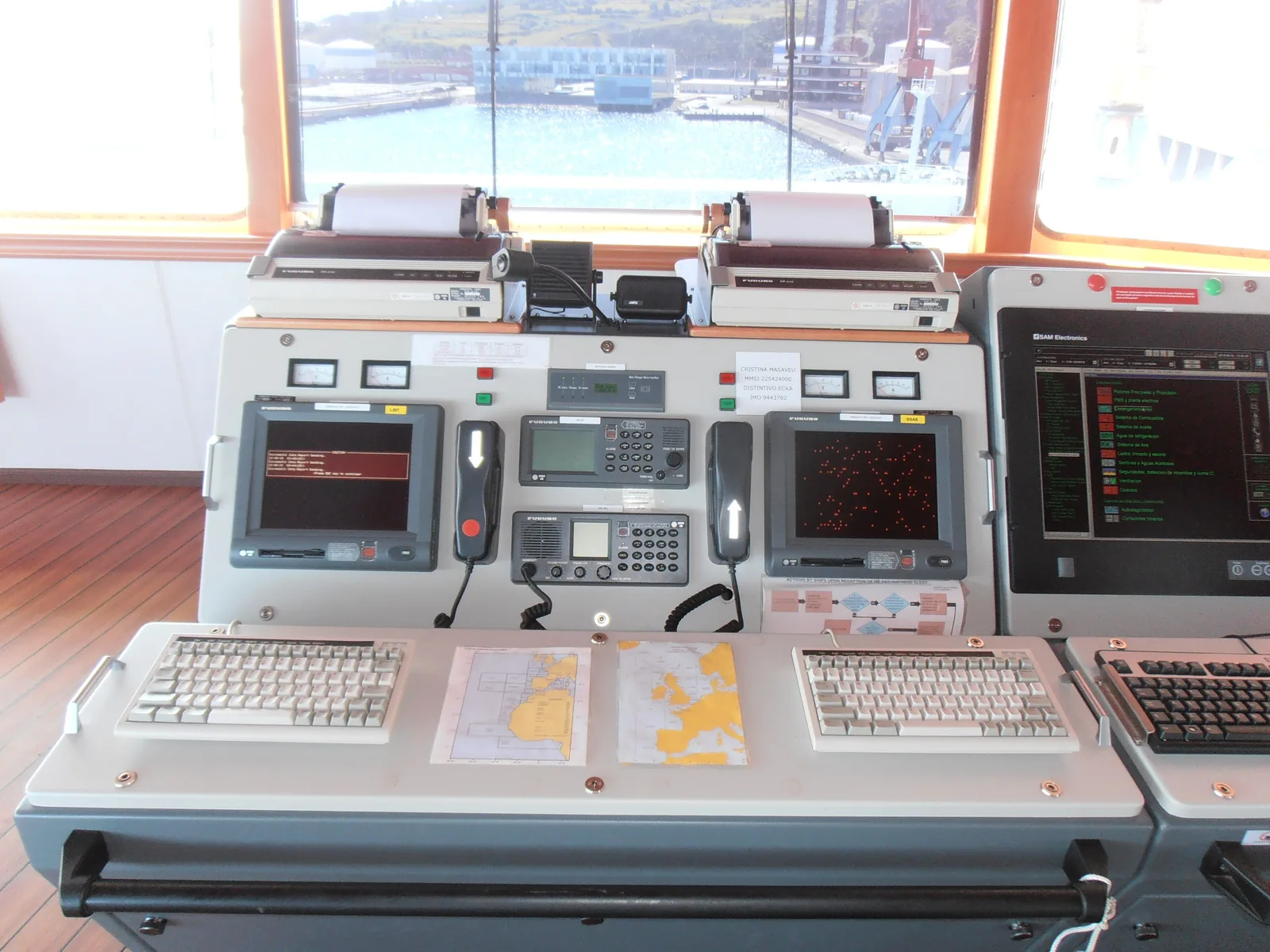
Know every control before you need it. The CEPT syllabus lists them: on/off, transmit power (high or low), channel selector, dual watch and scan, volume and squelch, and the DSC function with its own watch receiver (B1 1.1).
Use low power for short-range calls and high power when you need range. Squelch cuts the background hiss: turn it just past the point where the noise stops, or weak stations will be cut out too.
The DSC watch receiver on channel 70 is separate from the voice receiver, so your watch on 70 continues while you talk on another channel (IV/7.1.2). Dual watch and scan are for listening on a working channel while still hearing channel 16; they are not a replacement for the DSC watch.
- VHF channels you must have: 70 (DSC, 156.525 MHz), 16 (distress voice, 156.800 MHz), 13 (bridge-to-bridge, 156.650 MHz) and 6 (intership and SAR on-scene, 156.300 MHz) (IV/7.1.1).
- VHF works by line of sight: range depends mostly on antenna heights, not on power.
Topic 2 of 4
The MF/HF set: more controls, more range
The MF/HF transceiver needs a channel or a frequency, a mode and a tuned antenna. Typical controls: ITU channel number, receive and transmit frequency, transmitter tuning, mode of emission, volume and squelch, RF gain, AF gain and automatic gain control (B1 1.2).
Voice on MF/HF uses single sideband with suppressed carrier, emission class J3E. VHF voice is frequency (phase) modulated, G3E. DSC on VHF is G2B; on MF/HF it is F1B or J2B. You need the designations in the exam (A1 1.6).
Every transmission on MF/HF goes through the antenna tuning unit (ATU). If the ATU cannot match the antenna, the set will not transmit properly: one try, one alarm, then look for the fault rather than pressing the key again.
- MF/HF distress and safety voice frequencies: 2182, 4125, 6215, 8291, 12290 and 16420 kHz (47 CFR 80.1077).
- MF/HF DSC distress frequencies: 2187.5, 4207.5, 6312, 8414.5, 12577 and 16804.5 kHz.
- VHF channels can be simplex (one frequency) or duplex (two); HF channels are paired (ship and coast frequencies) or unpaired (CEPT GOC A1 1.7).
Topic 3 of 4
Antennas and power
Antennas fail quietly. VHF whips, MF/HF whips or wires on insulators, satellite antennas under domes, and the cables and glands between them all need checking (B1 1.3).
A cracked insulator or a wet connector can stop the MF/HF set reaching anyone.
SOLAS IV/13 asks for power at all times to run the radios and charge their batteries, and for a reserve source of energy to run them for distress, urgency and safety when both the main and emergency sources fail. It must run the VHF and the MF, MF/HF or satellite installation of your sea areas at the same time for at least one hour on ships with a compliant emergency source, or six hours on ships without one.
The reserve source must be independent of the ship's propulsion and electrical system. Batteries need an automatic charger that recharges them to minimum capacity within 10 hours, and their capacity is checked at intervals not exceeding 12 months when the ship is not at sea (IV/13.6).
- The reserve source may also light the radio controls (IV/6.2.4, IV/13.5).
- If a radio needs the GNSS position to work properly, that input must keep coming when main and emergency power fail (IV/13.8).
- Each radio installation must be clearly marked with the ship's GMDSS identities, such as call sign and MMSI (IV/6.2.5).
Topic 4 of 4
Practise and go further
The best places to practise this subject. When you finish, one tap brings you back to the course.
- Radio station: Keep the watch when the mains failsSimulator
- Module 2: frequenciesLesson
- Module 4: MF/HF DSCLesson
- Module 10: GNSS, antennas and batteriesLesson
- Module 3: VHF and DSCLesson
All lessons by programme item
- A1.6 Modes, classes of emission and the frequencies allocated to the maritime mobile service (A1 1.5–1.7)
- A3.5 Sources of energy: main, emergency and reserve (A3 3.5)
- B1.1 VHF radio installation: controls, dual watch, squelch and the DSC watch receiver (B1 1.1)
- B1.2 MF/HF radio installation: channels, frequencies, tuning, mode, gain and DSC scanning (B1 1.2)
- B1.3 Antennas and connections: VHF, MF/HF and satellite antennas (B1 1.3)
Sources
- IMO resolution MSC.496(105): SOLAS chapter IV in force from 1 January 2024 (Hong Kong Marine Department copy) · checked
- CEPT ERC Decision (99)01: harmonised examination syllabi for the GOC and ROC (amended 8 March 2024) · checked
- US 47 CFR Part 80 subpart W: GMDSS operating procedures for distress, urgency and safety (the ITU procedures in US law) · checked
Checked against SOLAS, IMO, CEPT and ITU-based sources on .