
Decide
Four situations at sea. Decide first, then read why.
The new third mate wants to test the DSC by pressing the distress button 'just for a second'. Do you let him?
Key points
- Routine callsShort call, then a working channel.
- DSC: individual call proposing a working channel.
- No answer: stop and try later.
- Radio check: working channel.
- The test routineDaily DSC self-test, weekly DSC test call, monthly EPIRB/SART/survival VHF.
- Never test with the distress button.
- Keep distress frequencies clear.
- Batteries in serviceDaily test and charge, monthly condition check, yearly capacity check ashore.
- UPS or a dedicated generator may be the reserve source.
- Log and chargesLog as it happens in UTC; distress and safety traffic is free.
- UK log: distress, urgency, safety, positions, tests.
- AAIC: who pays for paid traffic.
Check what you have read
Where should a routine conversation take place?
Worked case: One day of radio routine
You take over the radio duties at 0800 UTC on a cargo ship in sea area A2, within range of an MF DSC coast station. It is Monday, the day your company plans the weekly test, and the first of the month.
Before you read the solution: what would you do?
True or false?
Decide each statement before you see the answer.
Keep calling until the other ship answers.
All radio traffic is charged.
Short call, then a working channel.
Daily DSC self-test, weekly DSC test call, monthly EPIRB/SART/survival VHF.
Daily test and charge, monthly condition check, yearly capacity check ashore.
Log as it happens in UTC; distress and safety traffic is free.
The log can be filled in at the end of the voyage.
Test the DSC by pressing the distress button for a moment.
A radio check on channel 16 is fine.
Exercise: Make the routine right
Decide how to handle everyday radio work.
Step by step
You want a radio check. Where?
How do you test the VHF DSC daily?
Which call is free of charge?
Put a log entry in its usual order.
- 1Time in UTC
- 2Your initials
- 3What happened
- 4Station or frequency
Now on your own
Now the monthly checks.
How do you test the EPIRB monthly?
Which channel for the survival craft VHF test?
You call a ship three times; no answer. Next?
Check: 10 questions
Questions from this subject, explained after each answer.
Free: lesson + 10 questions · Exam Pass: all 26 questions, unlimited practice tests, your mistakes retrained
The full explanation and the lessons for each programme item
Topic 1 of 4
Routine calls: short, on the right channel
Call briefly, then move the conversation to a working channel. By DSC, send an individual routine call to the station's MMSI and propose a working channel; a coast station names the working channel in its acknowledgement. Then talk there, not on channel 16 or 70 (CEPT GOC C6).
By voice, call the station's name, say THIS IS and your name and call sign, and propose a working channel. If there is no answer, do not keep calling: call a few times (the radio station's exercise uses three), then stop and try later.
A radio check is short and done on a working channel, never on channel 16.
- Ship-to-shore, ship-to-ship, shore-to-ship and group calls exist by DSC; the coast station's acknowledgement completes a DSC routine call.
- Routine traffic by satellite works like a phone call or message, at the service's charges.
Topic 2 of 4
Tests and protecting the distress frequencies
Test without disturbing anyone. Distress and safety frequencies are protected: keep tests on them to a minimum, avoid harmful interference, and never transmit without authorisation (CEPT GOC C1 1.4). Tests and drills must never cause false alerts (MSC.514(105)).
The UK MCA routine shows what a typical flag State asks, and must be recorded: daily, test the DSC facilities without radiating, test the batteries and charge them if needed, and check the printers have paper; weekly, make a DSC test call to a coast station when in range (and test a non-battery reserve source); monthly, self-test each EPIRB without using the satellite system, test each SART, check battery security and condition and the aerials and insulators, and test each survival craft VHF on a channel other than 16 (MCA Master's Guide).
Your own flag State may word it differently: follow its rules and your company's procedures.
- A DSC test call is a call, not a distress alert: use the test function, never the distress button.
- Once a year at most, check the reserve battery capacity, not at sea (SOLAS IV/13.6.2).
Topic 3 of 4
Batteries, the log and traffic charges
Batteries are the reserve source most ships rely on. Know your type (sealed or vented lead-acid, for example), keep them charged by the automatic charger, check the voltage daily and the connections and compartment monthly. Some ships use a UPS or a dedicated generator instead (CEPT GOC B1 1.4).
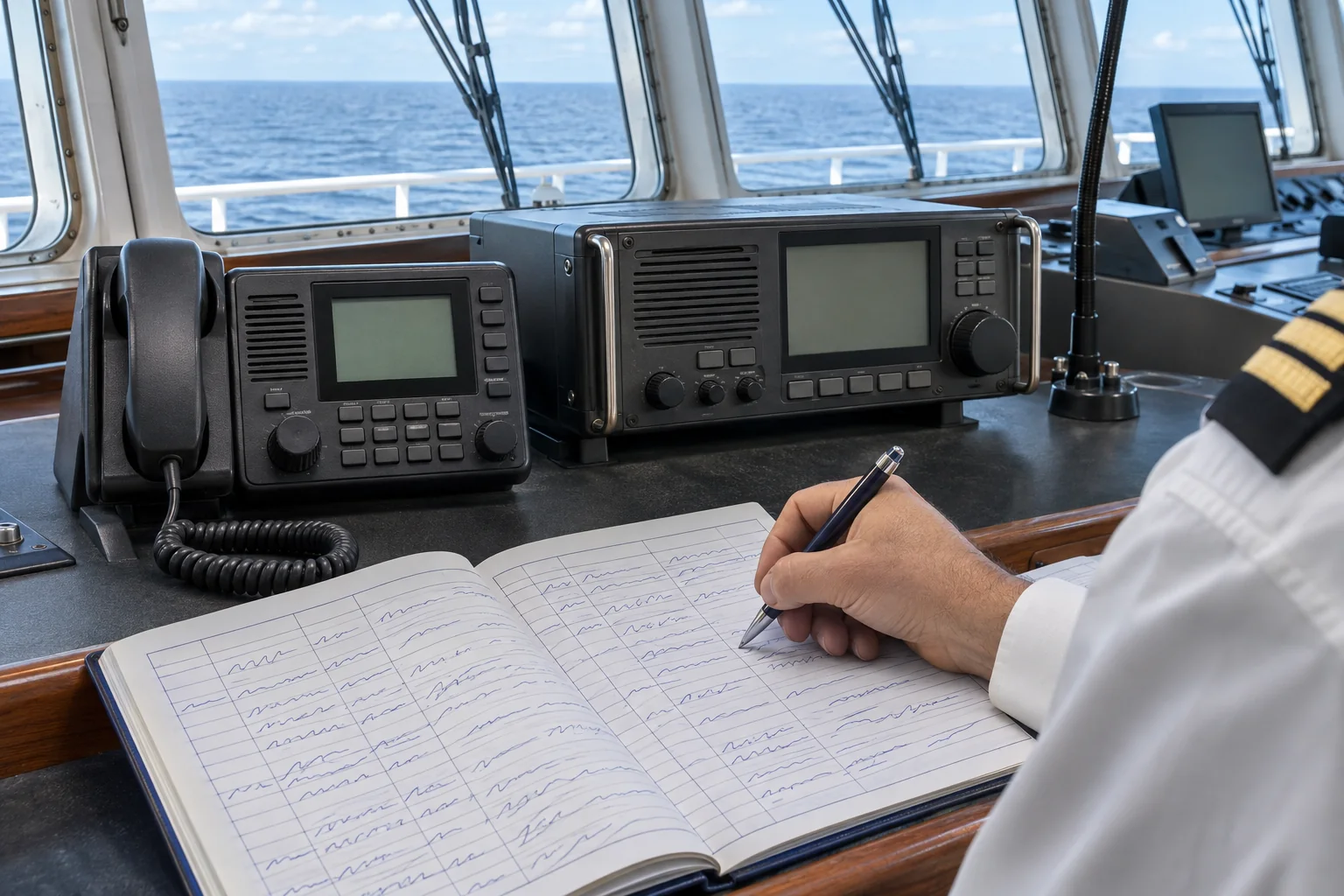
The radio log is required by SOLAS IV/17 and the Radio Regulations: a record of all incidents connected with the radio service that matter for safety of life at sea. The UK log records distress, urgency and safety traffic, regular positions of the ship and the results of tests (MCA Master's Guide). Write entries as they happen, in UTC.
Traffic charges: distress alerts, SAR coordination, medical messages where life is in imminent danger and urgent navigational or weather danger messages sent to the shore are free (47 CFR 80.1119(c)). Other traffic is charged; the Accounting Authority Identification Code (AAIC) tells the coast station who settles the account (CEPT GOC D5).
- Keep the obligatory service publications or their online versions to hand (CEPT GOC D2).
- A log entry: time (UTC), station or frequency, what happened, your initials.
Topic 4 of 4
Practise and go further
The best places to practise this subject. When you finish, one tap brings you back to the course.
- Radio station: Make a routine call with a working channelSimulator
- Module 10: batteriesLesson
- Module 13: radio log and documentationLesson
All lessons by programme item
- C6 Routine communication by DSC, radiotelephony and satellite (C6)
- C1.4 Protecting distress and safety frequencies: tests, interference, unauthorised transmissions (C1 1.4)
- B1.4 Reserve source of energy in service: batteries, charging, maintenance, UPS (B1 1.4)
- D2 Documentation, service publications and radio record keeping (D2)
- D5 Traffic charges and the Accounting Authority Identification Code (D5)
Sources
- UK MCA, A Master's Guide to the UK Flag (February 2015): GMDSS log and radio tests · checked
- IMO resolution MSC.496(105): SOLAS chapter IV in force from 1 January 2024 (Hong Kong Marine Department copy) · checked
- IMO resolution MSC.514(105): guidelines for the avoidance of false distress alerts · checked
- US 47 CFR Part 80 subpart W: GMDSS operating procedures for distress, urgency and safety (the ITU procedures in US law) · checked
- CEPT ERC Decision (99)01: harmonised examination syllabi for the GOC and ROC (amended 8 March 2024) · checked
Checked against SOLAS, IMO, CEPT and ITU-based sources on .