On this page
- What STCW is, in plain words
- 1978, 1995 and the 2010 Manila amendments
- The eight chapters of STCW
- STCW basic safety training: the four elements
- Refreshers and revalidation, as the Code states them
- Certificate of competency or certificate of proficiency?
- The main STCW certificates by rank
- Rest hours and alcohol limits under STCW
- Free STCW basics quiz
- More free practice
- The full guide
- STCW: common questions
- 1978the year STCW was adopted at IMO (in force since 28 April 1984)IMO
- 2010the Manila amendments, in force since 1 January 2012STCW/CONF.2/33
- 4 elementsin basic safety training under section A-VI/1 of the CodeSTCW Code A-VI/1
- 5 yearsthe longest interval between revalidations of an officer's certificateSTCW reg. I/11
The basicsWhat STCW is, in plain words
STCW stands for the International Convention on Standards of Training, Certification and Watchkeeping for Seafarers, 1978. Before it, every country set its own standards. STCW gave the world one floor: minimum standards that each country that joins it (a Party) must meet or go beyond.
It has two layers. The Convention holds the regulations, arranged in eight chapters. The STCW Code fills in the detail: Part A is mandatory and sets the minimum standards of competence in tables, rank by rank; Part B is recommended guidance on how to put the rules into practice. When a course says it follows "table A-VI/1-2", it means a mandatory table in Part A of the Code.
How it changed1978, 1995 and the 2010 Manila amendments
- 1978: the first global standard
Adopted on 7 July 1978, in force on 28 April 1984: the first international set of basic requirements for training, certification and watchkeeping.
- 1995: the Code is born
A major revision, in force on 1 February 1997. The technical annex was split into regulations and a new STCW Code, and Parties began reporting to IMO, which publishes the list of confirmed Parties known as the white list.
- 2010: the Manila amendments
Adopted in Manila on 25 June 2010 and in force on 1 January 2012. Until 1 January 2017, countries could still certify seafarers who had started their training or sea service before 1 July 2013 under the old rules.
- 2026: harassment and bullying
From 1 January 2026, table A-VI/1-4 of basic training also covers preventing and responding to violence and harassment, including sexual harassment, bullying and sexual assault.
What the Manila amendments brought in
- Stronger measures against fraudulent certificates of competency
- Revised hours of work and rest, and rules against drug and alcohol abuse
- Updated medical fitness standards
- New able seafarer certificates, deck and engine
- Training in electronic charts and information systems (ECDIS)
- Leadership, teamwork and marine environment awareness
- Electro-technical officers, and updated rules for tanker crews
- Security training, including preparing for pirate attacks
The mapThe eight chapters of STCW
| Chapter | What it covers | Examples |
|---|---|---|
| I | General provisions | Definitions, certificates, recognition, medical fitness, revalidation |
| II | Master and deck department | Officer of the watch, chief mate, master, deck ratings |
| III | Engine department | Engineer officers, electro-technical officer, engine ratings |
| IV | Radiocommunication and radio operators | GMDSS radio operators |
| V | Special training for certain types of ships | Oil, chemical and gas tankers, passenger ships |
| VI | Emergency, occupational safety, security, medical care and survival | Basic training, survival craft, advanced fire fighting, security |
| VII | Alternative certification | Certificates built from functions instead of departments |
| VIII | Watchkeeping | Rest hours, alcohol limits, keeping a safe watch |
Before your first shipSTCW basic safety training: the four elements
Section A-VI/1 of the Code has two steps. Safety familiarization is for everyone employed or engaged on a seagoing ship except passengers: before any shipboard duties you learn the alarms and safety signs, what to do for man overboard, fire or abandon ship, where your muster station and escape routes are, how to put on a lifejacket and how to close fire and watertight doors.
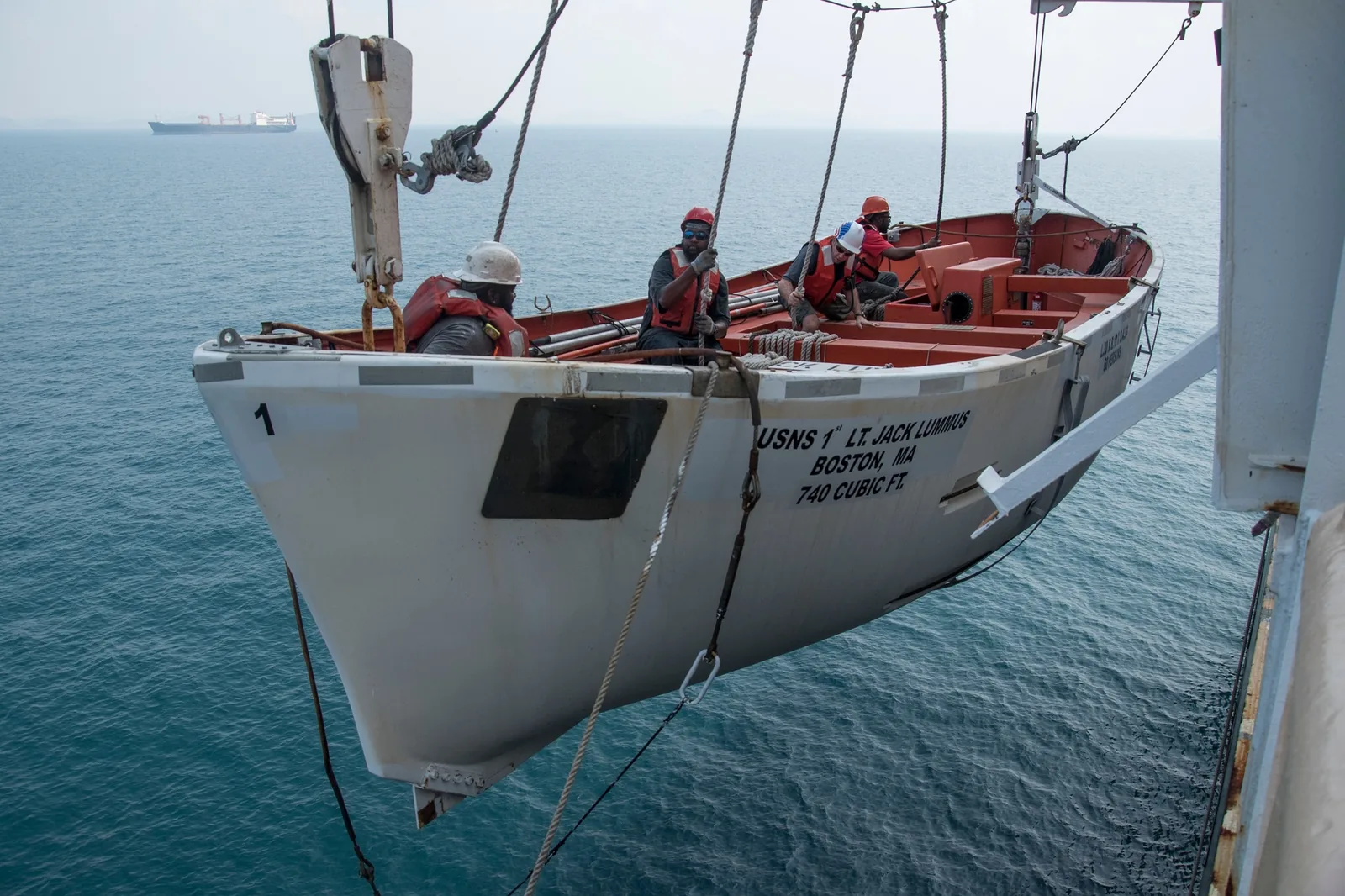
Basic training goes further. Every seafarer with designated safety or pollution-prevention duties must complete it before being assigned to any shipboard duties, and show the required standard through practical demonstration and examination or continuous assessment. It has four elements, each with its own table in the Code.
| Element | Code table | What you learn and show |
|---|---|---|
| Personal survival techniques | A-VI/1-1 | Lifejackets and immersion suits, jumping into the water, righting a liferaft, boarding survival craft, location devices |
| Fire prevention and fire fighting | A-VI/1-2 | The fire triangle, detection and alarms, extinguishers, breathing apparatus, rescue in a smoke-filled space |
| Elementary first aid | A-VI/1-3 | Resuscitation, bleeding, shock, burns and electric shock, moving a casualty, improvised bandages |
| Personal safety and social responsibilities | A-VI/1-4 | Emergency procedures, pollution prevention, safe work and enclosed spaces, teamwork, fatigue, harassment and bullying |
Not part of basic training (separate courses and certificates)
- Security awareness for all seafarers (regulation VI/6)
- Survival craft and rescue boats, and fast rescue boats (regulation VI/2)
- Advanced fire fighting for those who control fire-fighting operations (regulation VI/3)
- Medical first aid and medical care on board (regulation VI/4)
The five-year ruleRefreshers and revalidation, as the Code states them
For basic training, section A-VI/1 paragraph 3 asks you to provide evidence every five years that you have kept the standard in two of the four elements: personal survival techniques and fire prevention and fire fighting. IMO calls this a refresher training module every five years. A country may accept onboard training and experience for some of the skills, such as putting on a lifejacket or using breathing apparatus.
For masters, officers and radio operators, regulation I/11 sets the revalidation: at intervals not exceeding five years you must meet the medical fitness standards and establish continued professional competence. Certificates issued under chapter VI, such as basic training, are not part of this rule; they follow the five-year evidence above.
Two kinds of certificateCertificate of competency or certificate of proficiency?
A certificate of competency (CoC) is issued and endorsed by the Administration for masters, officers and GMDSS radio operators under chapters II, III, IV or VII. It lets you serve in a rank and carry out its functions at the level of responsibility it states. A certificate of proficiency (CoP) is any other STCW certificate showing that training, competence or sea-service requirements are met: basic training, survival craft and rescue boats, advanced fire fighting, security awareness, tanker training and more.
STCW also uses three levels of responsibility. The management level is the master, chief mate, chief engineer and second engineer. The operational level is the officer in charge of a navigational or engineering watch. The support level is the ratings, who work under the direction of the other two.
Find your rankThe main STCW certificates by rank
| Certificate | STCW regulation | Level | Kind |
|---|---|---|---|
| Officer in charge of a navigational watch, 500 GT or more | II/1 | Operational | Competency |
| Officer of the watch in the Philippines (MARINA) | II/1 | Operational | Competency |
| Second Mate (Foreign Going) in India (DG Shipping) | II/1 | Operational | Competency |
| Chief mate and master, 500 GT or more | II/2 | Management | Competency |
| Officer of the watch and master under 500 GT, near-coastal | II/3 | Operational | Competency |
| Rating forming part of a navigational watch | II/4 | Support | Proficiency |
| Able seafarer deck | II/5 | Support | Proficiency |
| Officer in charge of an engineering watch, 750 kW or more | III/1 | Operational | Competency |
| Chief and second engineer officer, 3,000 kW or more | III/2 | Management | Competency |
| Electro-technical officer | III/6 | Operational | Competency |
| GMDSS radio operator | IV/2 | Operational | Competency |
| Basic training, for all seafarers with safety duties | VI/1 | Every rank | Proficiency |
What regulation II/1 asks of an officer of the watch
- At least 18 years old
- 12 months of approved sea service in an approved programme with a training record book, or otherwise 36 months
- At least six months of bridge watchkeeping under supervision
- The radio requirements of chapter IV, and the standard of competence in section A-II/1
- Basic training, survival craft and rescue boats, advanced fire fighting and medical first aid
On watchRest hours and alcohol limits under STCW
- 10 hoursminimum rest in any 24-hour periodSTCW Code A-VIII/1
- 77 hoursminimum rest in any 7-day periodSTCW Code A-VIII/1
- 14 hourslongest interval between two rest periodsSTCW Code A-VIII/1
- 0.05%blood alcohol limit on duty (or 0.25 mg/l in the breath)STCW Code A-VIII/1
These limits apply to every officer in charge of a watch, every rating forming part of a watch and everyone with designated safety, pollution-prevention or security duties. The daily rest may be split into no more than two periods, one of them at least 6 hours long, and your rest hours are recorded in a standard format in the ship's working language and in English, with a copy for you. In an emergency the master may suspend the schedule, and must then give you adequate rest.
Test yourselfFree STCW basics quiz
Our free STCW quiz has 40 questions on the Convention and Code, basic safety training, certificates and revalidation, and rest hours. Every answer is explained and names the regulation it comes from. The questions are our own, written from the IMO texts: they are practice, not an official exam, and the practical parts of STCW training are always assessed in person.
In short
STCW decides
- The minimum competence for every rank, in the Code's tables
- Basic training before your first shipboard duties
- Revalidation at intervals not exceeding five years
- Rest hours and the alcohol limit on watch
Your country decides
- Who issues your certificate and what it costs
- Which schools and courses are approved
- How the five-year evidence is given and recorded
Learn the standard here, then follow your flag State's maritime administration for the certificate itself.
Related study on this site
More free practice
IALACOLREG Exam Pass
STCW: get ready for your exam with the Exam Pass
Unlimited timed mock exams, every mistake back until it's right, and a readiness score that shows when you're ready for the exam.
512 exam-style questions with explanations · 7 timed subject exams · every simulator scenario
One payment for 12 months, so it covers a resit too. No subscription.
Practice questions (with answers)
Compliance with the COLREGs:
Show answer
Correct answer: B. Does not exonerate a vessel from the consequences of neglecting good seamanship
Rule 2(a) states nothing in the rules exonerates any vessel from the consequences of neglecting good seamanship.
A 'vessel not under command' (NUC) is one that:
Show answer
Correct answer: C. Through exceptional circumstances cannot manoeuvre as required and therefore cannot keep out of another vessel's way
Rule 3(f) requires both inability to manoeuvre as required because of exceptional circumstances and consequent inability to keep out of another vessel's way.
A proper look-out requires the use of:
Show answer
Correct answer: C. Sight, hearing and all available means appropriate to the conditions
Rule 5 requires look-out by sight AND hearing as well as by all available means appropriate to the circumstances.
Which factor is NOT listed in Rule 6 for determining safe speed?
Show answer
Correct answer: C. Vessel's commercial schedule
Rule 6 lists visibility, traffic density, manoeuvrability, etc. Commercial schedule is never a factor in safe speed determination.
If there is any doubt about whether risk of collision exists:
Show answer
Correct answer: C. The risk shall be deemed to exist
Rule 7(a): if there is any doubt, such risk shall be deemed to exist.
If circumstances admit, course alterations to avoid collision shall be:
Show answer
Correct answer: B. Large enough to be readily apparent to the other vessel
Rule 8(b) requires alterations large enough to be readily apparent to another vessel observing visually or by radar, if circumstances admit.
A vessel less than 20m in a narrow channel:
Show answer
Correct answer: B. Shall not impede vessels that can only navigate within the channel
Rule 9(b): vessels under 20m shall not impede vessels which can safely navigate only within the channel.
A vessel may properly use an inshore traffic zone when:
Show answer
Correct answer: B. It is bound to or from a port, offshore installation, or station within the zone
Rule 10 allows inshore-zone use in specific cases, including vessels bound to or from a port, offshore installation or station within the zone, and for certain small craft, sailing vessels, fishing vessels or immediate danger.
The full guide
STCW is the IMO convention that sets minimum standards for how seafarers are trained, certified and keep watch. Here it is in plain words: how it is built, what basic safety training covers, which certificate goes with which rank, and what the five-year rule means.
STCW (the International Convention on Standards of Training, Certification and Watchkeeping for Seafarers, 1978) has two layers: the Convention's regulations, in eight chapters, and the STCW Code, whose Part A is mandatory and Part B is guidance. It was revised in 1995 and, in Manila, in 2010.
Who STCW applies to
Seafarers serving on seagoing ships of the countries that are Parties to the Convention: masters, officers, ratings and radio operators, and, for safety familiarization, everyone employed or engaged on board other than passengers. Your flag State's maritime administration applies it through its own rules.
How to use this page
Read the plain-words guide, find your certificate in the table by rank, then take the free 40-question STCW basics quiz. For the certificate itself, follow your flag State's maritime administration and an approved training provider: they set the courses, assessments and fees.
STCW: common questions
- What does STCW stand for?
- The International Convention on Standards of Training, Certification and Watchkeeping for Seafarers, 1978. It was adopted at IMO on 7 July 1978 and entered into force on 28 April 1984.
- What is STCW basic safety training?
- The basic training every seafarer with designated safety or pollution-prevention duties completes before any shipboard duties, under section A-VI/1 of the STCW Code. It has four elements: personal survival techniques, fire prevention and fire fighting, elementary first aid, and personal safety and social responsibilities.
- Does STCW basic training expire after five years?
- Section A-VI/1 asks seafarers qualified in basic training to provide evidence every five years that they have kept the standard in personal survival techniques and in fire prevention and fire fighting. How you give that evidence (a refresher course, onboard training or both) and how your certificate is dated are set by your flag State.
- What is the difference between a certificate of competency and a certificate of proficiency?
- A certificate of competency is issued by the Administration to masters, officers and GMDSS radio operators under chapters II, III, IV or VII. A certificate of proficiency shows that other STCW training or sea-service requirements are met, for example basic training or survival craft and rescue boats.
- How much does an STCW course or refresher cost?
- It depends on the country and the training provider, and STCW does not set prices. Ask approved providers in your country and check that your flag State recognises the course.
- Is the quiz on this page an official STCW exam?
- No. There is no single international STCW exam. Our 40 questions are our own practice questions written from IMO texts; your administration and training provider run the real examinations and practical assessments.
Other exams
Reviewed by Ramon Curto, Nautical teacher at IECNPC · Last reviewed: