
Seamanship basics: ropes, knots and the boat · Level R3 · 5 parts · about 13 min
Rope materials, strength and care; basic splices
5 short parts: Fibres · Construction · Strength · Care, inspection · Splices. Each part explains the idea, then gives the points to remember, the common mistakes, a worked case and a practice question; the Academy unit adds all 30 check questions.
1 · Fibres
Rope fibres: nylon, polyester, polypropylene and HMPE
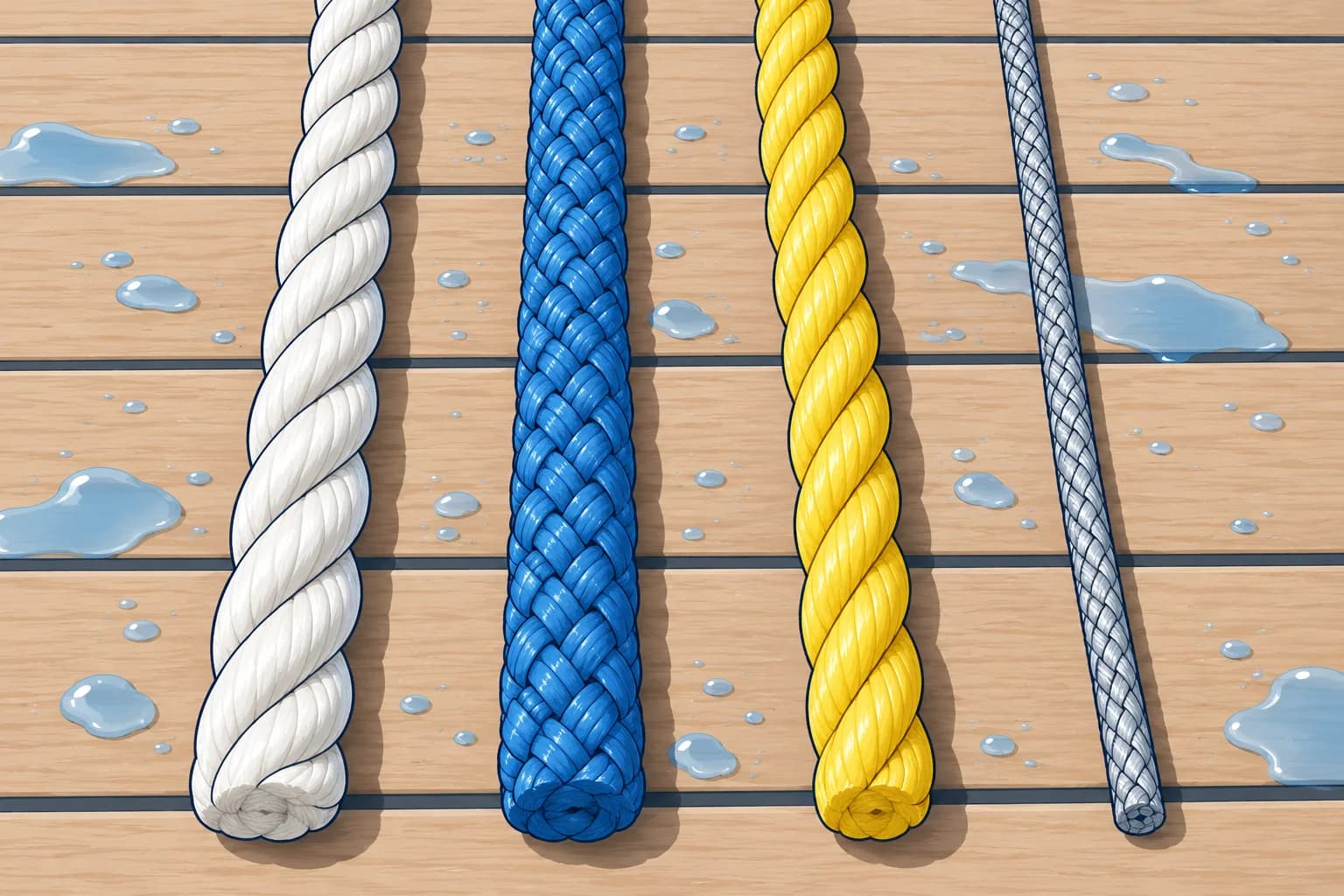
The fibre decides how a rope stretches, floats and ages. Choose stretch to cushion sudden loads, and low stretch to control sails.
Nylon
Nylon (polyamide) is strong and stretches considerably under load. That stretch absorbs shock, so nylon suits rope anchor rodes (lines connecting boat and anchor), mooring lines and tow lines. It loses some strength when wet and is harmed by long sun exposure. It sinks.
Polyester
Polyester is nearly as strong as nylon but stretches less, keeps its strength wet and resists sunlight well. It is the general-purpose yacht rope: sheets (sail-control lines), halyards (sail-hoisting lines) on cruising boats, control lines and also mooring lines. It sinks.
Polypropylene
Polypropylene is light, cheap and floats, so it is used for rescue lines, dinghy painters and pick-up lines. It is weaker, melts at a low temperature and breaks down quickly in sunlight. Never trust an old, faded polypropylene line with a load.
HMPE
HMPE (high-modulus polyethylene, sold as Dyneema or Spectra) is very strong for its weight and hardly stretches. It suits halyards and other sail-control lines where low stretch matters. Limits: it creeps (slowly lengthens under steady load), melts at a low temperature from friction and is slippery, so many knots hold it badly. It floats.
Others
Aramid fibres, such as Kevlar and Technora, have very low stretch but need protection from sunlight and repeated tight bending. LCP (liquid-crystal polymer) fibres, such as Vectran, have low stretch and little creep. PBO (polyphenylene benzobisoxazole), sold as Zylon, is strong but especially vulnerable to sunlight and moisture. These specialist fibres are expensive. Natural fibres, such as manila and hemp, can rot when stored wet.
Key figures
- Nylon
- High stretch: anchor, mooring, towing; sinks
- Polyester
- Low stretch, UV-resistant: sheets, halyards, general
- Polypropylene
- Floats; weak, poor in sunlight: rescue lines
- HMPE (Dyneema)
- Very strong, very low stretch; creeps, slippery
Remember
- Nylon stretches most: use it where shock loads must be absorbed.
- Polyester is the all-round yacht rope: low stretch, good in sunlight.
- Polypropylene floats but is weak and decays in sunlight.
- HMPE is very strong and barely stretches; creep and friction heat limit its use.
Common mistakes
Wrong: Use low-stretch HMPE for an anchor snubber.
Right: A snubber is a short stretchy line that cushions sudden loads on the anchor chain. Use nylon.
Wrong: Polypropylene is fine for mooring because it floats.
Right: Floating alone does not make a mooring line suitable. Check its rated strength, stretch, resistance to chafe (wear from rubbing) and protection from UV (sunlight).
Worked case
You are buying new lines for a 10 m cruising yacht: two mooring lines, an anchor snubber, a mainsheet and a line for the rescue throw bag. Which fibre for each?
Show the answer
Mooring lines: nylon for stretch in surge, or polyester for less stretch in a quiet marina. Snubber: nylon, for its stretch. Mainsheet: polyester, for low stretch and good handling. Throw bag: polypropylene, because it floats and stays on the surface where the casualty can reach it.
Practice question
Which fibre is best for an anchor snubber?
- HMPE, for its very low stretch
- Nylon, for its high stretch
- Polypropylene, for floating
- Aramid, for its strength
Show the answer
Answer: B. The snubber stretches to cushion sudden pulls on the anchor chain.
2 · Construction
How a rope is made: laid and braided
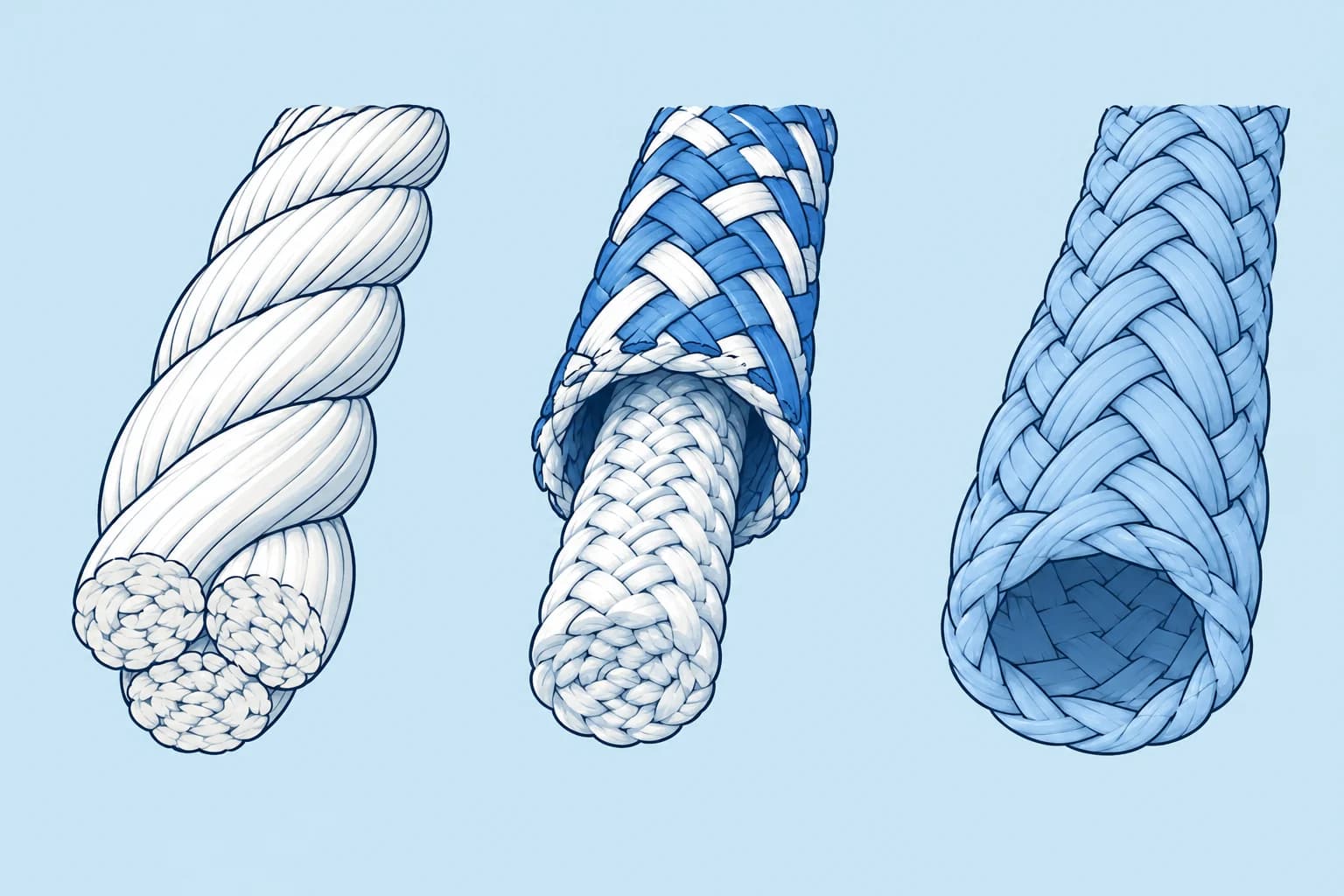
Choose a rope construction that suits the job and the fittings that grip it.
Three-strand
Three-strand laid rope has three strands twisted together. Most is right-hand laid: the strands spiral like a right-hand screw. It is cheap, stretchy, resists chafe (wear from rubbing) and is easy to splice by hand, so it is common for anchor and mooring lines. It can untwist under load.
Double braid
Braid-on-braid, or double braid, has a braided core inside a braided cover. In polyester double braid, both carry substantial load. With an HMPE core and protective polyester cover, the core usually carries most; the cover protects it and gives grip. Check the maker’s design. If the cover wears through, unload the rope and assess it: an intact-looking core does not prove it is safe.
Single braid
Single braid, often 12-strand, is one braided layer with no cover. In HMPE it is very strong, light and easy to splice, used for halyards and strops (short rope loops for attaching gear). Without a cover, wear reaches the load-bearing strands directly, and grip in rope clutches (fittings that clamp a line) may be poor.
Size
Ropes are sized by diameter in millimetres. Choose the size by load first, then for handling: a thin rope may be strong enough but hurt hands or slip in a rope clutch or winch (a drum that helps you haul a line) made for a bigger one.
Key figures
- Three-strand
- Cheap, stretchy, chafe-resistant, easy to splice
- Braid-on-braid
- Core and cover share load according to the rope design
- 12-strand single braid
- Light, strong in HMPE, easy splicing; no cover
Remember
- Three-strand: cheap, stretchy, easy to splice; good for anchor and mooring.
- Double braid: polyester core and cover both carry load; an HMPE core usually carries most.
- 12-strand HMPE: light, strong, easy to splice, but slippery and uncovered.
- Size for load, then check it fits clutches, winches and hands.
Common mistakes
Wrong: Only the core carries load in every double-braid rope.
Right: Polyester core and cover both carry load. An HMPE core usually carries most; check the maker’s design.
Wrong: Thinner is always better if it is strong enough.
Right: A rope too thin for the clutch or winch slips, and is hard to hold.
Worked case
You replace a 12 mm polyester halyard with equally strong 8 mm uncovered HMPE. Your rope clutch accepts 10–14 mm rope. The new line slips and is uncomfortable to hold. Why?
Show the answer
Strength alone is not enough. The 8 mm line is outside the clutch’s diameter range. Uncovered HMPE can also be slippery and uncomfortable to hold. Choose a suitable covered rope with enough strength and a diameter approved for your fittings.
Practice question
In an HMPE-core rope with a protective polyester cover, which part carries most of the load?
- The polyester cover
- The inner HMPE core
- Both in equal shares
- The end whipping
Show the answer
Answer: B. This design relies mainly on its HMPE core. In polyester double braid, both core and cover carry substantial load.
3 · Strength
Breaking load, working load and what weakens a rope
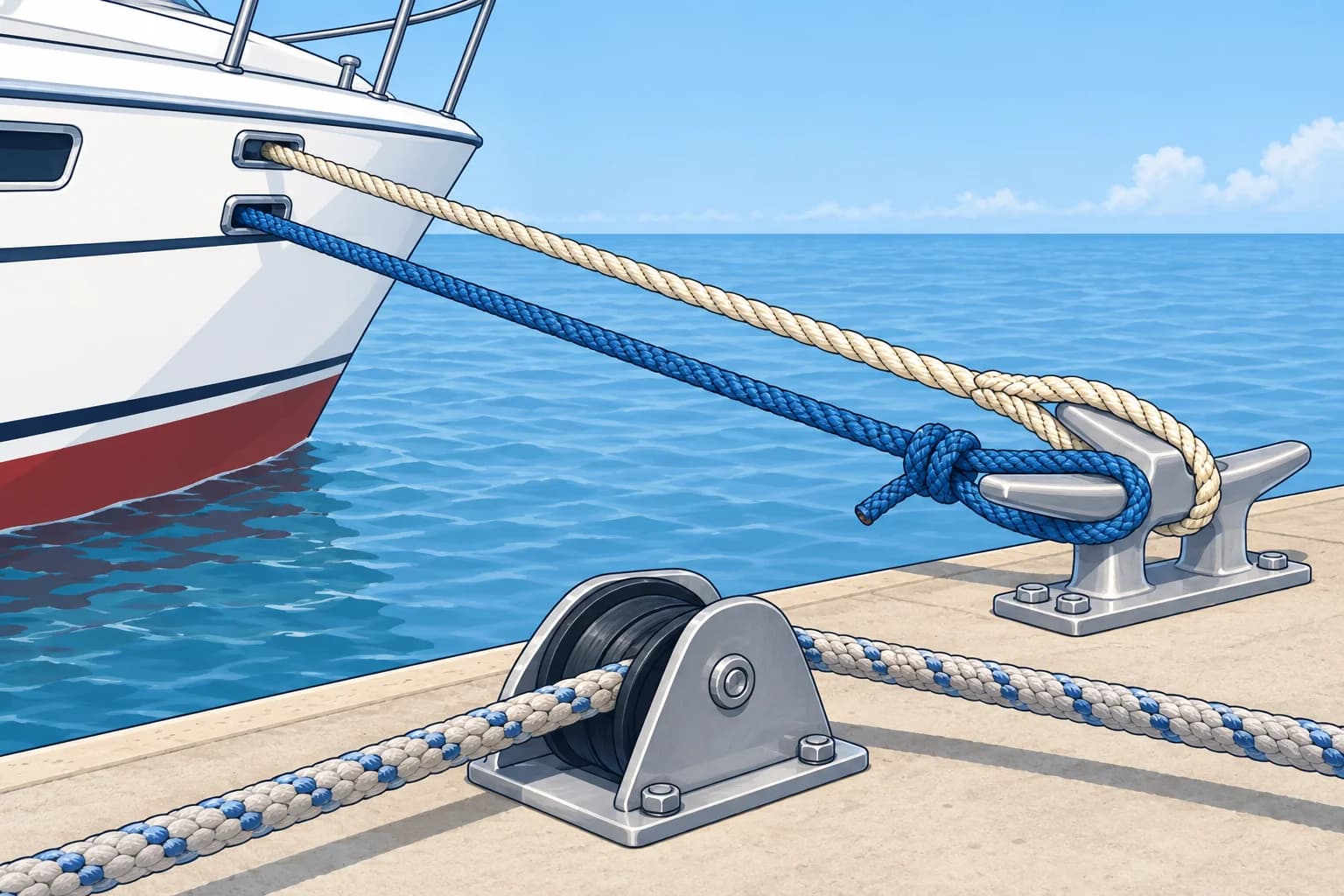
A breaking-load rating describes new rope under stated test conditions. Knots, bends and wear can reduce it. Work below it as the maker specifies.
Breaking load
The minimum breaking load (MBL) is the maker’s specified minimum breaking force for new rope under stated test conditions. Some ratings include spliced eyes. It is a test figure, not a safe load. Check what the rating includes: do not deduct splice loss again if it already includes that splice. Different makers test differently, so compare figures with care.
Working load
For a calculation, divide the relevant breaking strength by the specified safety factor to find the working-load allowance. In use, follow the maker’s working-load guidance for the rope, termination and job. A factor of 5 is an example, not a universal permission to load a rope.
Knots and splices
A knot bends rope sharply and reduces its breaking strength. The loss depends on the fibre, construction and knot. A correctly made splice usually retains more strength, but its efficiency also varies. Use rope-specific test data and the maker’s instructions.
Bends
A rope bent round a small radius is weakened on the outside of the bend. Lead loaded lines round sheaves (pulleys) and fairleads (rope guides) that are several times the rope's diameter, as the maker advises, and avoid sharp edges.
Ageing
Sunlight (UV), chafe (wear from rubbing), heat from friction, salt crystals and repeated loading all reduce strength. A five-year-old line that has lived in the sun may be far weaker than its label. Shock loads, such as a snatching anchor, can be many times the steady load.
Key figures
- MBL
- Specified minimum breaking force for new rope under stated tests
- Working load
- Relevant breaking strength ÷ specified safety factor; follow maker
- Bowline
- Reduces strength; loss depends on fibre, construction and knot
- Good splice
- Retention depends on rope and splice; check maker’s data
Remember
- MBL is a test figure for new rope, not a safe load.
- Working-load calculation: relevant breaking strength ÷ specified safety factor; follow the maker in use.
- Knots weaken rope; correctly made splices generally retain more strength.
- Sun, chafe, heat and tight bends reduce strength. Shock loads can exceed the working-load allowance and damage rope.
Common mistakes
Wrong: The rope’s breaking-load rating tells me its safe working load.
Right: That is a new-rope test figure, not a working load. Follow the maker’s guidance for the job.
Wrong: A knot is as strong as the rope.
Right: Knots reduce strength by a variable amount. A correctly made splice usually retains more; check the maker’s data.
Worked case
A new, unspliced rope has an MBL of 30 kN (kilonewtons). Assume a bowline retains two-thirds and an eye splice 90%, with a safety factor of 5. A friend says either meets a 4.5 kN steady working load. Do you agree?
Show the answer
No. Bowline: 30 × 2/3 ÷ 5 = 4 kN. Splice: 30 × 0.90 ÷ 5 = 5.4 kN. Only the splice meets 4.5 kN under these assumptions. For real use, follow the maker’s guidance for the rope, termination and job. Do not deduct splice loss again if the published rating already includes it.
Practice question
What does a rope's minimum breaking load (MBL) tell you?
- The load it can safely hold all day long
- Its specified minimum breaking force
- The load at which a knot starts to slip
- The weight of the rope per 100 metres
Show the answer
Answer: B. MBL describes new rope under stated test conditions. It is not a safe working load.
4 · Care, inspection
Rope care, inspection and snap-back
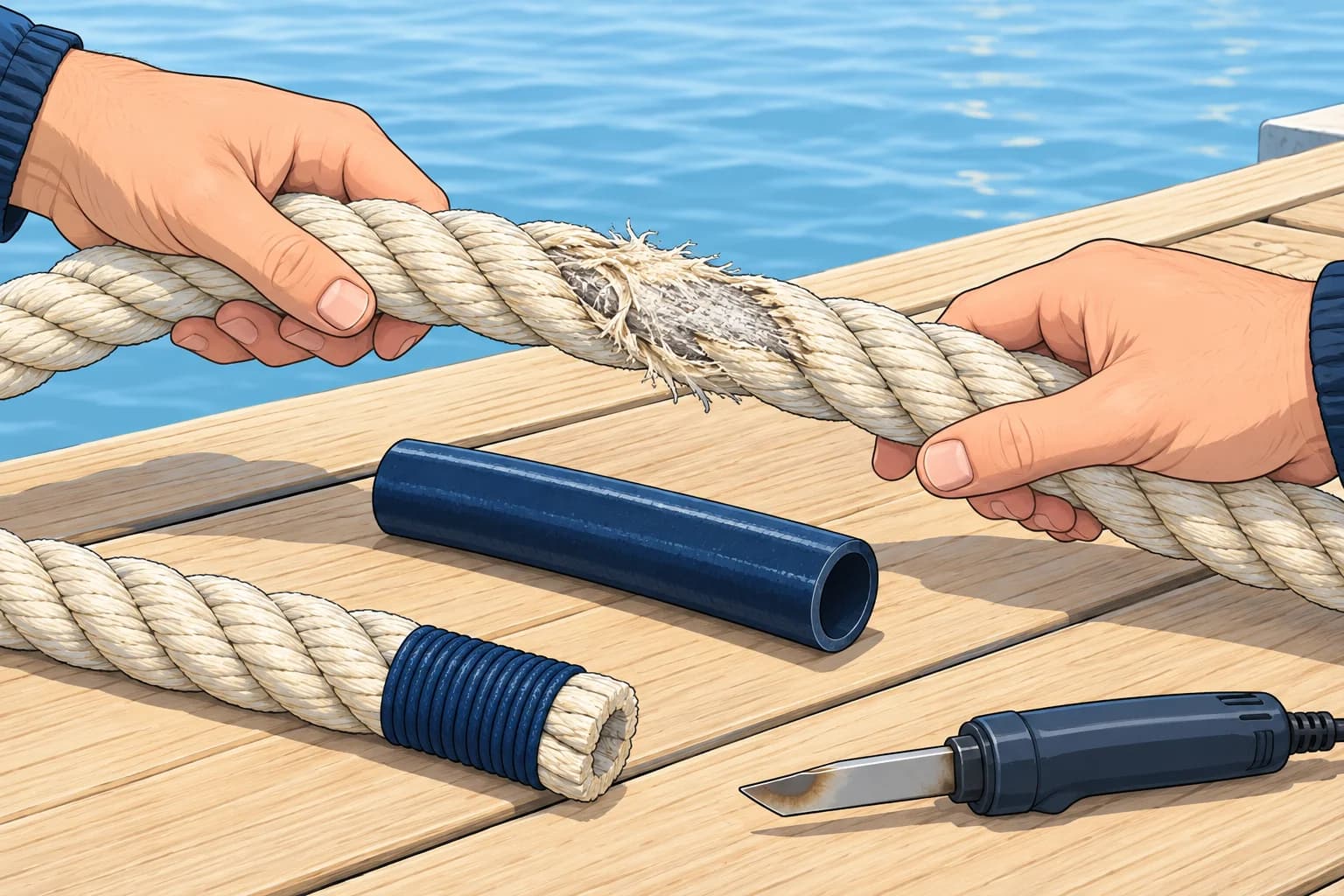
Protect ropes from chafe and sun, finish their ends, inspect them often and replace them in time. Keep clear of loaded ropes and possible recoil paths.
Chafe
Chafe is wear from rubbing, and it destroys more rope than anything else. Use chafe guards (sleeves of hose or tough fabric) where mooring lines pass through fairleads, move a halyard's wear point by shortening or lengthening it a little, and remove sharp edges.
Cleaning and storage
Rinse salt and grit out with fresh water now and then, let lines dry, and store them coiled out of the sun. Salt crystals and sand cut fibres from the inside. Do not use strong chemicals.
Finishing the ends
A cut rope frays. A whipping is thin twine bound near the end. Heat-seal nylon, polyester or polypropylene only where the maker permits, then whip. Aramid does not melt-seal. Follow the maker for mixed-fibre and other specialist ropes. Tape is temporary. A back splice finishes three-strand rope.
Inspection
Look and feel along the whole rope. Warning signs: fuzz and broken fibres, hard or glazed shiny spots from friction heat, stiff or crunchy areas, thin or flattened places, a cover sliding on its core, and faded, powdery colour from sunlight. Remove doubtful rope from load-bearing service. Shorten or re-end only when damage is local and the remaining rope is sound.
Snap-back
At the same tension, greater stretch generally means more stored elastic energy. If a loaded rope breaks, slips or a fitting fails, rope and fittings can recoil violently. Fittings can redirect recoil beyond the original line. Keep clear of loaded ropes and fittings, never enter a bight (a loop), and avoid the inside of turns. Low-stretch rope is dangerous too. A bollard or coaming (a raised rim around a cockpit or opening) does not guarantee shelter.
Inspecting a rope
- Secure the boat with sound lines, unload this rope, then wash and lay it out in good light. — Damage hides under grime.
- Run the whole length through your hands, slowly. — Hard, soft or thin spots are often easier to feel than see.
- Look closely at wear points: fairleads, clutches, sheaves, cleats and eyes. — Damage concentrates where the rope bends or rubs.
- Check for glazing, broken fibres, fading and a loose cover. — These can indicate heat damage, chafe, UV exposure or cover movement. Assess the core as the maker directs.
- Check splices and whippings are tight and complete. — A loose splice can pull out under load.
- Retire doubtful rope; shorten or re-end only a sound remainder after local damage, as the maker permits. — Unknown damage is unsafe even for lighter loads. Note the date to track wear.
Remember
- Chafe is the main killer: guard fairleads, move wear points, remove sharp edges.
- Rinse with fresh water, dry, store out of the sun.
- Whip ends; heat-seal suitable fibres as the maker permits.
- Snap-back can extend beyond the original line. Keep clear of loaded ropes, fittings and bights.
Common mistakes
Wrong: Glazed, shiny patches show the rope is well worn in.
Right: Glazing is heat damage from friction. The fibres there are weakened.
Wrong: Stand behind the bollard to watch the mooring line closely.
Right: Fittings can redirect recoil beyond the rope’s original line. A bollard does not guarantee shelter; keep clear.
Worked case
Checking your mooring lines after a stormy night in harbour, you find one line hard and shiny where it ran through the bow fairlead, with broken fibres around it.
Show the answer
First secure the boat with a sound replacement line and unload the damaged one. Remove it from load-bearing service. Cut out local damage only if the maker permits, the rest is sound and enough length remains for a proper termination. Otherwise replace it. Check the fairlead for sharp edges. Protect the replacement at the fairlead.
Practice question
What is the most common cause of rope damage on a boat?
- Rinsing it in fresh water
- Chafe from rubbing
- Coiling it clockwise
- Storing it below deck
Show the answer
Answer: B. Rubbing on fairleads, edges and sheaves wears through fibres.
5 · Splices
Basic splices: eye splice, back splice and braid splices
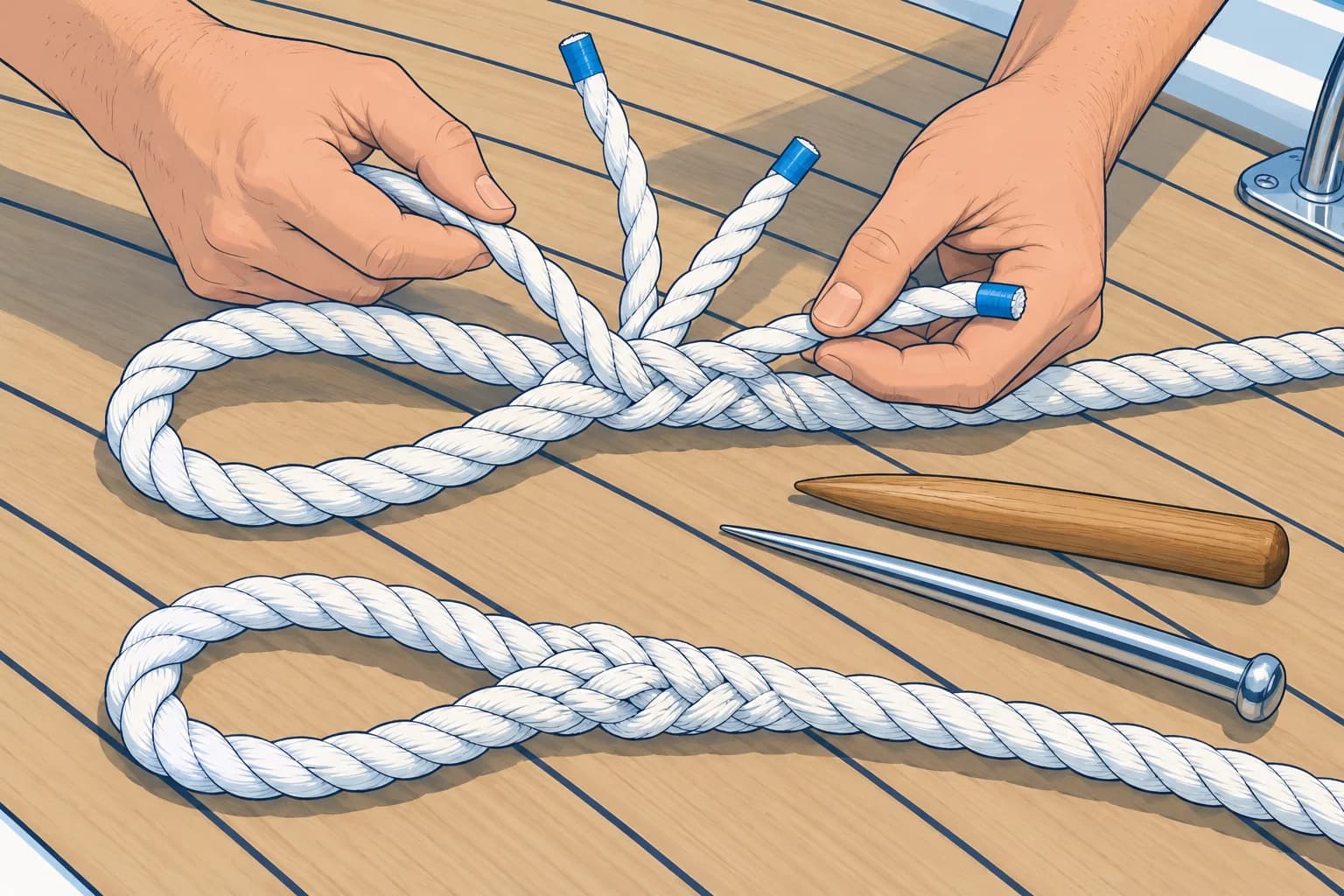
An eye splice in three-strand rope is a skill every skipper can learn. Braided ropes need a fid and the maker's own instructions.
Why splice
A splice joins or finishes rope by interweaving or burying its strands. A correctly made splice usually retains more strength than a knot. Its security depends on following the method for that rope. The eye splice makes a permanent loop; the back splice finishes an end; the short splice joins two ropes but makes them thicker.
Three-strand eye splice
Unlay (untwist) the strands for the maker’s specified length, whip or tape each end, and form the eye. Tuck each strand into the standing part (the intact rope beyond the unlaid end) against the lay: over one strand, under the next, so the tucks cross the rope's twist. Do all three strands in turn, then continue tucking.
How many tucks
Synthetic rope is slippery, so use at least five full tucks per strand for nylon and polyester, or more if the maker requires. Complete these with the full strands before any extra tapering tucks specified by the maker. Follow the maker’s dimensions for tapering (gradually reducing strand thickness) and tails (loose ends).
Back splice
For a back splice, first make a crown knot with the three strands at the end, then tuck them back down the rope as for an eye splice. The end becomes thicker and resists fraying. It may jam in blocks or fairleads, so check clearance; do not rely on it as a stopper.
Braided ropes
Braids are spliced by burying the rope inside itself, using a hollow fid (a splicing needle). Single-braid HMPE and braid-on-braid need different splice methods. Follow the rope maker's instructions exactly: a short or wrong splice in HMPE can slip out.
Eye splice in three-strand rope
- Mark the maker’s unlay length. Bind the rope at that mark to stop further untwisting, then unlay the end up to the binding. — Leaves enough strand for the required full tucks and finishing.
- Tape each strand end; form the eye the size you want. — Sealed ends are easier to tuck without unravelling.
- Identify the tails and standing strands using the maker’s first-round diagram. Make the first tuck as shown, against the lay. — Crossing the rope’s twist locks the first tuck.
- Complete the other two first-round tucks as shown. Each standing strand must be captured once; tails should not cross at the throat, where the eye rejoins the rope. — Completes the first full round evenly.
- Keep tucking over one, under one. Make at least five full tucks with each complete strand; add more if the maker requires. — Synthetic rope needs extra tucks to stop it pulling out.
- Pull each tuck snug and even; finish the taper and tails to the maker’s dimensions. — Even tension and the specified finish help keep the splice secure.
Remember
- A correctly made splice usually retains more strength than a knot.
- Tuck against the lay: over one, under one.
- At least five full tucks per complete strand in nylon or polyester; more if specified, before tapering.
- Braids need a fid and the maker's instructions.
Common mistakes
Wrong: Three tucks are enough in polyester.
Right: Use at least five full tucks per complete strand, or more if the maker specifies, before any tapering.
Wrong: Splice HMPE any way that looks right.
Right: Follow the maker's method and bury length. Short HMPE splices can slip out.
Worked case
A friend has made an eye in your three-strand polyester mooring line with three tucks per strand. It looks neat and holds when pulled by hand. Would you use it?
Show the answer
No. A hand pull does not prove a splice is secure. Remake it to the maker’s method and preparation length, with at least five full tucks per complete strand, or more if specified. Check the first round and finish the taper and tails to the maker’s dimensions before loading it.
Practice question
How do you tuck the strands in a three-strand eye splice?
- With the lay, under two strands
- Against the lay, over one, under one
- Round the rope in a single spiral
- Through the centre without crossing
Show the answer
Answer: B. Tucking across the twist locks the strands into the rope.