
Seamanship basics: ropes, knots and the boat · Level P1 · 5 parts · about 21 min
Ship mooring and anchoring stations: mooring and tug lines, safe working loads, the windlass and buoy mooring (STCW A-II/5)
5 short parts: Mooring lines · Mooring winches · Lines and loads · Tugs and buoys · Anchor station. Each part explains the idea, then gives the points to remember, the common mistakes, a worked case and a practice question; the Academy unit adds all 35 check questions.
1 · Mooring lines
The mooring arrangement: what each line does
Head and stern lines, breasts and springs each hold the ship in one direction. Know their jobs, the ship's plan and your place at the station.
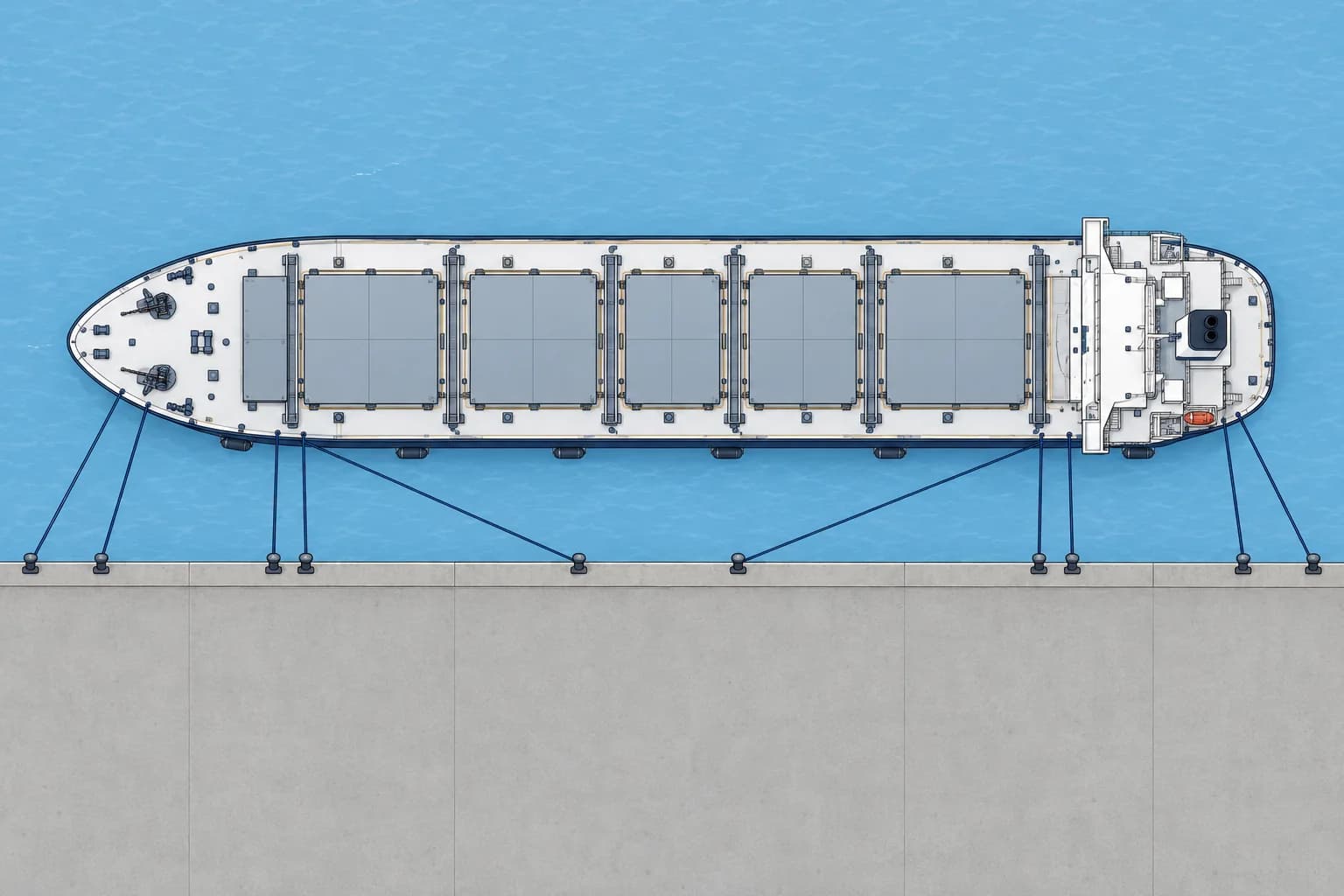
Lines and their jobs
You lead mooring lines through fairleads (deck guides) to shore bollards (strong posts). Head lines lead forward from the bow and resist movement astern. Stern lines lead aft from the stern and resist movement ahead. Breast lines run nearly at right angles to the ship and resist movement away from the berth: athwartships means sideways. Springs run nearly parallel to the ship and resist movement ahead or astern: longitudinal means along the ship.
Springs by name
A forward spring (head spring) leads aft from the forward part of the ship. An aft spring (back spring) leads forward from the after part. Lines in the same service should match in material and diameter to share load. A short line stretches less under the same load and can take more than its share as the ship moves. Report an unusually short lead; the officer decides a suitable longer lead from the plan.
The plan and the fittings
Every ship has a towing and mooring arrangements plan (IMO MSC.1/Circ.1175/Rev.1). It shows the fairleads, bollards and bitts (paired deck posts), their safe working load (SWL), the lines carried and how they are meant to be led. The SWL is also marked on each fitting. Use the leads shown on the plan, avoid sharp or multiple angles, and never put a rope and a wire through the same lead or on the same bollard.
The mooring party
Each station, forward and aft, has a responsible person in charge, usually an officer, who can see all the lines and the team and talks to the bridge by radio, naming the ship. The winch operator works the controls with a direct view of the line. Line handlers wear personal protective equipment (PPE): helmet, safety shoes and gloves. You are briefed on the berthing plan. Anyone not in the mooring party keeps off the mooring deck.
Before arrival
Prepare the station early. Test the winches and their emergency stops. Run ropes off their storage reels and flake them in loose, clear lengths on deck (never use them straight off the reel). Lay out heaving lines (light throwing lines), stoppers (short lines that hold a load temporarily) and messengers (light lines used to haul heavier ones). Clean up oil and clutter. Where a parting line can fly, and where to stand, is covered in Ropes: deck work safely.
Key figures
- Breast lines
- Most of the athwartships restraint: hold her on the berth
- Springs
- Most of the longitudinal restraint: stop her surging
- Same service
- Same material and diameter, so the lines share the load
- Fitting limit
- SWL marked on each fitting and in the towing and mooring plan
Remember
- Head and stern lines lead off the ends; breasts hold her in; springs stop her surging fore and aft.
- Lines in the same service should match in material and diameter so they share the load.
- Use the leads on the towing and mooring arrangements plan and respect each fitting's marked SWL.
- One responsible person per station sees all lines and talks to the bridge; others stay off the deck.
Common mistakes
Wrong: Springs mainly hold the ship against the berth.
Right: Breast lines give most of the sideways restraint. Springs mainly stop the ship moving ahead or astern.
Wrong: Make each line as short as possible: shorter is stronger.
Right: Report it; use a suitable longer lead only as directed by the officer.
Wrong: Take a rope straight off its storage reel to save time.
Right: Run it off and flake it on deck first, so it runs free and there is enough slack for anything that happens.
Worked case
Your ship is berthing port side to, with an offshore wind and a current from ahead. The officer asks which lines will do most to stop her being blown off the berth, and which will stop the current setting her astern.
Show the answer
Breast lines give most of the restraint against being blown off the berth, so they matter most in the offshore wind. The current from ahead tries to set her astern, so lines leading forward hold her: the aft (back) spring and the head lines. Lines in each group should be of the same type and size so they share the load.
Practice question
Which lines give most of the restraint that holds a ship against the berth?
- Head lines
- Stern lines
- Forward springs
- Breast lines
Show the answer
Answer: D. Breast lines run roughly at right angles to the ship, so they resist sideways movement best.
2 · Mooring winches
Mooring winches: drums, brakes and the line on the brake
A moored line is held on the winch brake, not the gear. Apply the tested setting, report any payout and stay clear.
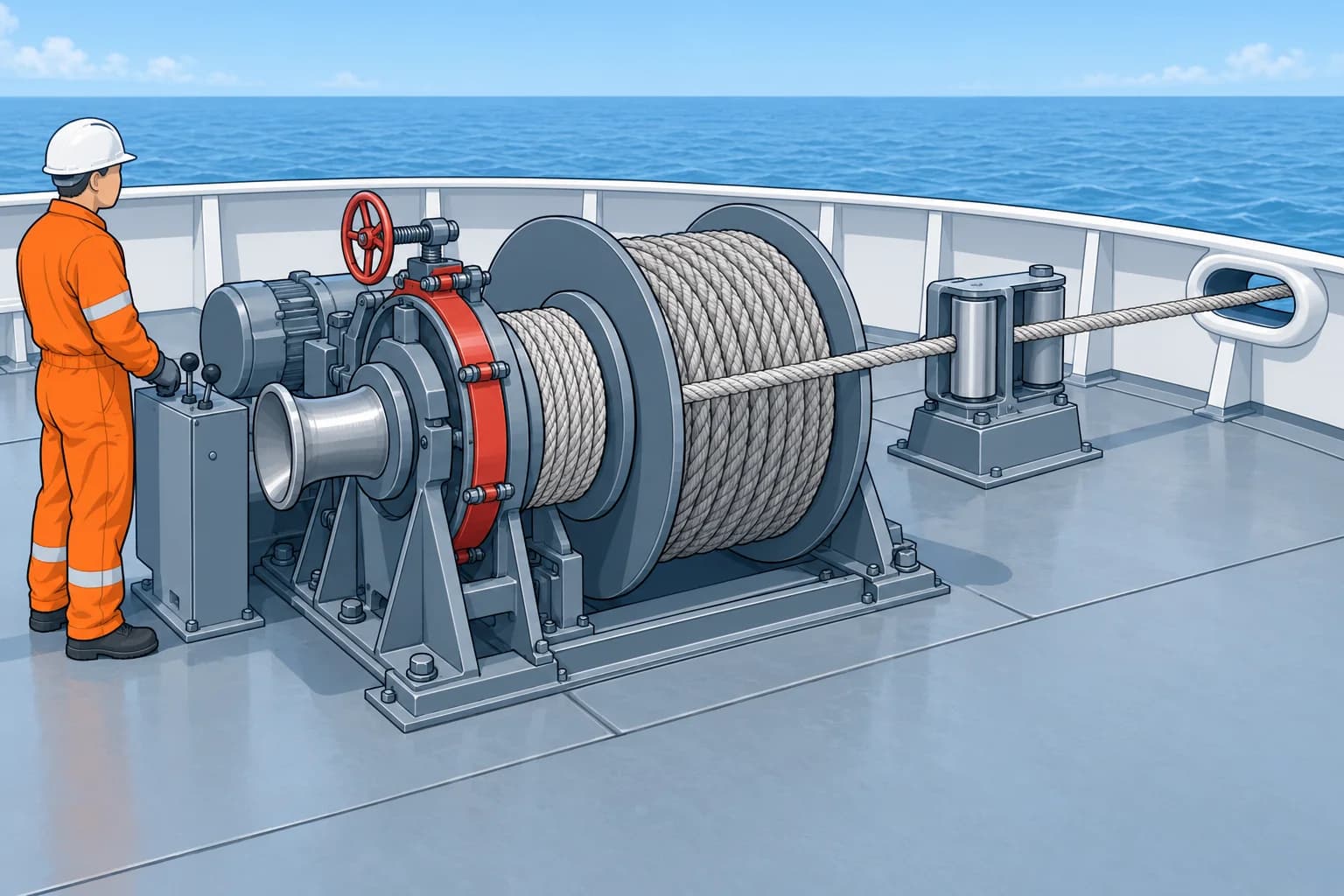
Drums
A mooring winch has a powered drum for each line. On a split drum a flange divides it into a tension section, where the line works, and a storage section for the rest of the line. Keep only one layer on the tension section: each extra layer reduces how much the brake can hold. A warping end (drum end) is a smooth barrel for heaving ropes that are not stored on the winch.
On the brake, out of gear
When the line is tight, stop heaving. Apply the band brake to its tested, marked setting, following the ship's procedure. Take the drum out of gear by disengaging the clutch. Now the brake holds the line. The gear and motor are not meant to hold a moored ship: a line left in gear cannot slip and can be overloaded until something breaks. During the stay, check the brakes and tend the lines as the tide and cargo change the ship's height.
Brake rendering
The brake is set to render, to slip and pay out, at a set load. OCIMF's Mooring Equipment Guidelines (MEG4) set it at 60 % of the ship design MBL, the breaking load the mooring system was designed around (next lesson). The brake is intended to render before an intact, correctly selected line breaks. A rendering winch is a warning. Report it; the officer decides when to heave back.
Reeling direction and tests
A band brake holds much better when the line pulls the drum in the direction marked on the winch, so reel the line on the correct way. Brakes wear and lose grip when oil or water reaches the lining. The ship tests the holding load as its maintenance plan sets, typically at least yearly and after any brake repair. Keep linings dry and report oil leaks.
Self-tensioning winches
Some winches have an automatic tension mode that heaves and pays out by itself. Do not leave it on once the ship is moored alongside: winches at both ends can pay out and let the ship walk along the berth. Use the brake. Winch construction and maintenance are in Ship: deck machinery.
Key figures
- Brake rendering (MEG4)
- 60 % of the ship design MBL (SDMBL)
- Tension section
- One layer only; extra layers reduce the brake's hold
- Moored line
- Brake on, clutch out (out of gear)
- Auto-tension
- Not used once the ship is moored alongside
Putting a mooring line on the brake
- Heave the line tight on the tension section, reeled in the marked direction, one layer only. — The brake reaches its rated hold only with the right direction and one layer.
- On the officer's signal, stop heaving. Apply the brake to its tested, marked setting, following the ship's procedure. — The brake, not the motor, must take the load.
- Disengage the clutch to take the drum out of gear. — A line left in gear cannot render and can overload the gear or the line.
- Leave the winch in manual mode, never auto-tension. — On auto, the ship can walk along the berth.
- Step clear of the line and report the line on the brake. — The officer keeps track of every line, and you leave the danger area.
- During the stay, check brakes and line tension as the watch routine sets. — Tide and cargo change the loads; a slack or rendering line needs action.
Remember
- Moored lines sit on the band brake with the drum out of gear.
- Rendering at 60 % of SDMBL (MEG4) is intended to protect an intact, correctly selected line.
- One layer on the tension section and the marked reeling direction keep the brake's full holding power.
- Brakes are tested to the maintenance plan, typically yearly and after repair; report oil on the linings.
Common mistakes
Wrong: Leave the winch in gear so the motor helps hold the ship.
Right: Put the brake on and take the drum out of gear. The brake can render; the gear can only hold until something breaks.
Wrong: A rendering winch is faulty, so heave the line back at once.
Right: Payout may mean excessive load or reduced brake holding power. Stay clear and report it; the officer decides what action is safe.
Wrong: Leave the winches on auto-tension alongside to save tending.
Right: Use the brake. On auto, winches at both ends can pay out and the ship can walk along the berth.
Worked case
During night cargo work you see the aft breast line paying out slowly from its drum, which is on the brake and out of gear. The ship is moving off the berth a little.
Show the answer
The brake is slipping: the load may have reached its setting, or its holding power may be reduced. Stay clear and report the payout and ship movement to the officer of the watch immediately. The officer may call more crew, heave back in gear, put out extra lines or ask for a tug. Do not tighten the brake beyond its tested, marked setting or stand beside the drum to investigate.
Practice question
Once a mooring line is tight, how is it held on the winch?
- In gear with the motor stopped
- In gear with the brake also on
- On the brake, drum out of gear
- On auto-tension, brake released
Show the answer
Answer: C. The brake holds the line and can render at its set load. In gear, nothing can slip before the line or the gear fails.
3 · Lines and loads
Mooring lines, tails and load limits (MEG4 and SOLAS II-1/3-8)
Know your lines' numbers: ship design MBL, line design break force and working load limit, and why stiff lines get softer tails.
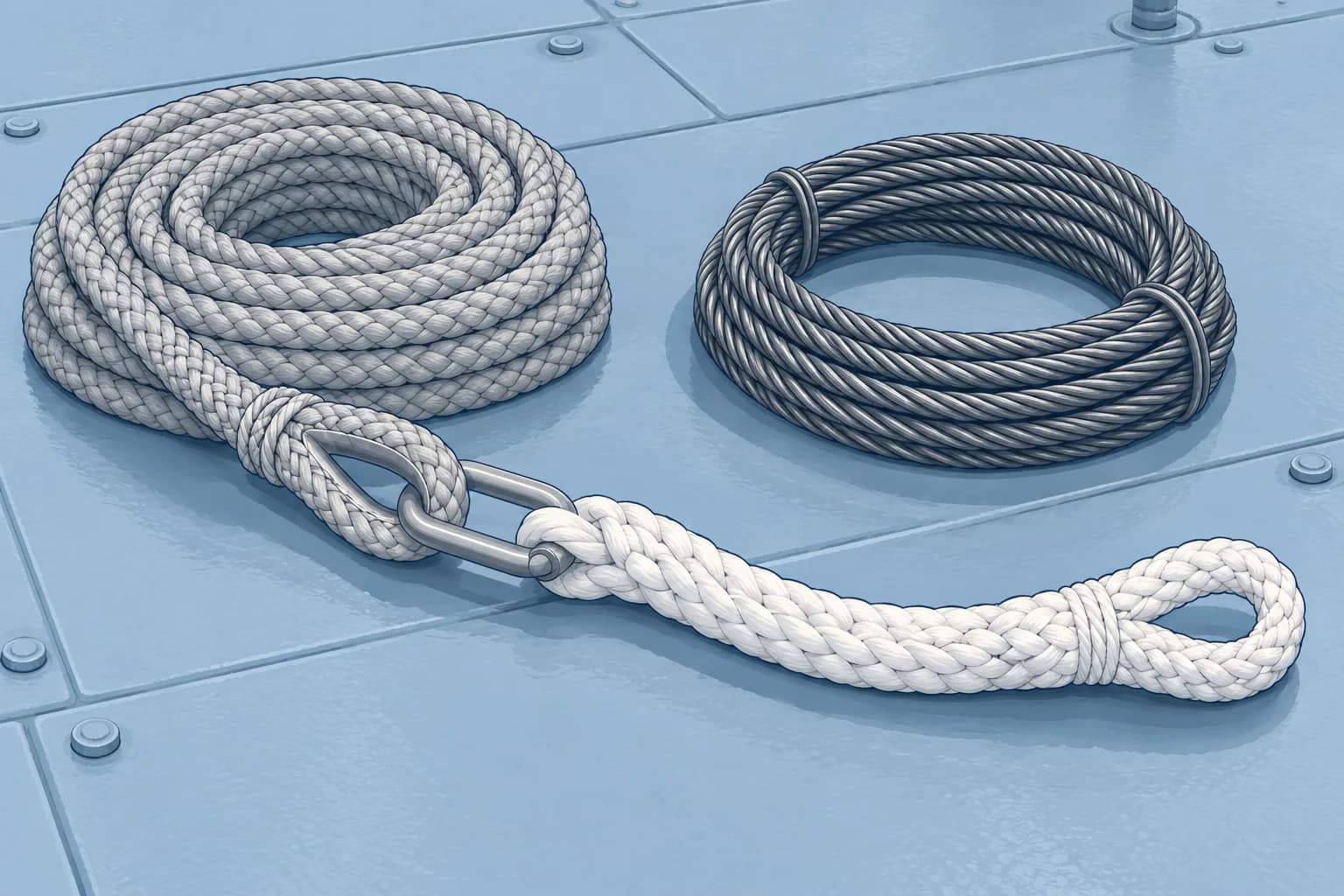
Line types
Ships use wire, high-modulus synthetic fibre (HMSF) lines, including high-modulus polyethylene (HMPE), and traditional synthetics such as polyester, nylon and mixed polyolefin. Wire and HMPE stretch little. They often have a tail, a short, more elastic rope at the outboard end, to soften surge loads. Use the connection specified for the ship's line and tail. Fibre properties and rope construction are covered in Ropes: rope materials.
The design numbers
The ship design minimum breaking load (SDMBL), called MBLSD in IMO texts, is the minimum breaking load of new, dry lines that the ship's fittings and hull structure were designed for. Every part of the system is chosen from it. The line design break force (LDBF) is the minimum force at which a new, dry, spliced line breaks; it should be 100–105 % of SDMBL. Nylon is tested wet. A tail's design break force should be 125–130 % of SDMBL.
Working load limit
The working load limit (WLL) is the most a line should carry in service: 50 % of SDMBL for synthetic lines and 55 % for wire. The brake setting is 60 % of SDMBL, above the WLL: rendering is a warning, not permission to exceed the WLL. Here, t means tonnes-force, a unit of pull. Example with an SDMBL of 70 t: synthetic line WLL 35 t, brake rendering 42 t, new line LDBF 70–73.5 t, tail 87.5–91 t.
Rules since 2024
The amendments to SOLAS II-1/3-8 entered into force on 1 January 2024. Ships of 3,000 gross tonnage and above constructed on or after that date must meet the mooring-design and line-selection requirements supported by MSC.1/Circ.1619. Smaller new ships should comply as far as reasonably practicable. Ships covered by this SOLAS regulation, including existing ships, must have mooring equipment and lines inspected and maintained, taking account of MSC.1/Circ.1620.
Inspecting lines
Look along the line for abrasion, cuts, kinks, heat damage (glazed or fused fibres) and slack or frayed splices, using the maker's retirement criteria. On a jacketed line, the cover's condition does not show the state of the load-bearing core. Each line and tail is identified and linked to its certificate and records. Store spare lines out of sunlight, water and chemicals.
Key figures
- LDBF
- 100–105 % SDMBL; new, spliced; dry except nylon tested wet
- Tail design break force
- 125–130 % of SDMBL
- WLL
- 50 % of SDMBL for synthetic lines; 55 % for wire
- Brake rendering
- 60 % of SDMBL: above the WLL; rendering is a warning
- SOLAS II-1/3-8
- Amended, in force 1 Jan 2024 (MSC.1/Circ.1619 and 1620)
- Example, SDMBL 70 t
- WLL 35 t, brake 42 t, LDBF 70–73.5 t
Remember
- SDMBL is the ship's reference strength: lines, tails, winches and fittings are all chosen from it.
- LDBF 100–105 % of SDMBL; tails 125–130 %; WLL 50 % for synthetics, 55 % for wire.
- Stiff HMSF or wire lines get elastic tails to soften surges, but tails change how a line fails.
- Since 1 January 2024, SOLAS II-1/3-8 requires mooring equipment and lines to be inspected and maintained.
Common mistakes
Wrong: A stronger replacement line is always safer.
Right: A line far above 105 % of SDMBL can overload winches and fittings before anything gives. Fit lines that match the design.
Wrong: A clean jacket means the core is sound.
Right: The jacket does not show the core's condition. Follow the maker's inspection and retirement criteria.
Wrong: The WLL is the load at which the line breaks.
Right: The WLL is the service limit, 50 % of SDMBL for synthetics. The design break force is about twice that.
Worked case
Your ship's SDMBL is 64 t. A new synthetic line's certificate gives an LDBF of 72 t; its nylon tail is certified at 82 t. The bosun says the extra strength must be safer. Should the line go into service?
Show the answer
No. Tell the officer before use. The line should be 64–67.2 t (100–105 % of SDMBL), so 72 t is outside the specified range. The tail's 82 t is within 80–83.2 t (125–130 %). A stronger line does not make the system safer if it no longer matches the design.
Practice question
What is the ship design MBL (SDMBL)?
- The load at which the winch brake slips
- The highest load the line may carry in use
- Break load the system is designed for
- The break load of a used, wet line
Show the answer
Answer: C. SDMBL is the minimum breaking load of new, dry lines that the fittings and hull structure were designed around.
4 · Tugs and buoys
Tug lines and mooring to a buoy
Tug lines are made fast and let go only on order, and kept clear of once loaded. Mooring to a buoy adds a boat crew and slip lines.
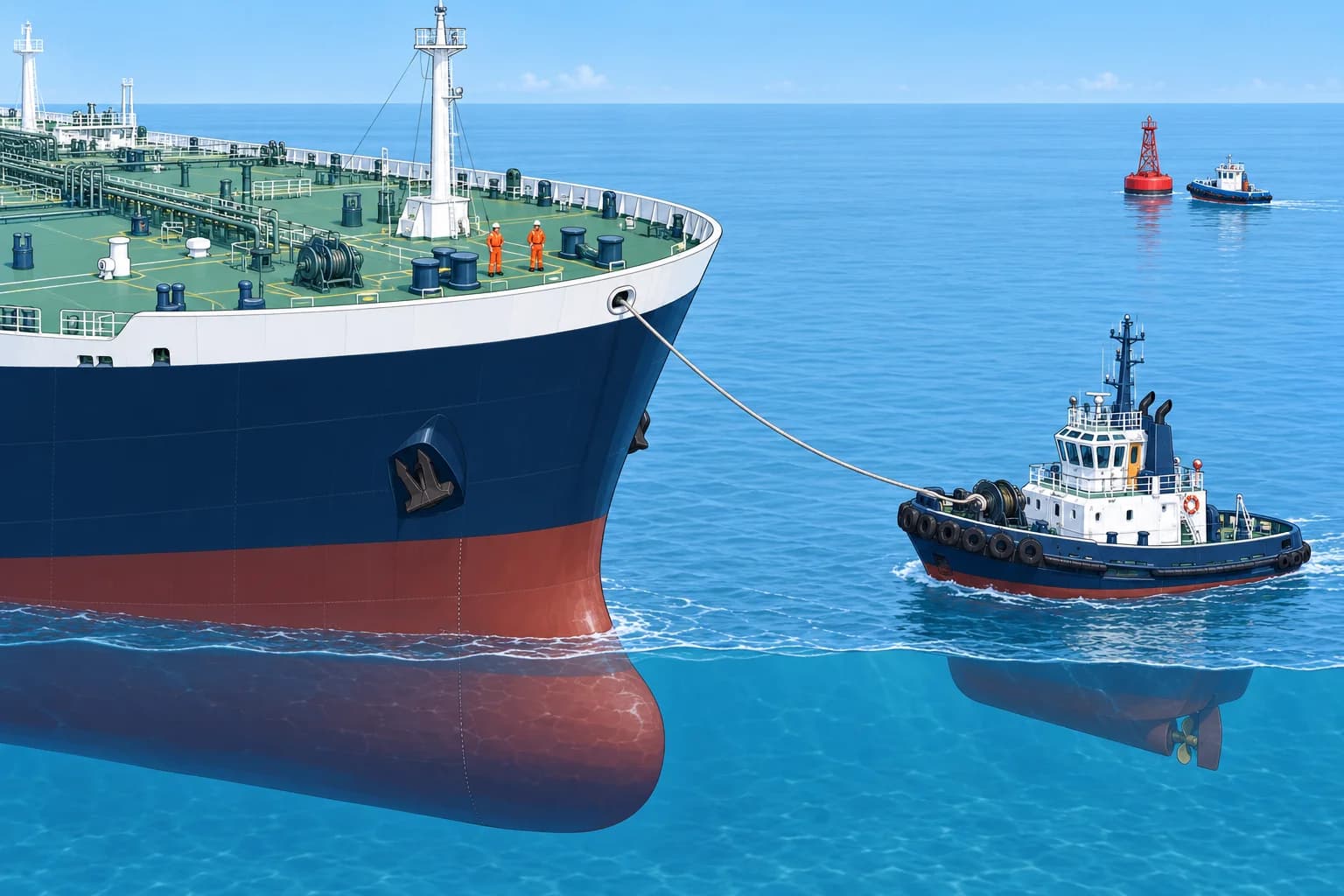
Taking the tug's line
Usually the tug passes up its own towline. On the bridge's order, throw a heaving line to the tug from the shoulder, the curved side near the bow, rather than the centre lead, which puts the tug dangerously close ahead of the bow. The tug bends on a messenger, a lighter line, and you heave the towline's eye aboard with it. The heaving line's weight is a rope monkey's fist or a soft pouch of no more than 0.5 kg, never metal.
Making fast
Use only enough turns of the messenger on the drum end to bring the eye aboard. Hold the towline with a stopper while you put the eye over the bitts the officer names, then clear the area quickly so the tug can move to a safe position. Once the tow is connected, nobody stands near it: a towline can come taut without warning. Report 'tug made fast' to the bridge.
Letting go
Never let go until the master or pilot orders it and the tug is ready. Wait until the tug eases the towline and the officer confirms it is slack. Use the messenger to heave in slack, stopper the towline and lift its eye off. Use turns of the tug's messenger around the bitts to control the towline as the tug retrieves it. A running towline can whiplash or foul the tug's propellers. Never handle a towline under load.
Girting
Girting (or girding) is when a tug is pulled sideways by its own towline, for example if the ship gains speed or turns while the tug lies across her. A tug can heel over and capsize in seconds. The tug master and pilot manage the risk. Follow release orders promptly, but never handle a loaded towline. If it is taut, report this immediately and stay clear until the officer confirms slack.
Mooring to a buoy
A mooring boat takes the ship's line, or a slip wire or slip rope, to a mooring buoy. The boat crew wear working lifejackets, with a lifebuoy and line in the boat; keep a lifebuoy and line ready on deck too. A slip line goes through the buoy's ring and back aboard, so the ship can let go from on board. Never put either slip-wire eye over the bitts: you may be unable to release it under load.
Key figures
- Heaving line weight (COSWP)
- Rope monkey's fist, or soft pouch of 0.5 kg at most; no metal
- Throwing to a tug forward
- From the bow's shoulder, on the bridge's order
- Letting go a tug line
- Only on the master's or pilot's order, tug ready
- Slip wire eyes
- Never put an eye over the bitts; it may become trapped under load
Remember
- Throw, make fast and let go tug lines only on the bridge's order, and clear the area once the tow is connected.
- Stopper the towline while the eye goes on or off the bitts; never handle a loaded towline.
- Girting can capsize a tug in seconds. On release orders, report any load; handle the towline only after confirmed slack.
- At a buoy: lifejackets in the boat, a lifebuoy ready, and slip lines that can be let go from on board.
Common mistakes
Wrong: Let the tug's line go as soon as the tug stops pulling.
Right: Wait for the master's or pilot's order; the tug must be ready to take its line back.
Wrong: Drop the eye over the side and let it run.
Right: Use turns of the tug's messenger around the bitts to control the towline as the tug retrieves it. A running towline can whiplash or foul the tug's propellers.
Wrong: Weight the heaving line with a shackle so it carries further.
Right: Use a rope monkey's fist or a soft pouch of no more than 0.5 kg. Metal weights injure the receiver.
Worked case
Leaving the berth, the forward tug is pulling on your bow. The ship starts to gather speed and the towline leads more and more across the tug. The pilot orders 'let go forward tug', but the towline is still bar-tight.
Show the answer
Report the loaded towline at once: the tug risks girting. Stay clear; the bridge and tug must ease the load. Once the officer confirms slack, stopper the towline, lift its eye off and control its return using the messenger around the bitts. Stay out of the line's path. Report 'towline released'. Report 'forward tug clear' only when the line is clear of the ship and the tug is safely clear.
Practice question
When do you throw the heaving line to a tug coming in forward?
- When the tug is close enough
- When the bridge orders it
- When the tug sounds its horn
- As soon as you see the tug
Show the answer
Answer: B. The bridge coordinates the tug's approach. Throw only on its order.
5 · Anchor station
The anchor station: windlass, letting go and reporting the cable
At the windlass you check the brake, clear the stoppers, walk the anchor out and report the cable in terms the bridge can picture.
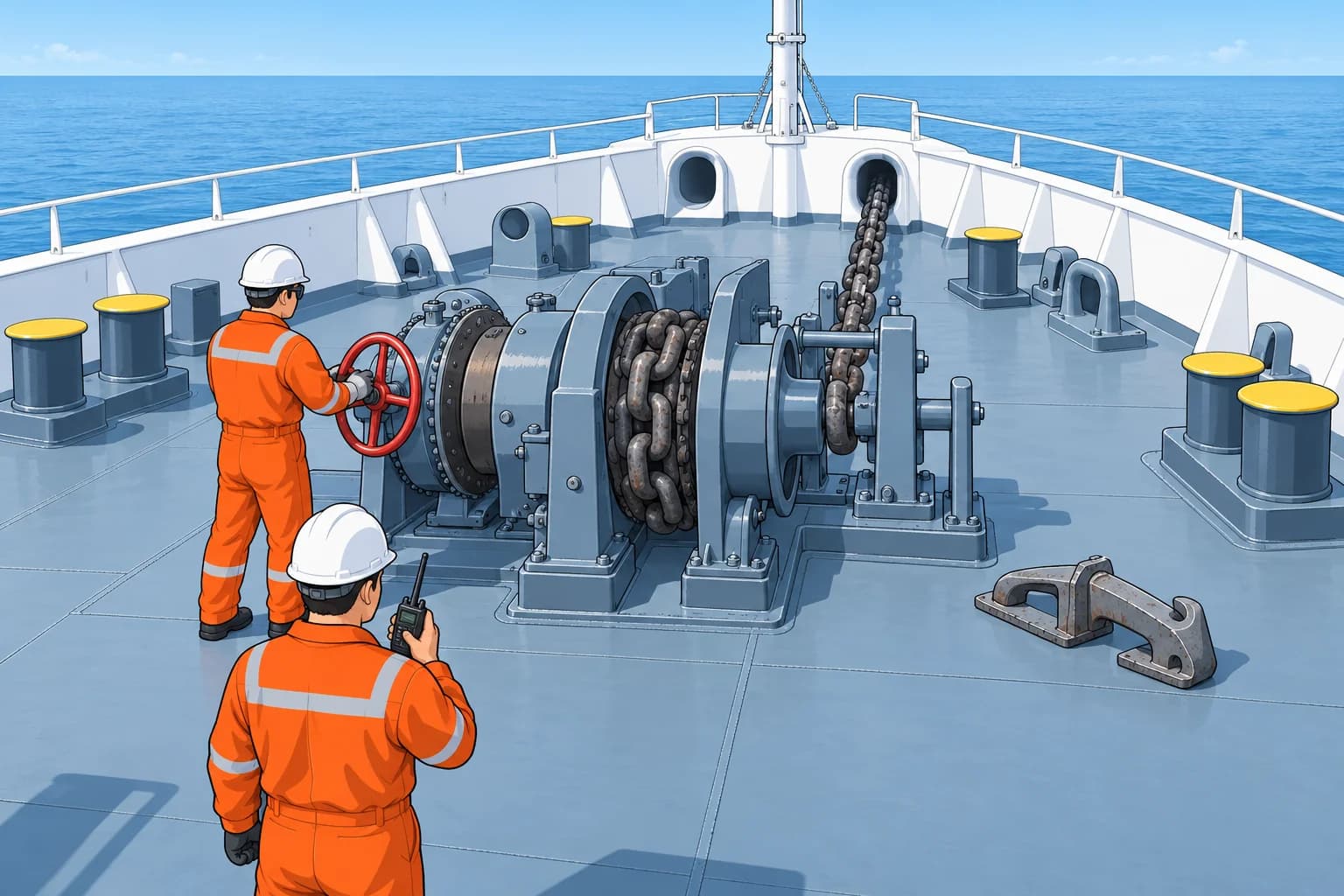
The windlass
The windlass drives a gypsy (cable lifter), a wheel with shaped pockets that grip the chain cable link by link. A clutch connects the gypsy to the motor (in gear) or frees it (out of gear), so only the band brake holds it. At sea the cable is held by a chain stopper on deck and often a devil's claw, a hook that grips one link, and the anchor is lashed. The cable's inner end, the bitter end, is secured in the chain locker. Machinery: Ship: deck machinery.
Getting ready
A competent seafarer checks the brake is on before clearing lashings, devil's claw and stopper. An officer is in charge, with a bridge radio. Wear helmet, safety shoes, gloves and goggles against rust and mud. Stand aft of, or well clear of, the windlass and moving cable. Walk the anchor out in gear, clear of the hawse pipe (the hull opening the cable passes through), to prove it runs. On very large ships, follow the ship's procedure for walking out in stages or fully.
Shackles
Cable comes in shackles, usually 27.5 m (15 fathoms), joined by marked joining shackles. Count them and report 'three shackles in the water' or 'on deck', as ordered. Without deep-water anchoring notation, the standard design lift is a vertically hanging anchor plus 82.5 m of cable. Follow the ship's stated limits. The bridge uses the engine to ease excessive cable strain; the windlass must not pull the ship against wind or current.
Reporting the cable
Report how the cable leads, ahead, astern, to port or starboard, often by clock position from the bow, and whether it is slack or under strain. A ship is brought up when she is riding to her anchor: the cable tightens, then sags back as she stops moving. Heaving up, report 'up and down' when the cable is vertical, 'anchor aweigh' when it breaks out of the seabed, then 'clear of the water', whether it is clear or foul (caught in cable or debris), and 'home' when housed.
Safe habits
If the anchor does not run when the brake is released, do not shake the cable: brake on, put it in gear and walk it out. Never enter the chain locker without enclosed-space precautions. Wash mud off the cable as it comes in. When housed, secure the anchor with stopper, brake and lashings so it cannot run at sea.
Key figures
- One shackle of cable
- 27.5 m (15 fathoms)
- Design lift without deep-water notation (IACS UR A3)
- Without deep-water notation: 82.5 m of vertical cable plus anchor
- PPE at the windlass
- Helmet, safety shoes, gloves, goggles; hearing protection
- Anchor will not run
- Brake on, in gear, walk it out; never shake the cable
Letting go an anchor from the brake
- Confirm the order and communications with the bridge, and check the brake is on. — The brake must hold before any stopper comes off.
- Engage the clutch, then clear the lashings, devil's claw and chain stopper. — With the gypsy in gear and the brake on, nothing can run unexpectedly.
- Release the brake and walk the anchor out under power, clear of the hawse pipe or to the depth ordered. — This proves the anchor runs and reduces the shock on the brake.
- Apply the brake, take the gypsy out of gear and report 'ready to let go'. — Now only the brake holds the cable, ready to release.
- On 'let go', release the brake, then control the cable's speed with it, counting the shackles. — An uncontrolled run can overheat the brake or tear out the bitter end.
- On the order, brake on and stopper on; report the lead and when she is brought up. — The stopper takes the riding load; the bridge needs the lead to know she is holding.
Remember
- Brake on before clearing the stoppers; walk the anchor clear of the hawse pipe to prove it runs.
- Report shackles in the water or on deck, the cable's lead and strain, and when she is brought up.
- Heaving up: up and down, aweigh, clear of the water (clear or foul), home.
- Stand clear of the windlass in full PPE; a chain locker is an enclosed space.
Common mistakes
Wrong: Shake the cable if the anchor sticks in the hawse pipe.
Right: Put the brake on, put the gypsy in gear and walk the anchor out under power.
Wrong: 'Anchor aweigh' means the anchor is back in the hawse pipe.
Right: Aweigh means it has broken out of the seabed. It is 'home' when housed.
Wrong: The windlass can heave the ship up to her anchor in a strong wind.
Right: Without deep-water anchoring notation, the standard design lift is the anchor plus 82.5 m of vertical cable. Follow the ship's rated limits. The bridge uses the engine to ease cable strain.
Worked case
Anchoring in 25 m of water, the officer orders 'let go'. With five shackles in the water, the cable leads at two o'clock and comes taut, then sags back while the ship stops moving relative to the shore.
Show the answer
Report to the bridge: 'five shackles in the water, cable leading two o'clock (on the starboard bow), ship brought up'. Brought up means she is riding to her anchor. On the order, put the brake on fully and the chain stopper on so it carries the load. Keep watching the cable: if it keeps jerking taut and the ship moves, the anchor may be dragging.
Practice question
What is the gypsy (cable lifter) on a windlass?
- The wheel whose pockets grip the cable
- The hinged bar that locks the cable on deck
- The hooked claw that holds one link of cable
- The pipe the cable runs through
Show the answer
Answer: A. The gypsy's pockets grip the links. The bar is the chain stopper and the claw is the devil's claw.