
Seamanship basics: ropes, knots and the boat · Level P1 · 5 parts · about 17 min
Deck work safely: snap-back zones, working aloft and over the side, enclosed spaces and permits to work (ratings)
5 short parts: Snap-back · Aloft and overside · Enclosed spaces · Permits to work · Pilot ladders. Each part explains the idea, then gives the points to remember, the common mistakes, a worked case and a practice question; the Academy unit adds all 31 check questions.
1 · Snap-back
Snap-back: the whole mooring deck is a danger zone
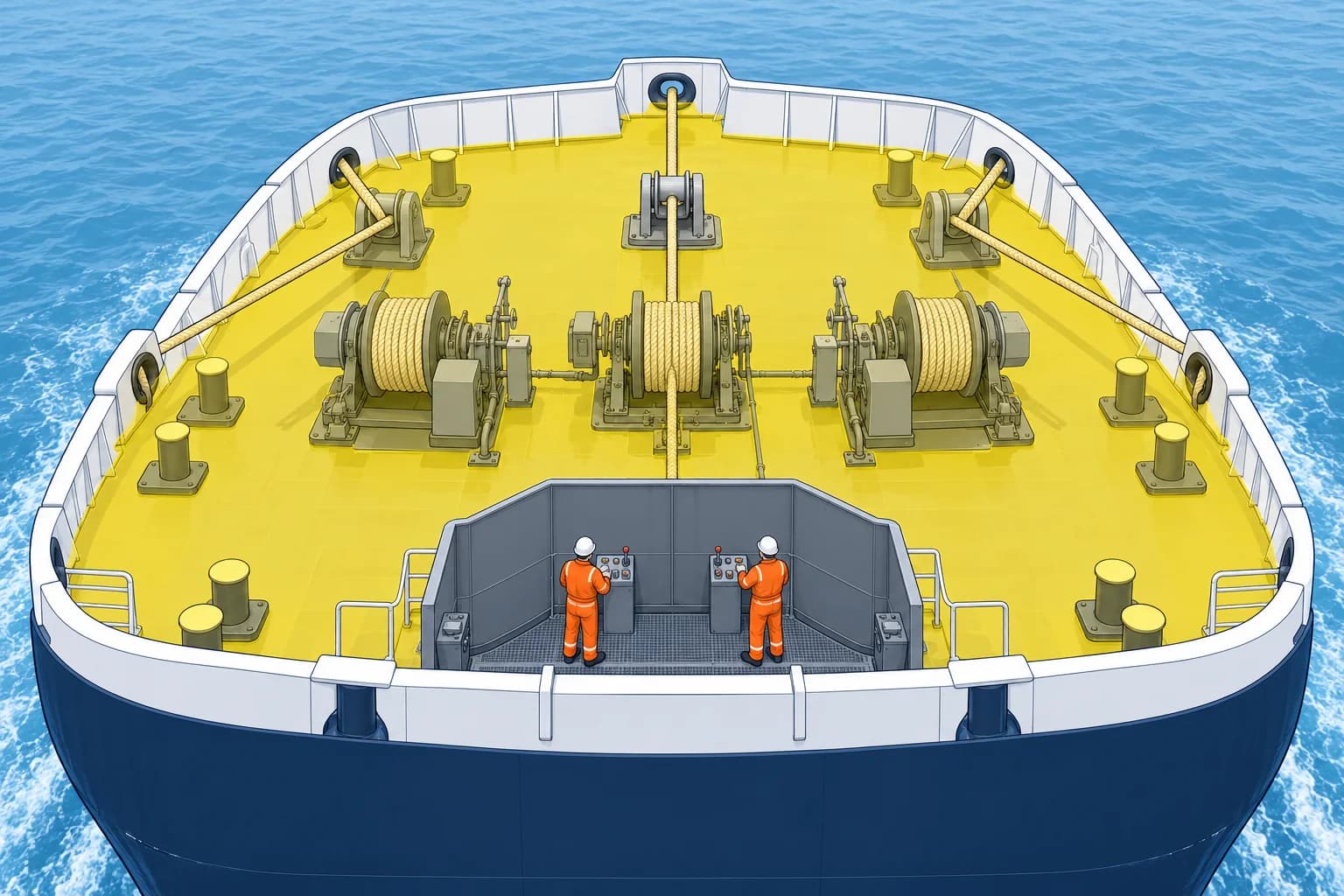
A line under tension that breaks or slips can whip across the deck faster than you can move. Stay out of bights and line paths, everywhere on the deck.
What snap-back is
Snap-back is the sudden, violent recoil of a line under tension when it parts (breaks), slips off a fitting or comes free from a snag. Low-stretch lines recoil too, and a stiff line fitted with a tail, a short elastic rope section, can recoil hard over a large area. Snap-back kills and maims, and you will not have time to react.
The whole deck
IMO guidelines (MSC.1/Circ.1619) say mooring areas should be treated as potential snap-back zones, with signs saying so. The UK Code of Safe Working Practices for Merchant Seafarers (COSWP) says to consider the whole mooring deck dangerous, side decks included. Painted snap-back zones are no longer advised: they can give a false sense of security, because a line can part anywhere, in more than one place, and fly outside any painted area.
Leads change the zone
A line led round a pedestal fairlead, a raised fitting that guides the line, or a roller changes direction. If it parts, the free end can sweep a wider area. A snagged line that suddenly comes free can move sideways or upwards, or snake.
Where you stand
Never stand in a bight (a loop) of rope or wire, in line with a rope under strain, or on the inside of a turn round a fitting. Stand behind protective structures where they are provided, and stay well clear of a snagged or trapped line. Only the mooring party belongs on the mooring deck. If anything looks overloaded, shout and tell the officer so the load can be reduced at once.
Related lessons
Rope stretch and stored energy are explained in Ropes: rope materials. The mooring station itself, its winches and lines, is in Ropes: ship mooring and anchoring stations.
Key figures
- Snap-back zone
- Treat the whole mooring deck as one (COSWP, MSC.1/Circ.1619)
- Painted zones
- Not advised: they give a false sense of security
- Pedestal fairleads
- Change and widen the danger area if the line parts
Remember
- Treat the whole mooring deck, side decks included, as a snap-back zone.
- Never stand in a bight, in line with a loaded line, or inside a turn round a fitting.
- Painted zones mislead: lines can part anywhere and fly outside them.
- Stay well clear of snagged lines and report any line or fitting that looks overloaded.
Common mistakes
Wrong: Outside the painted zone you are safe.
Right: A line can part at any point and recoil beyond any paint. Treat the whole deck as dangerous.
Wrong: Low-stretch lines cannot snap back.
Right: Low-stretch synthetic lines and wire ropes recoil too, and an elastic tail on a stiff line can make snap-back worse.
Wrong: Step over a slack bight to save time.
Right: A slack line can come under load without warning. Walk round it.
Worked case
You are aft during unmooring. The stern line has snagged on a fender on the quay and the winch is still heaving. A shipmate walks to the rail beside the fairlead to see what is happening.
Show the answer
Call ‘Stop heaving!’ and warn your shipmate to move clear. Tell the officer that the line is snagged. Keep everyone clear while the officer arranges for the load to be removed and the snag released safely. Do not approach until the line is slack and the officer confirms it is safe.
Practice question
According to the COSWP, which part of the mooring deck is a potential snap-back zone?
- Only the painted areas
- Only behind the winches
- Only near the fairleads
- The whole mooring deck
Show the answer
Answer: D. The COSWP says to consider the entire mooring deck dangerous, side decks included.
2 · Aloft and overside
Working aloft and over the side
Assess risks and use any permit your ship requires. Aloft, use fall protection and a rescue plan. Overside, add a lifejacket, lifebuoy and watcher.
What counts
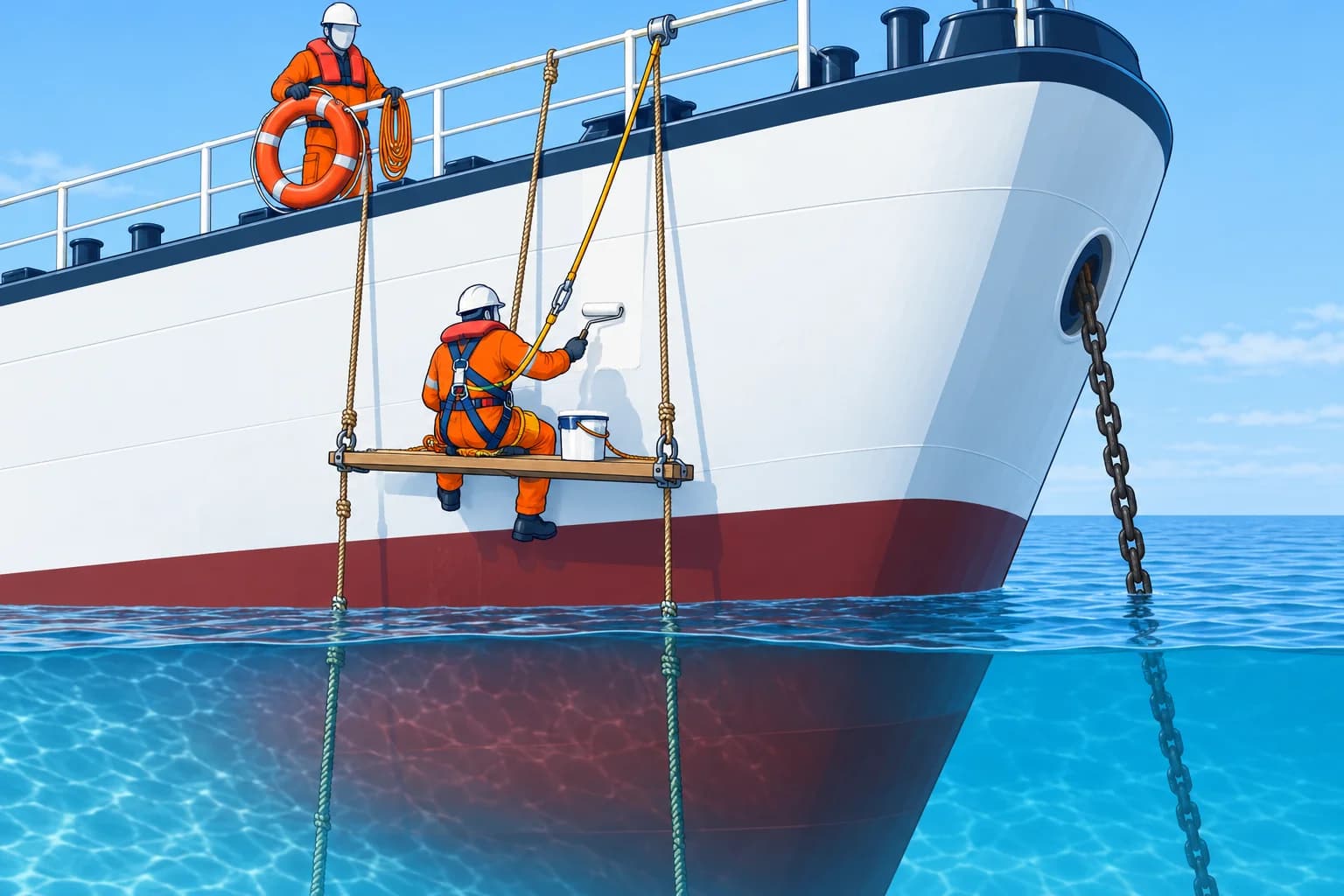
Working aloft (work at height) is any work where you could fall: on masts, ladders and staging, near open hatches, or inside tanks. Working over the side (overside) is work on a stage (a suspended work platform) or chair hung over the ship's side, or anywhere you could fall into the water. Both need a risk assessment and, where the ship's procedures require one, a permit to work (lesson 4). Only competent people do it, and trainees are supervised.
Equipment
Wear a safety harness with a lifeline or fall-arrest device secured to a strong point, at all times where you could fall. Over the side, also wear a working lifejacket and keep a lifebuoy with line ready. Someone on deck watches you all the time. The ropes of an overside stage should be long enough to trail into the water as extra lifelines. Inspect the harness, lanyard (a short securing line or strap), chair or stage and the gantlines (their hoisting ropes) before use.
Bosun's chair
A bosun's chair is a suspended seat for one person. Secure it to its gantline with a double sheet bend and seize the free end to the standing part (main rope) with small cord. Have the chair and gantlines examined and tested to four times the intended load under the ship's approved procedure. Use blocks (rope pulleys) rated for the work. Haul by hand, not with a winch. Secure anchor points to the ship's structure, never portable rails or stanchions (upright rail supports).
Tools and isolation
Send tools in a container by line, use tool lanyards and keep an exclusion zone below. Before work near the whistle or radar scanner, the officer arranges isolation and warning notices. Near radio aerials, prevent transmissions. Near the funnel, the duty engineer reduces steam, harmful gases and fumes as far as possible. Avoid work aloft near cargo operations.
Under way and weather
Do not work over the side while the ship is under way, except in an emergency; then a rescue boat must be ready and a responsible person watches closely. Allow for the ship's motion and the weather, even alongside.
Key figures
- Bosun's chair
- Chair and gantlines: test to 4 × intended load; double sheet bend
- Overside extras
- Working lifejacket, lifebuoy with line, watcher on deck
- Under way
- No overside work except in emergency; rescue boat ready
- Control first
- Isolate whistle/radar; stop radio transmissions; control funnel fumes
Before you go over the side
- Confirm the ship is not under way unless this is emergency work. Check the briefing, rescue plan and any required permit. — Everyone must know the controls and rescue plan. Emergency overside work under way needs a rescue boat ready.
- Inspect the harness, lanyard, lifeline, gantlines and the stage or chair. — Damaged gear fails under load.
- Put on the harness and a working lifejacket; secure your lifeline to an independent strong point. — If the stage or chair fails, the lifeline still holds you.
- Place a lifebuoy with line ready and confirm who is watching from deck. — Someone must see a fall and act at once.
- Secure tools with lanyards and send them down in a container. — A dropped tool can injure someone or knock you off balance.
- Confirm with the officer: whistle/radar isolated with warning notices, radio transmissions stopped and funnel fumes controlled as needed. — Whistle blasts, moving radar scanners, radio transmissions and funnel emissions can injure you.
Remember
- Assess risks, use any permit the ship requires, and have competent people and a rescue plan for aloft and overside work.
- Harness and lifeline wherever you could fall; add a working lifejacket over the side.
- Lifebuoy with line and a deck watcher; no overside work under way except in emergency.
- Tools on lanyards; keep the area below clear. Isolate whistle/radar, stop radio transmissions and control funnel fumes.
Common mistakes
Wrong: Clip your lifeline to the stage you are working from.
Right: Secure it to an independent strong point, so it holds you if the stage fails.
Wrong: Use the winch to haul a shipmate up in the bosun's chair.
Right: Haul by hand so you can control the lift. Stop immediately if the chair or line snags; never force it.
Wrong: Carry the paint tin up the ladder in one hand.
Right: Keep both hands for climbing; send tools and paint up by line in a container.
Worked case
While the ship lies at anchor in a light swell, the mate wants the ship's name repainted on the bow. You are to go down on a stage.
Show the answer
Being at anchor does not make the swell safe. Start only if the officer accepts the risks and confirms the rescue plan and any required permit; postpone if the stage cannot be kept safe. Wear a harness on an independent lifeline and a working lifejacket. Have a deck watcher and lifebuoy with line ready. Secure tools and keep the stage ropes trailing into the water.
Practice question
Working over the side, what do you wear besides a harness and lifeline?
- A working lifejacket
- A survival suit
- A breathing apparatus
- A high-visibility vest
Show the answer
Answer: A. If you fall into the water, the lifejacket keeps you afloat until you are recovered.
3 · Enclosed spaces
Enclosed spaces: awareness for ratings
An enclosed space can kill with air that looks normal. Never enter without a permit and a tested atmosphere, and never rush in to rescue.
What they are
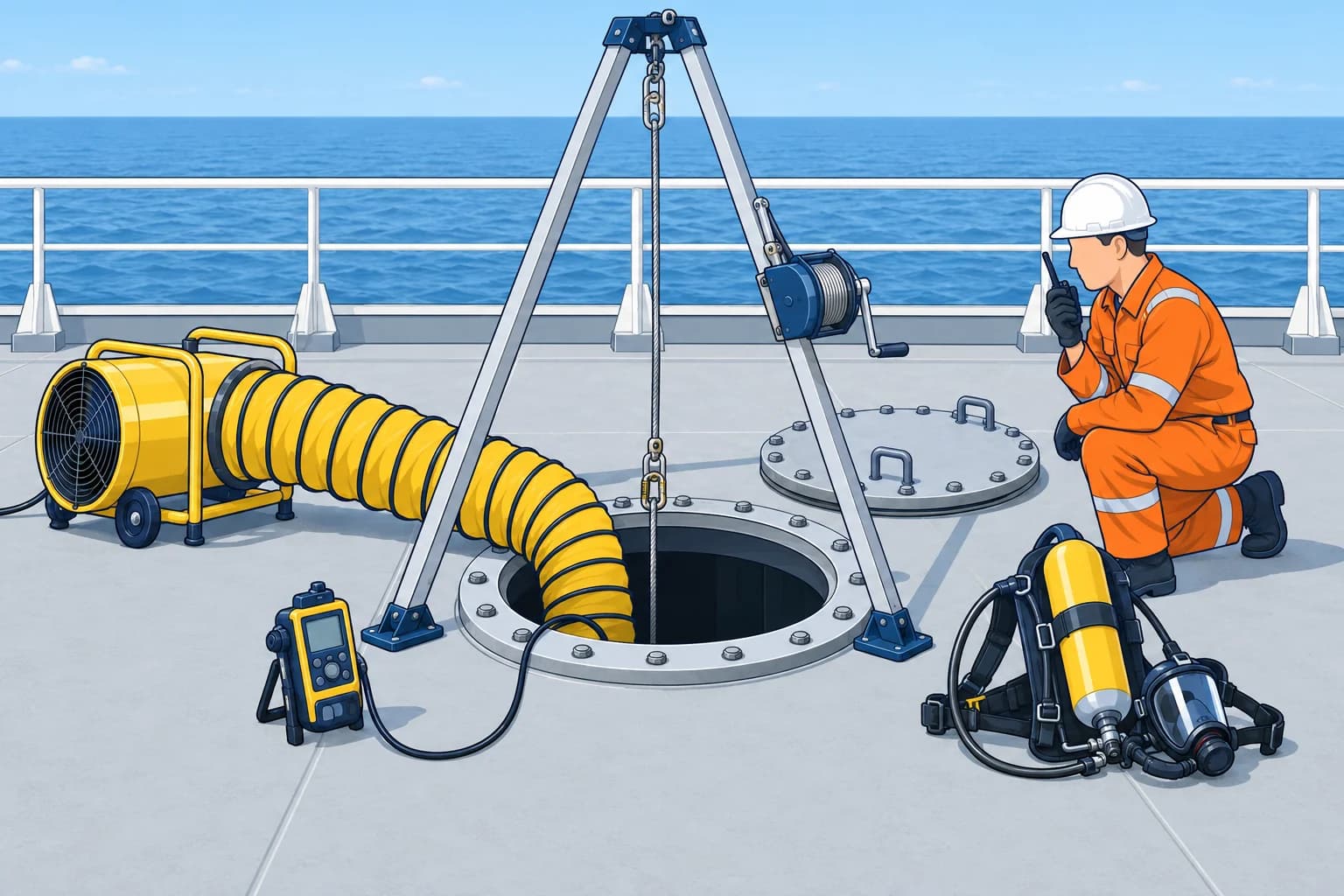
An enclosed space may contain hazardous air or lack oxygen and has at least one feature: limited entry or exit, poor ventilation, or no design for continuous human occupancy. Examples include cargo holds, ballast tanks, fuel tanks, chain lockers (spaces storing the anchor chain), and connected spaces. The air may lack oxygen or contain toxic or flammable gas, and you cannot see or smell the danger. A single breath of very low-oxygen air can make you collapse.
The rules
SOLAS requires ships to carry a portable atmosphere testing instrument (regulation XI-1/7) and to hold enclosed space entry and rescue drills at least every two months (regulation III/19). Under XI-1/7, the instrument must measure at least oxygen, flammable gases or vapours, hydrogen sulphide and carbon monoxide. The IMO's 2025 Revised Recommendations (resolution MSC.581(110)) add an enclosed space register listing every such space and forbid single-person entry.
Before entry
Entry needs an authorised officer's permit to work, valid for at most eight hours. Ventilate before entry and throughout occupancy. Test from outside and keep monitoring; leave if ventilation fails. Readings: 20.9 % oxygen; carbon dioxide below 0.5 %; flammables below 1 % of the lower flammable limit (LFL), the concentration at which gas can ignite; toxic gases below half their occupational exposure limit (OEL), the workplace limit. At least two people enter. A separate attendant stays outside with communications and rescue equipment ready.
If someone collapses
Raise the alarm at once. The attendant does not go in. Do not enter to help without self-contained breathing apparatus (SCBA) and the ship's rescue plan: many of those who die in enclosed spaces are would-be rescuers. The trained rescue team goes in with SCBA, harness and lifeline. The full entry procedure is in Law: personal safety.
Key figures
- Atmosphere tester
- SOLAS XI-1/7: portable instrument carried on board
- Entry and rescue drills
- At least every two months (SOLAS III/19)
- Atmosphere entry limits (MSC.581(110))
- 20.9% O2; CO2 <0.5%; flammable <1% LFL; toxic <50% OEL
- Entry permit (IMO)
- Valid for no more than 8 hours
- Entering alone
- Not permitted
Remember
- Testing and a permit do not change an enclosed space's status. Keep all entry precautions in force.
- Entry needs a permit, ventilation, tested air, at least two entrants and a separate attendant outside.
- Drills at least every two months; a portable atmosphere tester is carried under SOLAS XI-1/7.
- Never enter to rescue without SCBA. Raise the alarm and follow the ship's rescue plan.
Common mistakes
Wrong: If the air smells fresh, the space is safe.
Right: Low oxygen and many toxic gases have no smell. Only a test shows the atmosphere.
Wrong: The attendant goes in at once if the worker collapses.
Right: The attendant raises the alarm and stays out. Only the equipped rescue team enters.
Wrong: After an hour of ventilation no test is needed.
Right: Test after ventilating and keep testing while people are inside; conditions change.
Worked case
The bosun sends you to fetch a spare shackle from the forward chain locker. The hatch is open and the ladder looks fine, but nobody has mentioned a permit.
Show the answer
Do not go in. A chain locker is an enclosed space: rusting steel and mud can use up the oxygen. Tell the bosun and the officer that a permit, ventilation, an atmosphere test and an entry team and a separate attendant are needed first, or that the shackle should be fetched another way.
Practice question
How often must enclosed space entry and rescue drills be held, at least?
- Every week
- Every 2 months
- Every 6 months
- Every year
Show the answer
Answer: B. SOLAS III/19 requires them at least every two months.
4 · Permits to work
Permits to work, risk assessment and toolbox talks
A permit is a signed record that a job’s hazards are controlled. Work only within its scope and validity. Stop and report if conditions change.
What a permit is
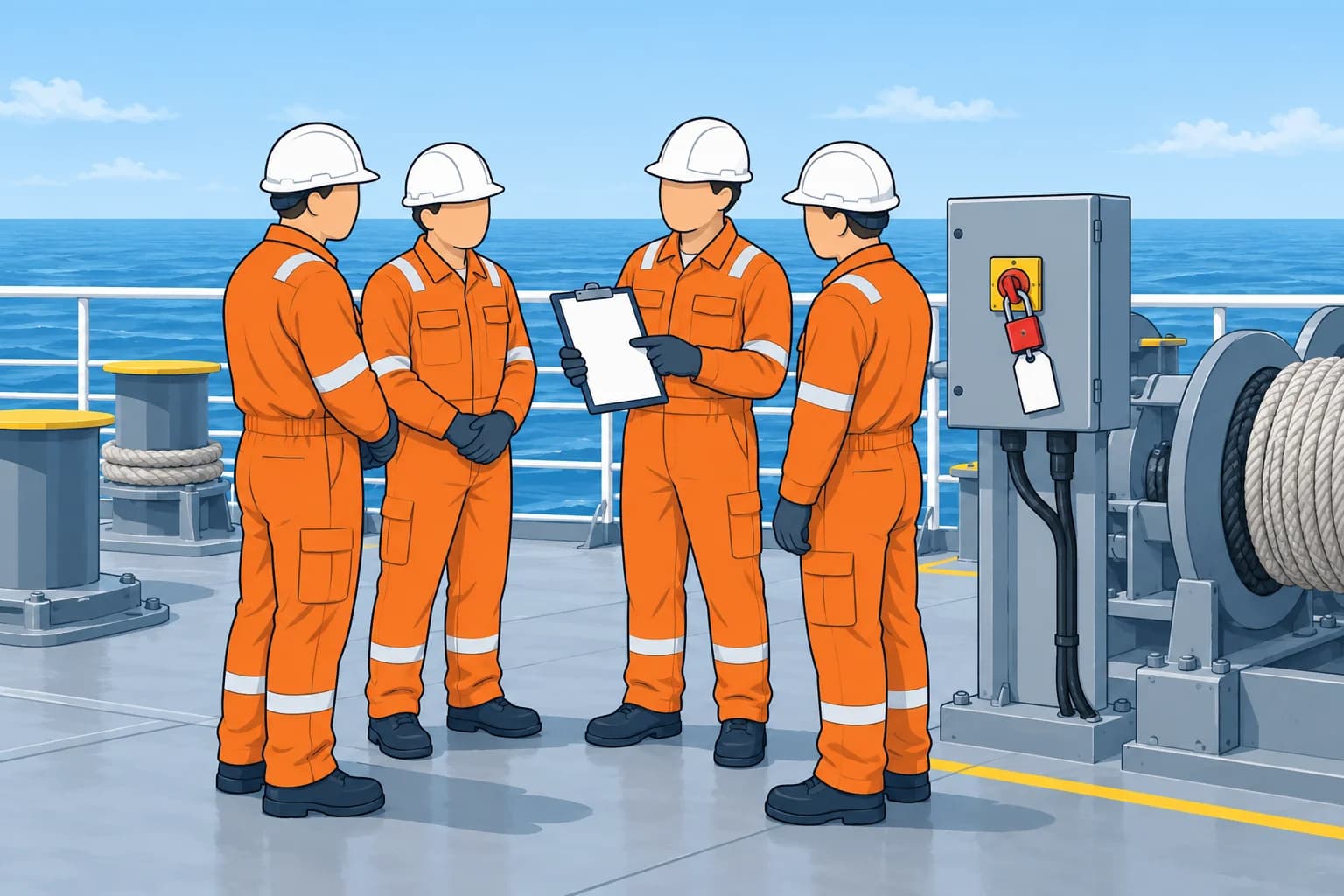
A permit to work (PTW) is a written, signed form, part of the ship's safety management system (SMS), confirming that the controls for a hazardous job are in place before it starts. It does not make the job safe by itself; it makes sure the safety steps are followed. Typical permit jobs are enclosed-space entry, hot work, work aloft or over the side, isolating machinery or electrics, and work on deck in bad weather.
Risk assessment and toolbox talk
Every permit rests on a risk assessment: what could go wrong, how likely and how bad it is, and which controls reduce the risk. Before work starts, the team holds a toolbox talk, a short briefing at the job on the task, hazards, controls, who does what and how to stop. Speak up if anything is unclear. If conditions change, stop and report: the permit is suspended until the change is assessed.
Who signs
An authorised officer issues and closes the permit after checking the precautions. The competent person doing the work countersigns to show they understand it, and should not be the same person as the authorised officer. The permit states the location, the work, tests done, safety measures and its validity: no more than 24 hours in the COSWP, and eight hours for enclosed-space entry in the IMO recommendations.
Isolation
Isolation separates equipment from every energy source. Release or restrain stored energy, then have a competent person verify the isolation before work starts. Lock out, tag out (LOTO) secures isolating points with locks and identifying tags under the ship's procedure. Never remove another person's lock or tag. The officer coordinates related permits so work cannot conflict and shared isolations remain effective.
Closing
Do only the work on the permit. When it is done, make the site safe and report to the authorised officer. They confirm everyone and all tools are clear and coordinate safe reinstatement under the ship's procedure. Keep isolations in place until release is authorised; personal locks are removed by their owners under that procedure. The officer records completion and closes the permit.
Key figures
- Permit validity (COSWP)
- No more than 24 hours
- Enclosed-space entry permit (IMO)
- No more than 8 hours
- Signatures
- Authorised officer issues and closes; worker countersigns
Remember
- A permit records that controls are in place; it does not make a job safe by itself.
- Permits rest on a risk assessment and start with a toolbox talk at the job.
- Do only the work on the permit; lock out and tag out, and never remove another person's lock.
- The authorised officer issues and closes the permit; the person doing the work countersigns.
Common mistakes
Wrong: Once the permit is signed, changing conditions do not matter.
Right: If conditions change, stop and report. The permit is suspended until the change is assessed.
Wrong: While you are there, fix the next pump as well.
Right: Do only the work on the permit. Report extra work for assessment; it may require a new permit.
Wrong: Take your tag off when your part of the job is done.
Right: Report completion. Remove your own lock only as the ship's procedure directs; never remove anyone else's.
Worked case
You hold a permit to chip and paint a vent on the forecastle (forward deck). The wind rises and spray starts coming over the bow. Your partner says the permit is valid until 1700, so you should carry on.
Show the answer
Stop work, make the area safe and tell the authorised officer. Heavy spray on the forecastle was not part of the risk assessment, so the permit should be suspended while the change is assessed. Work restarts only when the officer says so, perhaps with extra controls or a new permit.
Practice question
What does a permit to work do?
- It makes the job safe by itself
- It confirms the controls are set
- It replaces the risk assessment
- It allows any work in that area
Show the answer
Answer: B. It is a formal record that the control measures are in place. The controls make the job safe, not the paper.
5 · Pilot ladders
Rigging the pilot ladder: SOLAS V/23 now and from 2028
Pilots and crew have died from badly rigged ladders. Rig it as designed, at the right height, on strong points, with a lifebuoy, line and light ready.
The rule
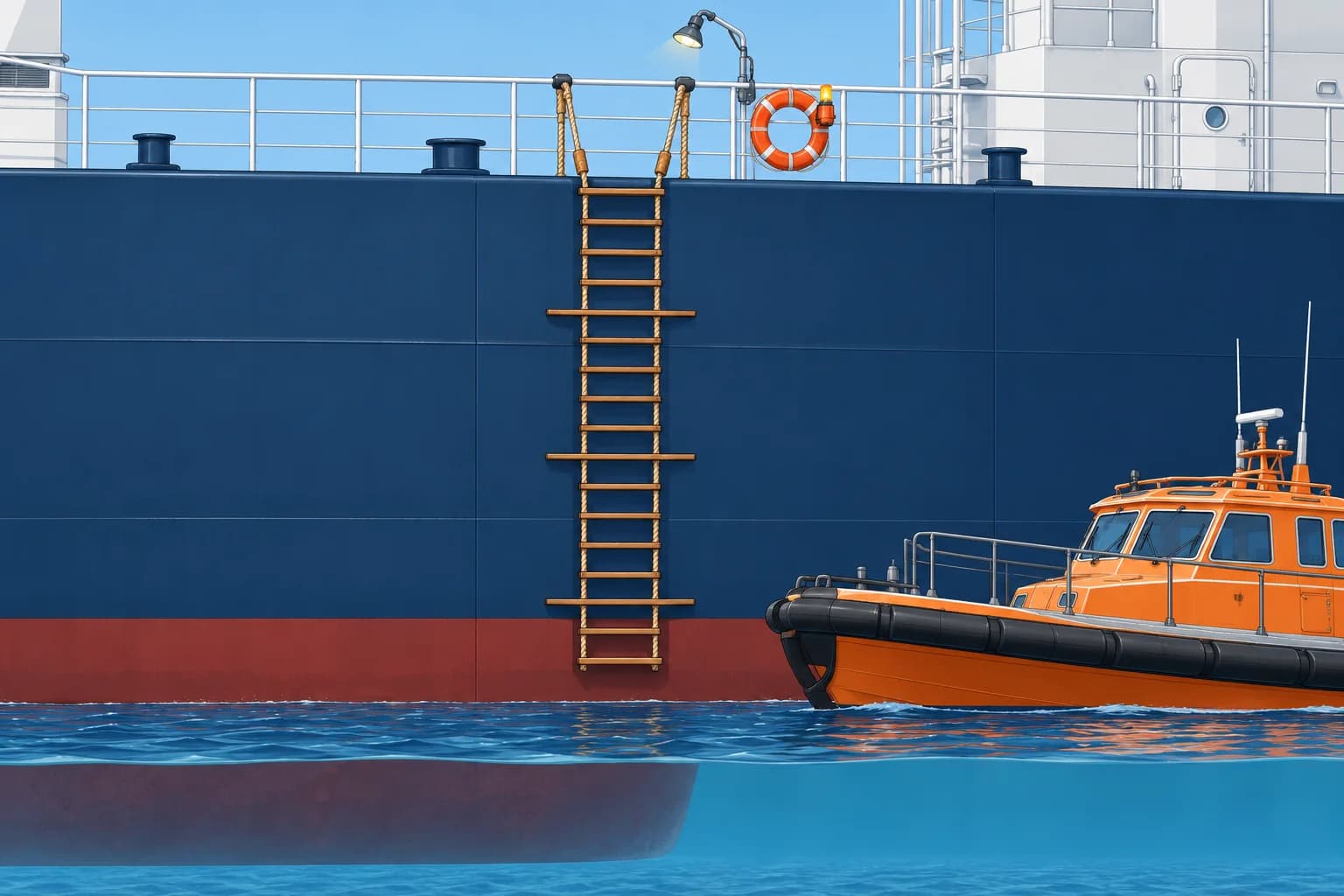
SOLAS regulation V/23 sets the rules for pilot transfer arrangements, together with IMO resolution A.1045(27) and the ISO 799 ladder standards. Deck ratings rig the pilot ladder under a responsible officer, who is in contact with the bridge and arranges an escort for the pilot by a safe route to and from the bridge.
Height and the 9 m rule
Rig the ladder's bottom at the height the pilot requests. Keep steps horizontal against the hull, clear of discharges and overhangs. If access is more than 9 m above water, use a combination arrangement: an accommodation ladder (boarding stairway) with a pilot ladder alongside. Keep the bottom platform horizontal, at least 5 m above water and secured to the hull. The pilot ladder must extend at least 2 m above it.
Securing
Secure the ladder's side ropes to the designated strong points on deck, never to rails, and never with shackles through the ladder. The steps and spreaders (long steps that resist twisting) must not carry the ladder's weight; make sure none is twisted or trapped. Under the new standards, strong points, shackles and securing ropes require 48 kN (kilonewtons, a unit of force), and intermediate-length securing devices need type approval. The transition dates are below.
Ready at the ladder
At the point of access keep a lifebuoy with a self-igniting light and a heaving line (a light throwing rope). At night, light the ladder and the ship's side with a forward-shining overside light. Wear a harness and safety line while rigging. Rig manropes, separate hand ropes, if the pilot asks for them. Before use, check for worn side ropes and loose or cracked steps, and keep the boarding area clear. Mechanical pilot hoists must not be used.
From 2028
Amendments to V/23 (resolution MSC.572(110)) and new performance standards (MSC.576(110)) enter into force on 1 January 2028. New installations must comply from then; existing SOLAS arrangements by the first survey on or after 1 January 2029. Stowage, maintenance and replacement rules apply to all ships from 2028: ladders are retired 30 months after entering service or 36 months after manufacture, whichever comes first. A spare is carried. Accommodation ladders and gangways: Ship: deck machinery.
Key figures
- Ladder alone
- Access point no more than 9 m above the water
- Combination
- Pilot ladder at least 2 m above the bottom platform
- At the access point
- Lifebuoy with self-igniting light, heaving line, lighting
- New rules in force
- New: 1 Jan 2028; existing SOLAS: first survey from 1 Jan 2029
- Ladder service life (2028)
- 30 months in service or 36 from manufacture, first reached
- Securing strength (new standards)
- 48 kN: strong points, shackles and securing ropes
Remember
- A responsible officer supervises rigging, stays in contact with the bridge and arranges a safe escort.
- Keep steps horizontal against the hull. Access more than 9 m above water needs a combination arrangement.
- Secure the side ropes to strong points, never rails; steps must not carry the ladder's weight.
- Lifebuoy with self-igniting light, heaving line and lighting ready at the point of access.
- New V/23 rules from 1 January 2028; existing SOLAS arrangements verified by the first survey from 2029.
Common mistakes
Wrong: Tie the ladder to the handrail; it is close and looks strong.
Right: Secure it to the designated strong points. Rails are not designed for the load.
Wrong: Let the bottom spreader take the weight to keep the ladder tidy.
Right: Steps and spreaders are not suspension points. Secure both side ropes to the designated strong points.
Wrong: The 2028 rules apply only to ships built after 2028.
Right: Existing SOLAS arrangements must comply by the first survey on or after 1 January 2029, and maintenance rules apply to all ships from 2028.
Worked case
Loaded today, your tanker's point of access is 7 m above the water. Tomorrow, carrying ballast water instead of cargo, it will be 11 m. Both times the pilot asks for the bottom of the ladder 2 m above the water.
Show the answer
Today, access is 7 m above water: use the pilot ladder alone, secured to strong points, with its bottom 2 m above water. Tomorrow, access is 11 m: use a combination arrangement. Keep the accommodation ladder's bottom platform horizontal, at least 5 m above water and secured to the hull. The pilot ladder extends at least 2 m above the platform. A responsible officer supervises both.
Practice question
Who supervises the rigging of the pilot ladder?
- The pilot from the pilot boat
- The master from the bridge
- The bosun without an officer
- A responsible officer
Show the answer
Answer: D. A responsible officer supervises rigging, communicates with the bridge and arranges the pilot's safe escort.