On this page
- What the IMDG Code is, and why it is law
- Which amendment is in force now
- How the Code is organised
- The nine classes and their divisions
- UN numbers and the Dangerous Goods List
- Packing groups
- Marine pollutants
- Segregation in plain words
- The documents
- EmS and MFAG: what to do in an emergency
- Who needs IMDG training
- Practise: free 40-question IMDG quiz
- Questions people ask
The basicsWhat the IMDG Code is, and why it is law
Two IMO conventions give the IMDG Code its force. SOLAS chapter VII holds the mandatory rules for dangerous goods carried in packaged form, and MARPOL Annex III holds the rules for harmful substances (marine pollutants) carried in packaged form. IMO describes the Code as an extension of both: the conventions set the duty, the Code gives the detail.
IMO first adopted the Code in 1965 as a recommendation. It has been mandatory under SOLAS since 1 January 2004, so a ship of a SOLAS state carrying packaged dangerous goods must follow it, and so must the shippers, packers and forwarders who prepare those goods for the voyage.
A few parts stay advisory, as IMO lists them: among them the detailed training paragraphs 1.3.1.4 to 1.3.1.7, most of the security chapter 1.4, the segregation flow chart and the layout of the multimodal dangerous goods form.
The Code covers packaged goods. Bulk cargoes have their own codes: solid bulk cargoes the IMSBC Code, liquid chemicals in bulk the IBC Code and liquefied gases in bulk the IGC Code.
In force nowWhich amendment is in force now
IMO amends the Code every two years, mostly to keep it in step with the UN Recommendations on the Transport of Dangerous Goods, which road, rail and air rules also follow. Each set has a number and a year, like 42-24.
- Mandatory now
Amendment 42-24 (2024 Edition)
In force since 1 January 2026, as IMO Publishing states. This is the edition to have on board and in the office today.
- Adopted, not yet mandatory
Amendment 43-26 (2026 Edition)
Adopted by IMO's Maritime Safety Committee on 21 May 2026 (resolution MSC.587(111)). States may apply it voluntarily from 1 January 2027, and it enters into force on 1 January 2028.
Finding your wayHow the Code is organised
The Code comes in two volumes and a Supplement. Volume 2 holds the Dangerous Goods List; volume 1 holds everything else. Its seven parts follow the life of a shipment:
- Part 1: general provisions, definitions and training
- Part 2: classification, the nine classes
- Part 3: the Dangerous Goods List, special provisions, limited and excepted quantities
- Part 4: packing and tank provisions
- Part 5: consignment procedures: marking, labelling, placarding and documents
- Part 6: construction and testing of packagings, IBCs, large packagings and tanks
- Part 7: transport operations: stowage and segregation on board
The Supplement carries related IMO texts that are not part of the mandatory Code, among them the EmS Guide and the Medical First Aid Guide (MFAG).
Classes and labelsThe nine classes and their divisions
Every dangerous good is put in one of nine classes by its main hazard; some classes split into divisions. A substance with a second hazard also carries a subsidiary-hazard label. The labels below are our own drawings of the 100 mm diamond labels; on a container they appear as 250 mm placards.
- Class 1
Explosives
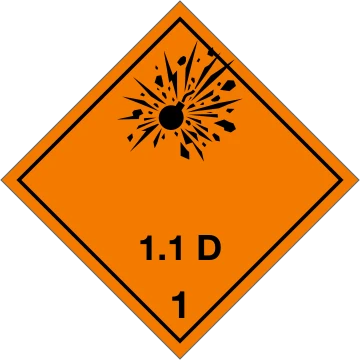
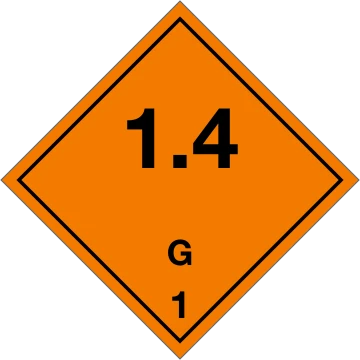
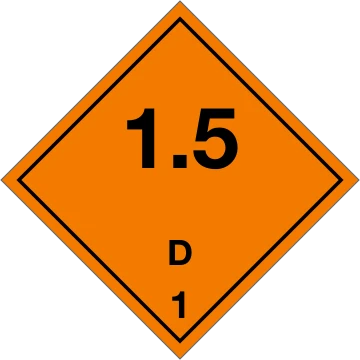
Substances and articles that explode, from mass-explosion hazards to articles that only burn or make a small pop. The compatibility group letter after the division (1.4S, 1.1D) decides which explosives may travel together.
- 1.1 mass explosion
- 1.2 projection hazard
- 1.3 fire hazard
- 1.4 no significant hazard
- 1.5 very insensitive, mass explosion
- 1.6 extremely insensitive articles
- Class 2
Gases
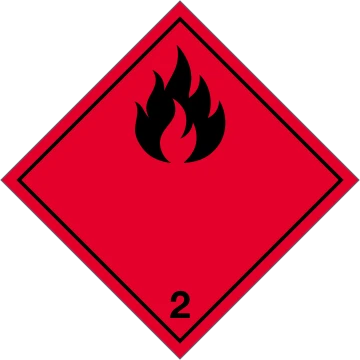
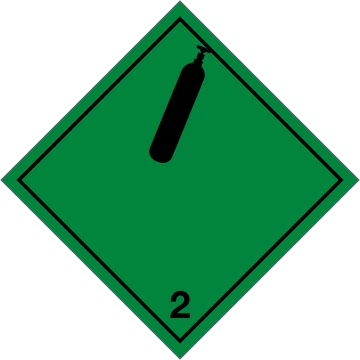
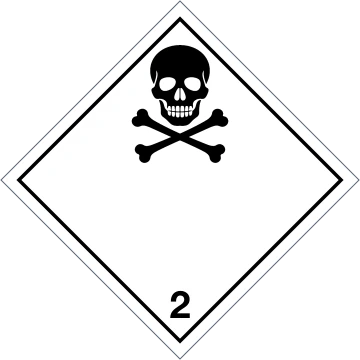
Compressed, liquefied, dissolved or refrigerated gases, and aerosols.
- 2.1 flammable gases
- 2.2 non-flammable, non-toxic gases
- 2.3 toxic gases
- Class 3
Flammable liquids
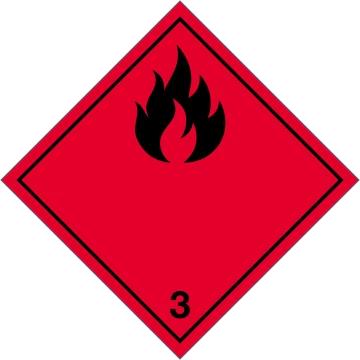
Liquids that give off flammable vapour at a flashpoint of 60 °C or below, such as petrol, paints and many solvents.
- Class 4
Flammable solids and similar
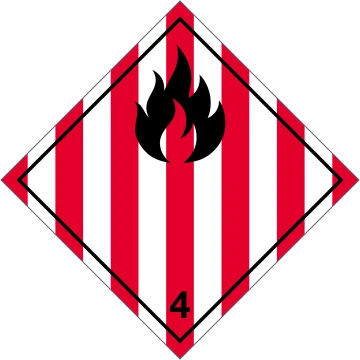
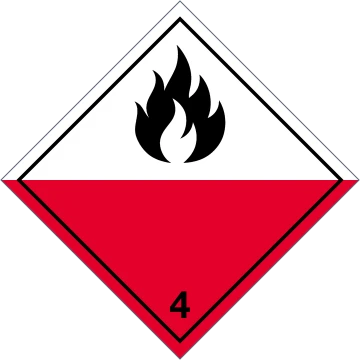
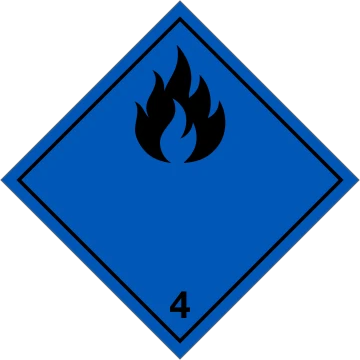
Solids that catch fire easily, heat up by themselves, or give off flammable gas with water.
- 4.1 flammable solids, self-reactive, polymerizing and solid desensitized explosives
- 4.2 liable to spontaneous combustion
- 4.3 dangerous when wet
- Class 5
Oxidizers and organic peroxides
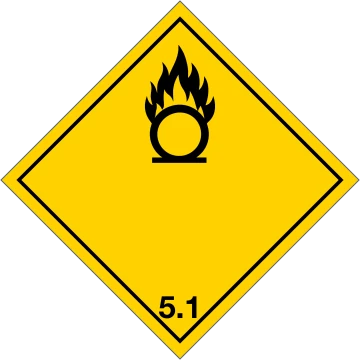
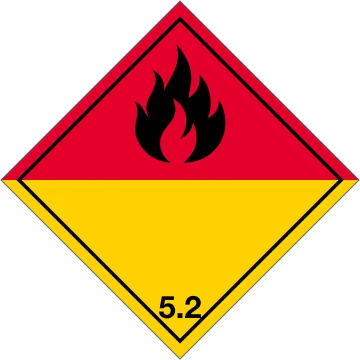
Substances that give up oxygen and make other materials burn fiercely, and unstable organic peroxides.
- 5.1 oxidizing substances
- 5.2 organic peroxides
- Class 6
Toxic and infectious substances
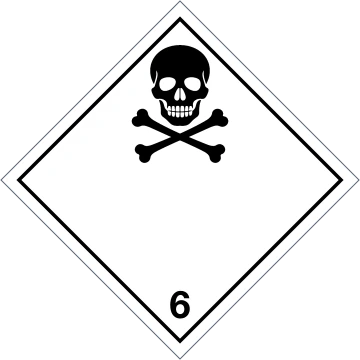
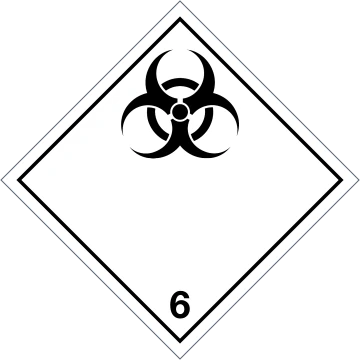
Poisons, and materials that carry pathogens such as medical and clinical samples.
- 6.1 toxic substances
- 6.2 infectious substances
- Class 7
Radioactive material
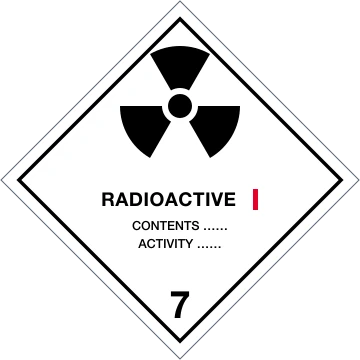
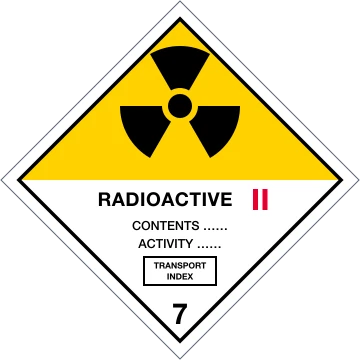
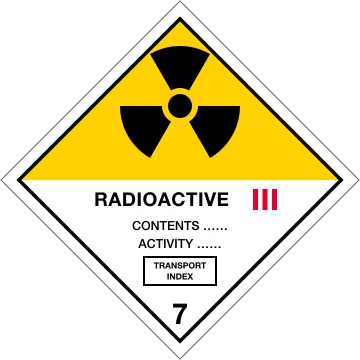
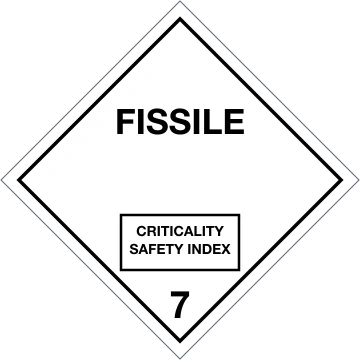
The label category (I-WHITE, II-YELLOW, III-YELLOW) rises with the radiation level at the package surface and the transport index; fissile material has its own label.
- Class 8
Corrosive substances
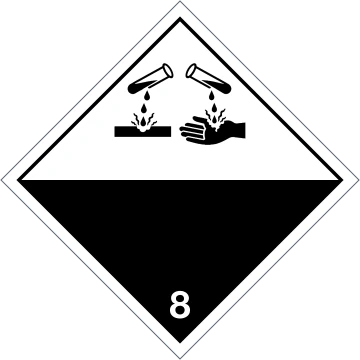
Acids, alkalis and other substances that damage skin or eat through metal.
- Class 9
Miscellaneous dangerous goods
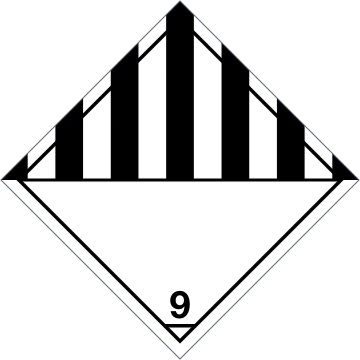
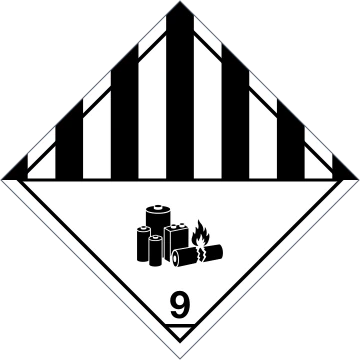
Hazards that fit no other class: lithium and sodium ion batteries (with their own 9A label), dry ice, asbestos, environmentally hazardous substances not covered elsewhere.
Reading the listUN numbers and the Dangerous Goods List
Each dangerous good, or group of goods, has a four-digit UN number from the UN Recommendations, for example UN 1203 for petrol or UN 1913 for refrigerated liquid neon. The same number is used by road, rail, air and sea, so it follows the cargo door to door.
The Dangerous Goods List in chapter 3.2 is a long table sorted by UN number. Each row gives the proper shipping name (the exact name to write on documents and packages), the class, any subsidiary hazard, the packing group, special provisions, how much may go as a limited or excepted quantity, the packing and tank instructions, the EmS codes, the stowage and segregation codes, and a column of properties and observations in plain words.
Reading the row is the first step for any shipment: it tells the shipper how to pack and mark the goods, and tells the ship how to stow them and what to do in a fire or spill. For example, IMDG 42-24 lists UN 1913 as class 2.2 with fire schedule F-C and spillage schedule S-V.
Degree of dangerPacking groups
Most classes are split further by degree of danger into three packing groups: I for great danger, II for medium danger and III for minor danger. The packing group decides how strong the packaging must be. UN packagings carry a code with a letter: X for groups I to III, Y for II and III, Z for III only.
Classes 1, 2, 7, divisions 5.2 and 6.2, and the self-reactive substances of 4.1 have no packing groups; they are controlled in other ways.
MARPOL Annex IIIMarine pollutants
Marine pollutant mark

Marine pollutants are substances harmful to the marine environment; this is where MARPOL Annex III comes in. They are classified under chapter 2.10 by their toxicity to fish, crustaceans and algae, and they keep their main class (a marine pollutant can be class 3 or 8, for example). If nothing else applies, they ship as class 9 environmentally hazardous substances.
Packages and cargo transport units carry the marine pollutant mark: a diamond with a dead fish and a dead tree, shown as well as the class label. The transport document says MARINE POLLUTANT after the description. Very small inner packagings have an exemption from the mark.
StowageSegregation in plain words
Segregation keeps goods that could react with each other far enough apart that a leak or fire in one does not set off the other. The DGL row and the segregation table in chapter 7.2 say, for each pair of classes, how far apart they must be. The table uses four terms, each stricter than the last:
1. Away from
Kept far enough apart that they cannot react dangerously in an accident, but they may share the same hold or deck. In practice at least 3 m apart horizontally.
2. Separated from
In different holds or compartments when under deck (a fire- and liquid-resistant deck between them counts). On deck, at least 6 m apart horizontally.
3. Separated by a complete compartment or hold from
A whole hold or compartment lies between them. On deck, at least 12 m apart.
4. Separated longitudinally by an intervening complete compartment or hold from
A whole hold or compartment between them in the fore-and-aft direction; one above the other is never enough. At least 24 m apart.
PaperworkThe documents
Dangerous goods transport document
The shipper's description of each dangerous good, in a set order: UN number, proper shipping name, class and any subsidiary hazard, packing group, and extras such as MARINE POLLUTANT, the flashpoint when 60 °C or below, and the quantity. It includes a signed declaration that the goods are correctly classified, packed, marked, labelled and in proper condition. Often called the dangerous goods declaration (DGD).
Container or vehicle packing certificate
Signed by the person responsible for packing the container or vehicle: it confirms the unit was clean and fit, that incompatible goods were not packed together, that the packages were secured and that the unit is marked and placarded. IMO's multimodal dangerous goods form combines it with the transport document.
Ship's list, manifest or stowage plan
On board, the ship keeps a special list, manifest or detailed stowage plan showing every dangerous good and where it is stowed, and has emergency response information for each one ready to hand.
EmergenciesEmS and MFAG: what to do in an emergency
The EmS Guide (Emergency Response Procedures for Ships Carrying Dangerous Goods) gives a fire schedule and a spillage schedule for each dangerous good. Fire schedules are coded F-A to F-J and spillage schedules S-A to S-Z; the two codes for each substance are in the DGL row, so the crew can turn straight to the right page. The schedules take account of the type of ship, the quantity and packaging, and whether the goods are on deck or under deck.
The MFAG (Medical First Aid Guide for Use in Accidents Involving Dangerous Goods) is published jointly by IMO, the WHO and the ILO as the chemicals supplement to the International Medical Guide for Ships. It tells the crew how to treat poisoning, burns and exposure. Both guides are in the IMDG Code Supplement.
PeopleWho needs IMDG training
Chapter 1.3 of the Code requires training for shore-based personnel who take part in shipping dangerous goods by sea: those who classify, pack, mark, label and placard, fill in documents, load and unload containers, offer goods for shipment, accept them at the terminal, and plan stowage. Training must fit each person's job.
It comes in layers: general awareness of the Code, function-specific training for the person's tasks, and safety training on the hazards and what to do in an emergency. Someone not yet trained may work only under the direct supervision of a trained person, and training is refreshed as the Code changes. IMO lists the detail of 1.3.1.4 to 1.3.1.7 as recommendatory.
Seafarers are trained for dangerous cargo through STCW and their company's safety management system under the ISM Code, rather than through chapter 1.3. Officers in charge of cargo still need to read the Code itself.
Practise: free 40-question IMDG quiz
Our own practice questions on classes, labels, UN numbers, packing groups, segregation, documents, EmS and training, each with an explanation. They are practice questions written by IALACOLREG, not an official IMO or training-centre question bank, and passing them is not a certificate.
Questions people ask
What does IMDG stand for?
International Maritime Dangerous Goods. The IMDG Code is IMO's code for carrying dangerous goods by sea in packaged form.
Is the IMDG Code mandatory?
Yes. It has been mandatory under SOLAS chapter VII since 1 January 2004, and it carries out MARPOL Annex III for marine pollutants. A few parts, such as the training detail in 1.3.1.4 to 1.3.1.7, stay recommendatory.
What is the latest IMDG amendment?
Amendment 42-24 (2024 Edition) has been mandatory since 1 January 2026. Amendment 43-26 was adopted on 21 May 2026; it may be used voluntarily from 1 January 2027 and becomes mandatory on 1 January 2028.
How many classes are in the IMDG Code?
Nine: explosives, gases, flammable liquids, flammable solids, oxidizers and organic peroxides, toxic and infectious substances, radioactive material, corrosives and miscellaneous dangerous goods. Classes 1, 2, 4, 5 and 6 have divisions.
What is the difference between 'away from' and 'separated from'?
'Away from' allows the goods in the same hold or on the same deck, at least 3 m apart. 'Separated from' needs different holds or compartments under deck, or at least 6 m apart on deck.
Who has to be trained in the IMDG Code?
Under chapter 1.3, every shore-based person involved in shipping dangerous goods by sea, trained for their own job: shippers, packers, forwarders, terminal and shipping-line staff. Seafarers are trained under STCW and the ISM Code.
Does this site issue IMDG certificates?
No. IALACOLREG explains the Code and offers free practice questions. IMDG training certificates come from training providers and employers; check what your company or authority accepts.
The IMDG Code is published by IMO and is IMO copyright. This page explains it in our own words and reproduces none of its tables. For any real shipment, use the current edition of the Code.