

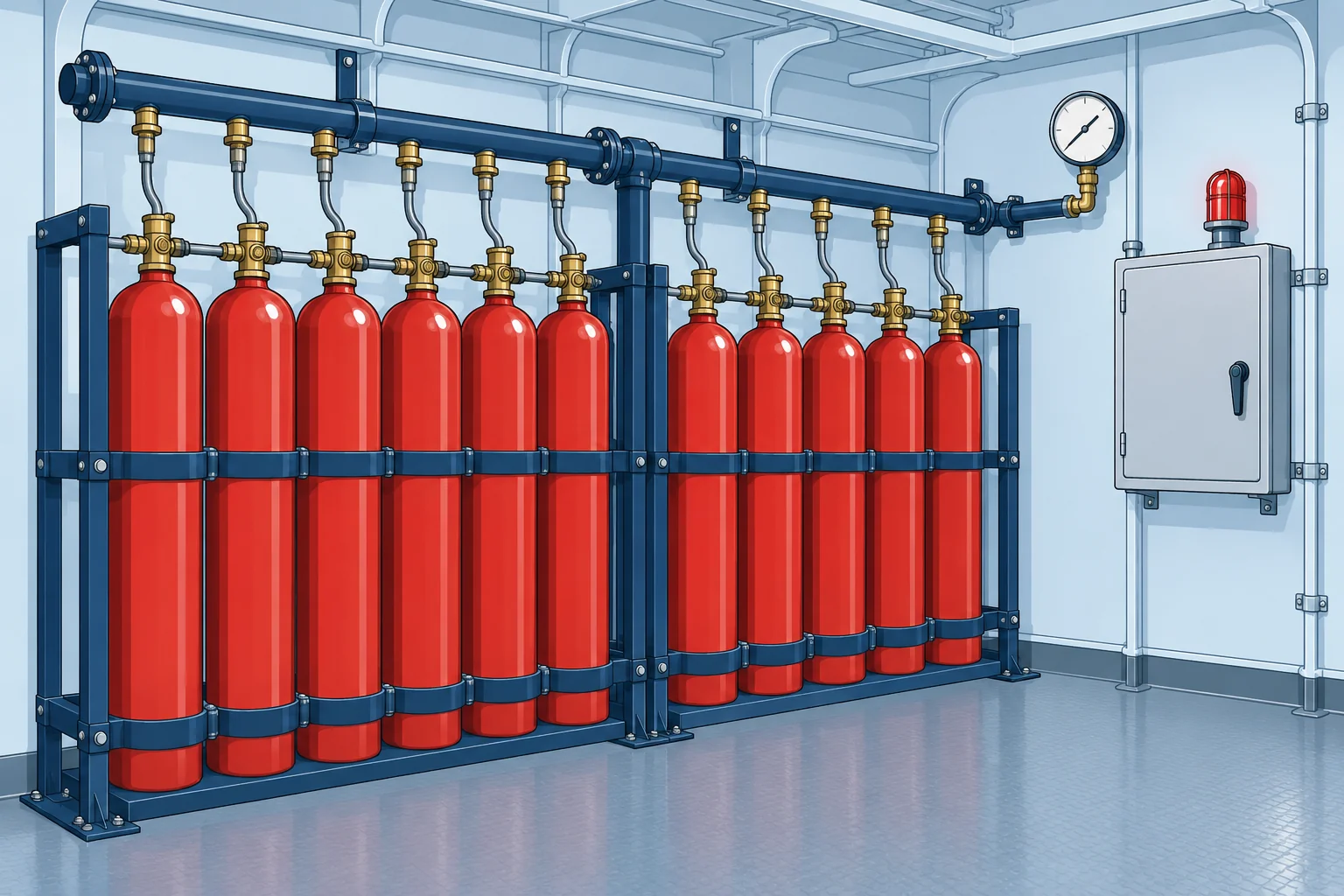
Managing fixed systems: the release decision and after
1The lesson in plain words
Use fixed systems under approved instructions. Confirm release conditions, keep the space sealed as required, and plan safe re-entry with the master.
The decision
Releasing CO₂ ends any attack by people and makes the space deadly. The master decides, advised by the chief engineer and the on-scene commander. Release when the fire is beyond the fire party’s control or entry is too dangerous. First, everyone out and counted by name, openings and dampers shut, fans and fuel stopped. A late release with open doors wastes the available charge.
Machinery spaces and holds
Discharge the prescribed machinery-space CO₂ charge rapidly: 85 % within 2 minutes. A hold fire usually smoulders deep in the cargo. Hold systems carry gas for 30 % of the gross volume of the largest hold. In container and general cargo holds at least two-thirds of the gas can go in within 10 minutes (solid bulk: 20 minutes), and the controls allow one third, two thirds or all of it, based on the hold’s loading condition. Top up if temperatures rise; keep the hold sealed, sometimes until port.
Waiting before re-entry
CO₂ suppresses fire but hardly cools it. Keep the space sealed; cool and monitor boundaries until temperatures have fallen and stayed down. There is no universal waiting time. Follow the master’s authorised re-entry plan. Assess reignition and explosion risks before initial entry; BA does not protect against explosion. Initial entry needs BA, backup, communications and charged hoses. Coordinate ventilation and test oxygen, CO₂, flammable vapours and relevant toxic gases before unprotected entry.
Water mist and local application
Local application protects a particular hazard, such as a purifier or engine fuel equipment. Use it promptly under the installed instructions; it can operate without waiting for evacuation or machinery shutdown. Smoke, heat and toxic gases still make the space dangerous, so you still need BA. Whole-space water-mist systems have different operating conditions: follow their instructions. Coordinate electrical isolation without delaying an approved local system.
High-expansion foam
High-expansion foam fills the protected space with light foam. The system must fill the largest protected space within 10 minutes. Inside-air systems use air from the protected space; outside-air systems use outside air. Follow the installed ventilation shutdown, closing and pressure-relief arrangements; do not obstruct designated foam outlets or vents. Foam hides openings and obstacles and does not provide breathable air. Any authorised re-entry needs BA, lifelines, charged hoses, communications, entry control and a ready backup team.
2Key data
- CO₂ pre-discharge alarm
- At least 20 s before release (FSS Code ch. 5)
- Machinery-space CO₂
- 85 % of the prescribed charge discharged within 2 minutes
- Cargo-hold CO₂
- Gas for 30 % of the gross volume of the largest hold
- Container and general cargo holds
- Two-thirds within 10 min; release 1/3, 2/3 or all by loading
- High-expansion foam
- Fills the largest protected space within 10 minutes
- Re-entry after CO₂
- Authorised plan: cooling, protected entry, ventilation and gas tests
3Key points
- 1
The master decides on release; everyone must be out and counted by name first.
- 2
Machinery space: 85 % in 2 minutes. Hold: 30 % of gross volume, released in thirds to suit the load; keep sealed.
- 3
CO₂ hardly cools: opening too early can cause reignition. Follow the master’s authorised re-entry plan.
- 4
Use approved local application promptly; it does not make the fire space safe to breathe.
- 5
Foam hides hazards and does not supply breathable air; authorised re-entry needs BA and rescue cover.
4Frequent mistakes
Wrong: Open the engine room an hour after the CO₂ release to see if the fire is out.
Right: Keep it sealed and cool and monitor boundaries until temperatures stay down. Follow the authorised entry, ventilation and gas-testing plan.
Wrong: Release the full hold charge at once and open the hatch the next morning.
Right: Hold fires smoulder: release the part charge the loading condition and instructions call for, top up if needed, and keep the hold sealed, often until port.
Wrong: Delay the CO₂ decision while one more hose team tries.
Right: When entry is no longer safe, clear the space and release; a delayed release into a hotter fire may fail.
5Practice case & exam keys
A fuel-spray fire in the engine room has spread beyond the local water-mist area. Heat has driven the attack team out. The chief engineer reports all engine staff out, fuel pumps stopped and quick-closing valves shut. One skylight is still open.
Show the answer
Confirm everyone is out and counted by name with the bridge. Check fuel isolation and confirm fans are stopped; close the skylight and verify all openings and dampers. Then obtain the master’s release order and follow the approved discharge sequence. Log the time, keep the space sealed and monitor temperatures while maintaining boundary cooling.
Exam keys
- Before CO₂: persons counted, openings closed, ventilation and fuel stopped; the master decides.
- Machinery spaces: 85 % in 2 minutes. Holds: 30 % of gross volume; container holds two-thirds in 10 min, staged release.
- Authorised re-entry: BA, backup, communications and hoses; coordinate ventilation and test oxygen, CO₂, flammable vapours and relevant toxic gases before unprotected entry.
- High-expansion foam: largest protected space filled within 10 minutes.
Finish this unit
When you've read it, answer three questions. Get all three right to finish the unit; opening the page alone doesn't count.
My notes for this unit
No notes