

Taking command of a fire and training fire parties
1The lesson in plain words
At officer level you direct firefighting: one commander, clear teams, a command post and training that fits your ship.
Who commands
The master has overall command, normally from the bridge, which acts as the command centre: it holds the fire control plan, the fire panel, the radios and the logbook. The on-scene commander, usually the chief officer (or the chief engineer for a machinery-space fire), directs firefighting at the scene. With an A-VI/3 certificate (advanced fire fighting under STCW regulation VI/3) that may be you, so you must think about the whole fire.
The command post
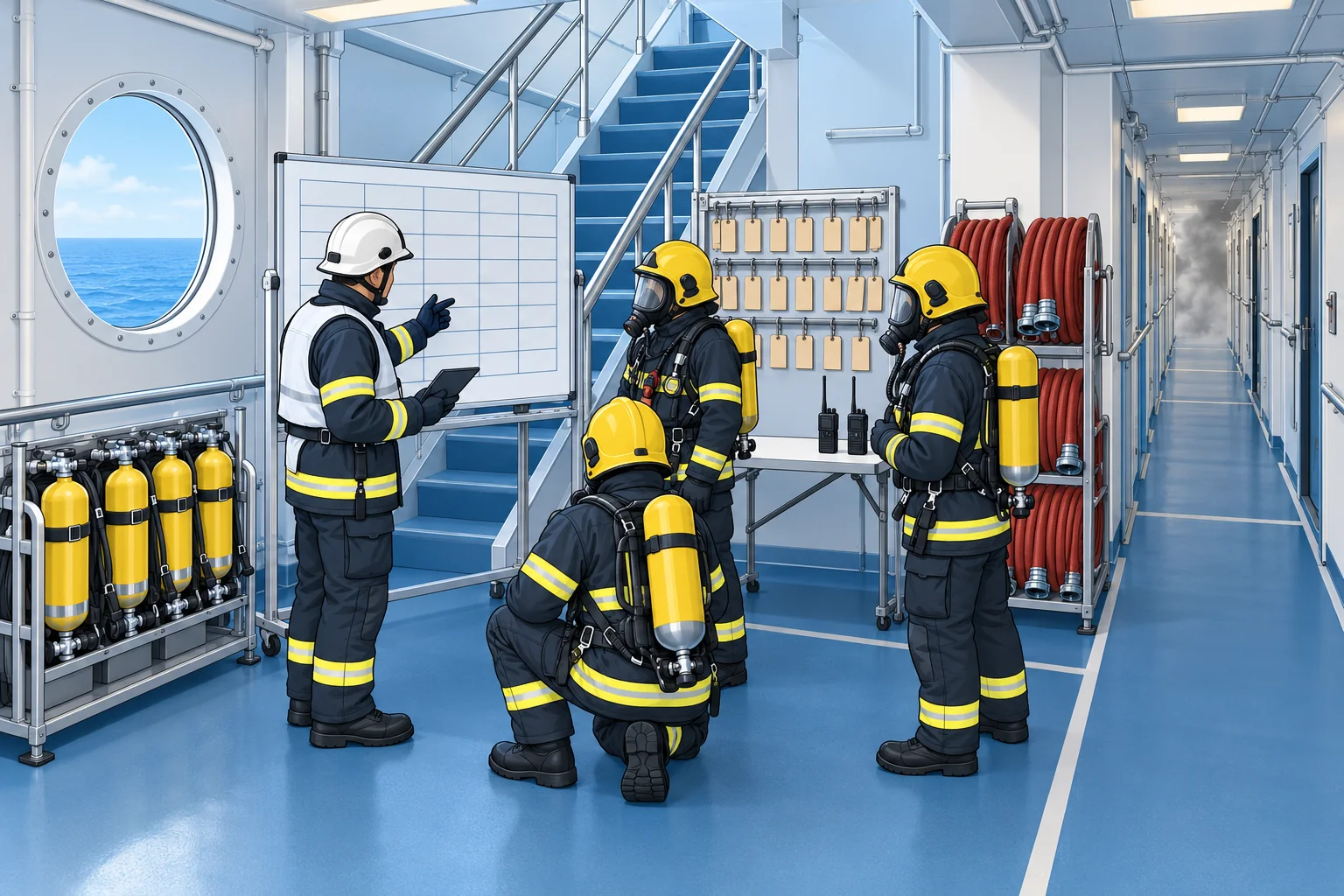
Set up a forward command post near the entry, in clean air with a safe escape route and a radio link to the bridge. The on-scene commander directs operations there. The breathing apparatus (BA) controller records each team’s names, entry time, cylinder pressures and agreed withdrawal limits, tracks reports, and warns when withdrawal or relief is due. Move the post if smoke threatens it, and tell every team.
Information flow
Use one radio channel for the fire party and a second channel, or the phone, between the scene and the bridge. Teams report to the on-scene commander, who reports to the bridge. The bridge keeps a timeline: alarm, muster, entries, isolations, boundaries checked, fixed-system decisions. Insist on short messages that are repeated back, and regular situation reports. Silence from a team inside is treated as a problem, not as good news.
Organising people
Assign attack, backup, boundary cooling, ventilation, isolation, first aid and support teams. The backup team stands ready in BA at the entry before the attack team goes in. Plan reliefs early: heat and hard work exhaust teams. Life safety comes first. Confirm missing people’s names and last-known positions, then assess whether a protected rescue is viable. Do not commit crews to untenable conditions: heat or smoke that prevents safe entry and withdrawal.
Training fire parties
STCW expects you to organise and train fire parties. Train for your ship's real risks: fuel spray in the engine room, the galley, cabins, cargo, and the special cases of tankers or car carriers. Change the scenario and the location, use smoke generators or blacked-out masks, let different people lead, and debrief honestly. A drill that always ends at the same hydrant teaches very little.
2Step by step
Taking charge at the scene
- 1
Confirm the headcount, names and last-known positions of missing people with the bridge.
Life safety comes first; assess whether a protected rescue is viable. Do not enter untenable conditions.
- 2
Size up: where the fire is, what is burning, where it is spreading, what hazards are near.
You can only choose a tactic for a fire you have understood.
- 3
Set up the forward command post and BA entry control in clean air.
The controller records teams, entry times, pressures and withdrawal limits, tracks reports and warns when relief is due.
- 4
Agree stopping ventilation, closing openings and isolating fuel and power that is not needed.
It starves the fire and protects the teams.
- 5
Commit the attack team when backup, a protected withdrawal route and any boundary cooling needed for safe entry are ready.
Backup provides rescue cover; boundary protection must match the fire and entry route.
- 6
Report to the bridge and reassess at agreed intervals.
Fires change; the master needs a current picture for big decisions.
3Key data
- STCW basis
- Regulation VI/3; Code table A-VI/3, advanced fire fighting
- Four competences
- Control, organise and train, inspect and service, investigate
- Comes after
- Basic fire fighting, STCW A-VI/1-2
- Keeping it valid
- Evidence of the standard of competence every 5 years
4Key points
- 1
The master has overall command; the on-scene commander directs firefighting from a forward command post.
- 2
The backup team is ready in BA at the entry point before the attack team goes in.
- 3
Reports follow the chain, and the bridge keeps a timeline of every event and decision.
- 4
Confirm names and last-known positions; assess a protected rescue. Never commit crews to untenable conditions.
- 5
Train on your ship's real risks, vary scenarios and let different people lead.
5Frequent mistakes
Wrong: The on-scene commander leads the attack team into the space.
Right: The commander stays at the command post: from inside the smoke you cannot see the whole fire or run the teams.
Wrong: Send the attack team in as soon as it is dressed; the backup can follow.
Right: The backup team is dressed and ready at the entry point before anyone goes in.
Wrong: Run the fire drill at the same place each month so everyone knows the routine.
Right: Vary the location and the scenario; a routine drill tests memory, not readiness.
6Practice case & exam keys
You are chief officer. A fire is reported in the laundry on the upper deck. Two crew members are missing from the muster. The attack team is putting on BA and the second officer asks you what to do next.
Show the answer
Confirm names and last-known positions. Assess whether a protected search is viable; do not enter untenable conditions. Set the command post and BA entry control in clean air, with backup ready before entry. Arrange agreed ventilation and power isolation and boundary cooling. Report to the master and reassess as conditions change.
Exam keys
- Master: overall command from the bridge; on-scene commander: forward command post in clean air.
- Backup team ready before entry; BA entry control board at the entry point.
- Information flows up the chain; the bridge keeps the timeline.
- Table A-VI/3: control, organise and train, inspect and service, investigate.
Finish this unit
When you've read it, answer three questions. Get all three right to finish the unit; opening the page alone doesn't count.
My notes for this unit
No notes