

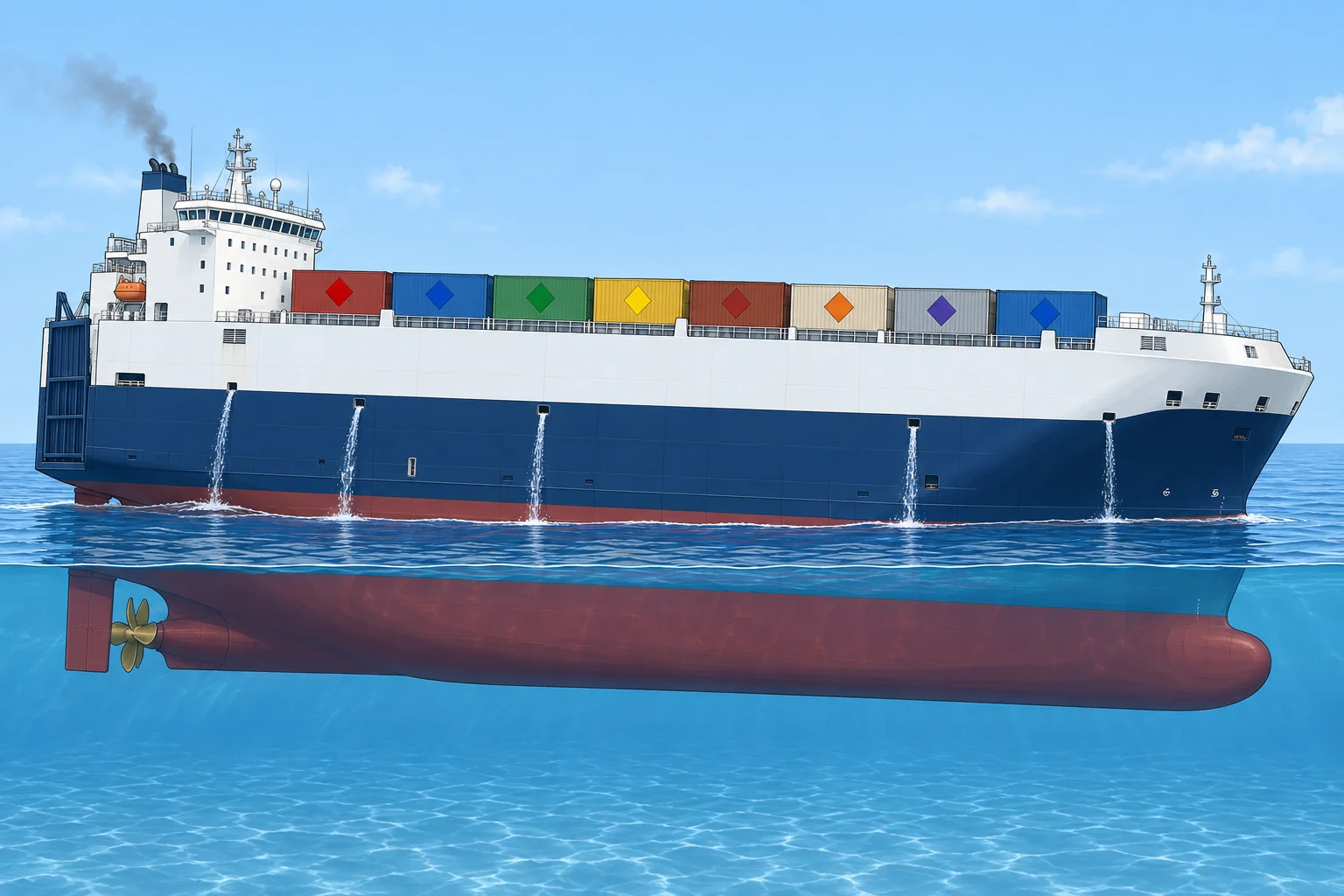
Firefighting water, stability and dangerous goods
1The lesson in plain words
Firefighting water can capsize the ship, and burning cargo may need special treatment. Watch stability and check cargo emergency guidance before you attack.
Water you add
Track retained firefighting water: hose inflow minus drainage, pumping and other losses, including evaporation. High in the ship it raises the centre of gravity (G), and loose water across a deck adds a free surface effect, which acts like a further rise of G. Both reduce the metacentric height (GM), the measure of initial stability. A slow list that does not come back can mean water collecting on one side.
A worked example
Four hoses each deliver 15 tonnes an hour. With no drainage or other losses, two hours leaves 4 × 15 × 2 = 120 t on board. On a 10,000 t ship, if that water lies 8 m above G, the rise of G is about 120 × 8 ÷ 10,120 ≈ 0.09 m. That is before the free surface effect, which can be many times larger if the water spreads across a wide deck. Tell the chief officer, and plan drainage early.
Controlling the water
Use the nozzle pattern and flow needed for the fire and cargo emergency guidance. Spray is not automatically a lower flow. Shut unnecessary streams and arrange drainage early. Clear scuppers (deck drains) and use portable pumps or eductors (water-driven suction pumps). Keep vehicle-deck drains clear. Ask the engine room to watch bilges and tanks. If stability is in doubt, the master may reduce the water and accept more fire damage to save the ship.
Dangerous goods on fire
For packaged dangerous goods under the IMDG Code (International Maritime Dangerous Goods Code), identify cargo and location from the dangerous goods manifest and stowage plan. Use the UN number (cargo identifier) to find its EmS codes in Dangerous Goods List column 15. The EmS Guide (emergency response procedures for ships carrying dangerous goods) gives fire schedules, F-A to F-J, and spillage schedules, S-A to S-Z. Use both to choose safe agents, application and cooling methods.
Toxic smoke and reactive cargo
Burning cargo can give off toxic or corrosive smoke. Keep unprotected crew clear and upwind. Fire teams need BA and protective clothing suited to the chemical hazard; ordinary fire outfits are not chemical suits. Use the Medical First Aid Guide (MFAG) for crew exposed to chemicals. Some cargoes react with water; some, such as oxidising cargoes, supply their own oxygen, so smothering with CO₂ does not work. Ask the company and its shore experts for advice early.
2Key data
- Rise of G
- Weight × height above G ÷ new displacement
- Free surface
- Loose water reduces GM; wide decks are the worst
- EmS fire schedules
- F-A to F-J
- EmS spillage schedules
- S-A to S-Z
- Where to find the codes
- IMDG Dangerous Goods List, column 15; identify cargo by UN number
- Chemical exposure
- Medical First Aid Guide (MFAG)
3Key points
- 1
Water retained above G raises G; loose water adds free surface and reduces effective GM.
- 2
Work out the tonnes you are adding, and plan drainage early.
- 3
Match flow and pattern to the fire; shut unnecessary streams and keep drains clear.
- 4
Dangerous goods: find the EmS fire and spillage schedules before you attack.
- 5
Oxidising cargo makes its own oxygen; CO₂ smothering will not work on it.
4Frequent mistakes
Wrong: More water is always safer in a big fire.
Right: Water high in the ship and loose on decks can capsize her; use only what the fire needs and drain it.
Wrong: Treat a burning container like any other fire and use jets.
Right: Check the DG manifest and EmS first; choose the agent, application and cooling method for the cargo.
5Practice case & exam keys
After 90 minutes fighting a fire in the accommodation on a ro-ro ship, the ship has taken a 4° list to port that is slowly increasing. Water is running along the vehicle deck below. Three hoses are still running, one of them on a boundary that is already cool.
Show the answer
Alert the master: the growing list is a stability emergency. Stop only streams confirmed unnecessary; preserve attack-team protection and essential boundary cooling. Keep monitoring the boundary. Clear vehicle-deck drains, start pumping, and check bilges and tanks with the engine room. Have the chief officer assess retained water and free surface. Do not ballast to correct the list until its cause is known.
Exam keys
- Water retained above G raises G; loose water adds free surface and reduces effective GM.
- Rise of G = weight × height ÷ new displacement.
- EmS Guide: fire schedules F-A to F-J, spillage schedules S-A to S-Z.
- Identify cargo from the manifest and stowage plan; use its UN number to find the EmS codes.
Finish this unit
When you've read it, answer three questions. Get all three right to finish the unit; opening the page alone doesn't count.
My notes for this unit
No notes