

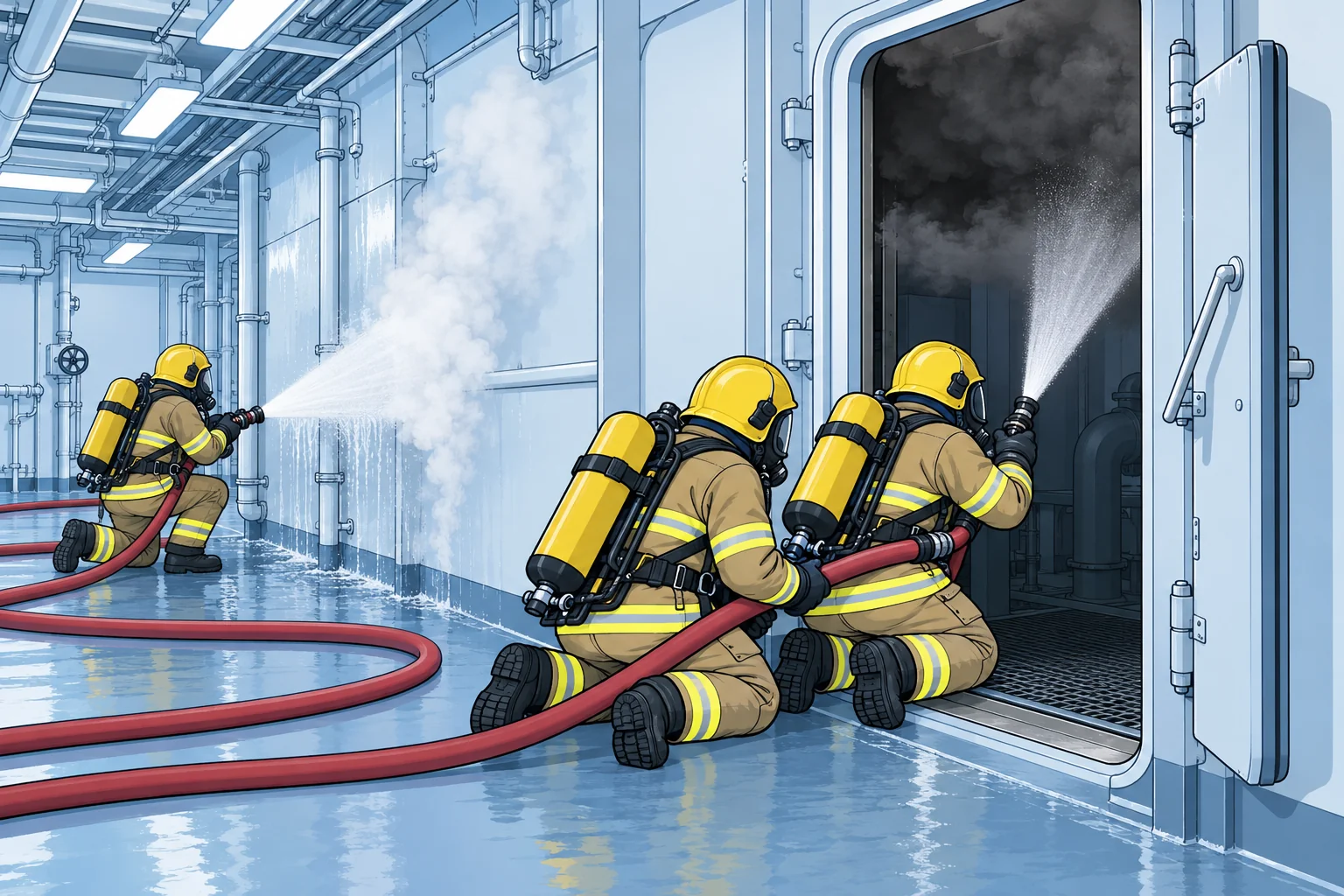
Fire tactics: attack, starve, ventilate and isolate
1The lesson in plain words
Size up first, then choose: go in and put it out, or hold the boundaries, starve the fire of fuel and air, and let time or a fixed system finish it.
Size up first
Before you choose a tactic, answer four questions: where exactly is the fire, what is burning, where is it spreading, and who might be inside? Use the fire control plan, the fire panel, a thermal imaging camera (TIC, which shows heat through smoke) and reports from people who escaped. Then choose an offensive attack (a team goes in to put it out) or a defensive one (you hold the boundaries while a fixed system or time does the work).
Direct and indirect attack
A direct attack applies water or foam to burning material. An indirect attack applies water to hot compartment surfaces from outside to generate steam. Use it only when nobody is inside: steam and displaced hot gases can cause fatal burns. Keep crews clear of escaping steam. Short fine-spray pulses into the gas layer are gas cooling, a different technique. Short pulses do not guarantee protection from scalding. Follow your ship’s training for nozzle pattern, flow and position.
Boundary starvation
Boundary starvation means taking the fuel away from around the fire: move or protect anything that can burn in the next spaces, such as paint, mattresses, stores or cargo. It works together with boundary cooling, which keeps the steel too cool to ignite things on the far side. Together they turn a growing fire into a contained one, even before anyone attacks it.
Ventilation and smoke
Normally you keep the space shut to starve the fire. Sometimes you ventilate on purpose, called smoke extraction, to clear an escape route or help a team find a casualty. Do it only to a plan: hoses charged, the team ready, an exit path for the smoke, ideally on the downwind side. Opening at the wrong time feeds a smouldering fire and can cause a backdraught or flashover (see Fire theory).
Isolating fuel and power
Stop fuel and lubricating-oil pumps, close the quick-closing valves and isolate the electrical supply to the area, while keeping the lighting, fire pumps and emergency power you still need. Shut off hydraulic and thermal-oil lines that run through the space. Agree every isolation with the engine room and log it, so nothing is restarted by mistake while a team is inside.
2Key data
- Offensive attack
- A team goes in to extinguish; needs backup and a way out
- Defensive attack
- Hold the boundaries; starve the fire or use a fixed system
- Indirect attack
- Water on hot surfaces from outside; compartment must be unoccupied
- Boundary starvation
- Remove or protect fuel in the spaces around the fire
- Smoke extraction
- Only to a plan, with hoses charged and the team ready
3Key points
- 1
Size up before you act: location, fuel, spread and people inside.
- 2
Offensive when the fire can be reached safely; defensive when it cannot.
- 3
Indirect attack generates steam from hot surfaces in an unoccupied compartment; gas cooling is a different technique.
- 4
Boundary starvation and cooling contain the fire from outside.
- 5
Ventilate only to a plan; isolate fuel and power, and log every isolation.
4Frequent mistakes
Wrong: Open the space to let the smoke out as soon as possible.
Right: Keep it closed unless you ventilate to a plan, with charged hoses ready; fresh air can make the fire explode.
Wrong: Short spray pulses make a steam attack safe with people still inside.
Right: Indirect steam attack needs an unoccupied compartment. Keep crews clear of escaping steam; short pulses do not prevent all scalding.
Wrong: Isolate all electrical power on the ship at once.
Right: Isolate the affected area but keep the fire pumps, lighting and emergency power you need.
5Practice case & exam keys
Smoke is coming from under the door of the paint store forward. The door is hot at head height. Nobody is missing. The store is next to the bosun's store, which holds rope and drums of thinner.
Show the answer
The hot door suggests dangerous entry conditions. Keep it shut and choose defensive tactics; nobody is reported missing. Close down ventilation to the forecastle, cool the paint-store boundaries and the deck above, and starve the boundary by moving the thinner drums out of the bosun's store if it is safe. If the store has a fixed system, prepare it for the master's decision. Keep a charged hose at the door.
Exam keys
- Offensive attack: team enters; defensive: boundaries held while the fire is starved.
- Indirect attack: water on hot surfaces from outside an unoccupied compartment; steam can cause fatal burns.
- Boundary starvation removes fuel next to the fire; boundary cooling protects the steel.
- Ventilation and smoke extraction only to a plan, with hoses charged.
Finish this unit
When you've read it, answer three questions. Get all three right to finish the unit; opening the page alone doesn't count.
My notes for this unit
No notes