

Running MOB, fire and abandon-ship drills
1The lesson in plain words
A drill done once in calm water is worth ten read about. Practise MOB, fire and abandon-ship until the first steps happen without thinking.
Why drill
Under stress, people do what they have practised and freeze at what they have not. For races using World Sailing’s Offshore Special Regulations (OSR), crews must practise crew-overboard recovery and abandoning ship at least annually. Make drills short, safe and regular, and include fire. Start in calm water with plenty of room, then try a little more wind or the dark.
MOB drill
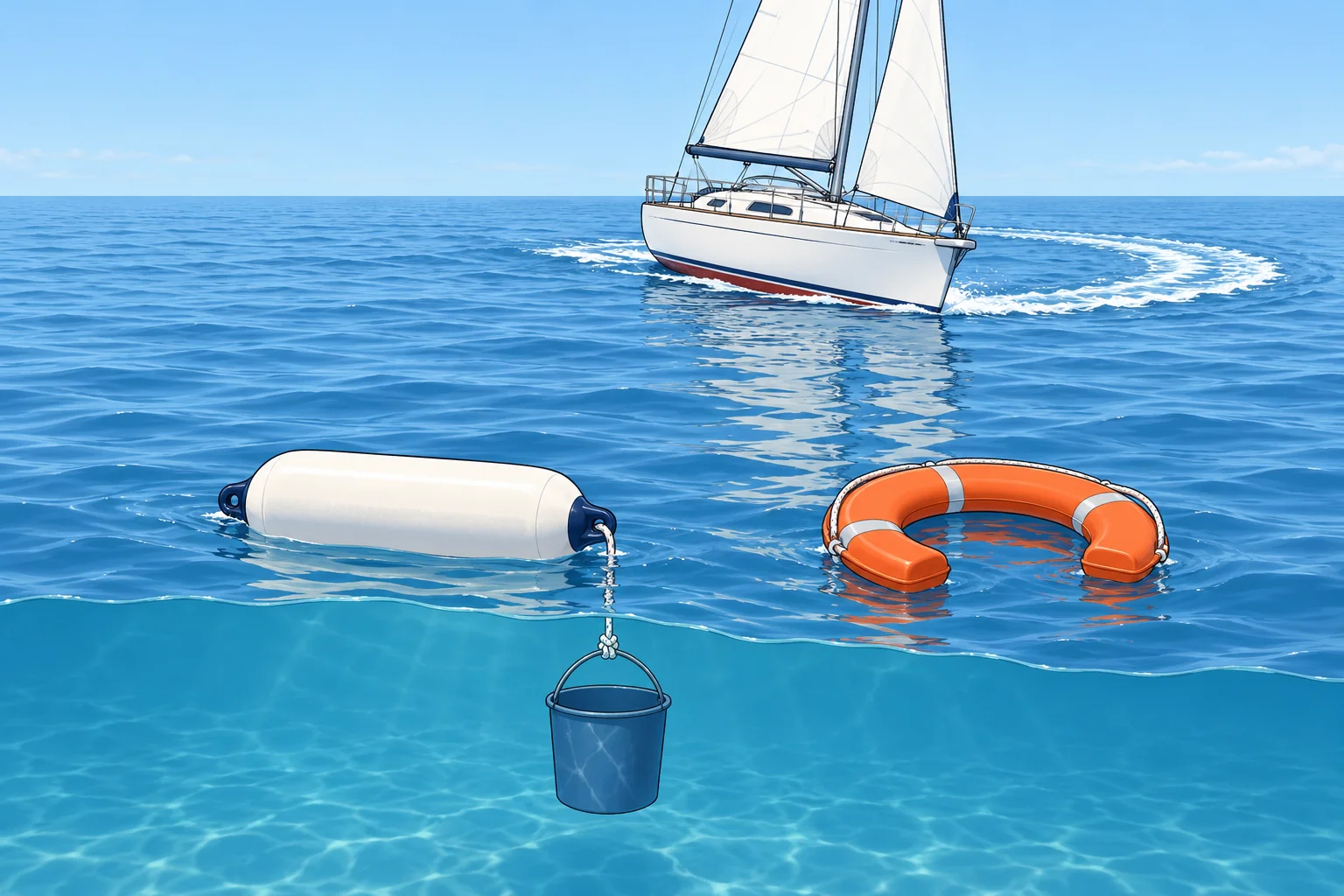
Throw a fender tied to a bucket, which drifts like a person, without warning, shouting ‘Man overboard!’. The crew run the first actions: shout, throw, point, press MOB, call. The helm chooses the manoeuvre and returns. Recover the dummy aboard using your boat’s planned recovery method. Then let a less experienced crew member helm while the skipper plays ‘overboard’ by watching only.
Fire drill
Announce ‘Drill: fire in the engine compartment’. Identify the engine stop, fuel shut-off and ventilation closures. Simulate operating them unless the skipper has confirmed that a real shutdown is safe and planned. Identify the fire port (an opening for discharging an extinguisher); do not open the engine compartment or discharge equipment. Rehearse a Mayday off air. Vary the scenario: galley, cabin, electrical. Check that everyone can find the extinguishers and fire blanket.
Abandon-ship drill
On a calm day at the mooring, walk through the steps: Mayday and EPIRB (simulated), warm clothes and lifejackets, grab bag to the cockpit, liferaft ready, who does what. Time it. Take a sea survival course: inflating and boarding a real raft in a pool is the best practice there is, as it is not done with your own raft.
Stay safe
Never use a person in the water for a drill. Simulate radio calls on a trainer, or with an instructor using a properly isolated dummy load, never on air. Tell the crew it is a drill, keep watch for other boats and stop if anything goes wrong.
2Step by step
Running a man-overboard drill
- 1
Pick calm water with room, brief that drills will happen, and keep a lookout.
The drill must not create a real emergency.
- 2
Throw the dummy without warning and shout ‘Man overboard!’.
Surprise tests the first reactions.
- 3
Let the crew run the first actions and the manoeuvre while you watch.
They learn by doing, not by being told.
- 4
Practise bringing the dummy aboard using your boat’s recovery equipment.
This rehearses the recovery sequence; a light dummy does not prove you can lift a person aboard.
- 5
Time it and swap roles so another crew member helms.
Anyone may have to do it, including when the skipper is overboard.
- 6
Debrief briefly on what worked and what to change.
Each drill makes the next one better.
3Key points
- 1
Practise MOB and abandonment at least annually; include regular fire drills.
- 2
Use a fender and bucket as an MOB dummy; never a real person.
- 3
Swap roles so others helm, not only the skipper.
- 4
Simulate radio calls off air.
- 5
A sea survival course gives real liferaft practice.
4Frequent mistakes
Wrong: Inflate your own liferaft for practice.
Right: It must then be repacked by a service station. Practise on a course with a training raft.
Wrong: Use a real Mayday on Channel 16 to make the drill realistic.
Right: Practise on a simulator or with an instructor using a properly isolated dummy load. A false Mayday can start a real search.
5Practice case & exam keys
You planned an MOB drill today. The crew are new, the harbour entrance is busy and the wind is rising. Tomorrow offers sheltered water. What do you practise now, and what waits?
Show the answer
Do a clearly announced walkthrough at the berth now. Rehearse roles and calls off air. Postpone the dummy recovery until you have calm, clear water and a dedicated lookout. Brief stop conditions, then run the drill, swap roles and debrief. Fit fire and abandon-ship walkthroughs around safe conditions, rather than a fixed timetable.
Exam keys
- Practise MOB and abandonment at least annually, more with new crew; include regular fire drills.
- MOB dummy: fender and bucket; full cycle including recovery aboard.
- Fire drill by location; abandon drill as a walkthrough; sea survival course for rafts.
- Safety: never a person in the water, radio calls off air, keep a lookout.
Open practise
It opens here in IALACOLREG Academy. When you finish, come back to this unit: your result counts towards this module.
My notes for this unit
No notes