

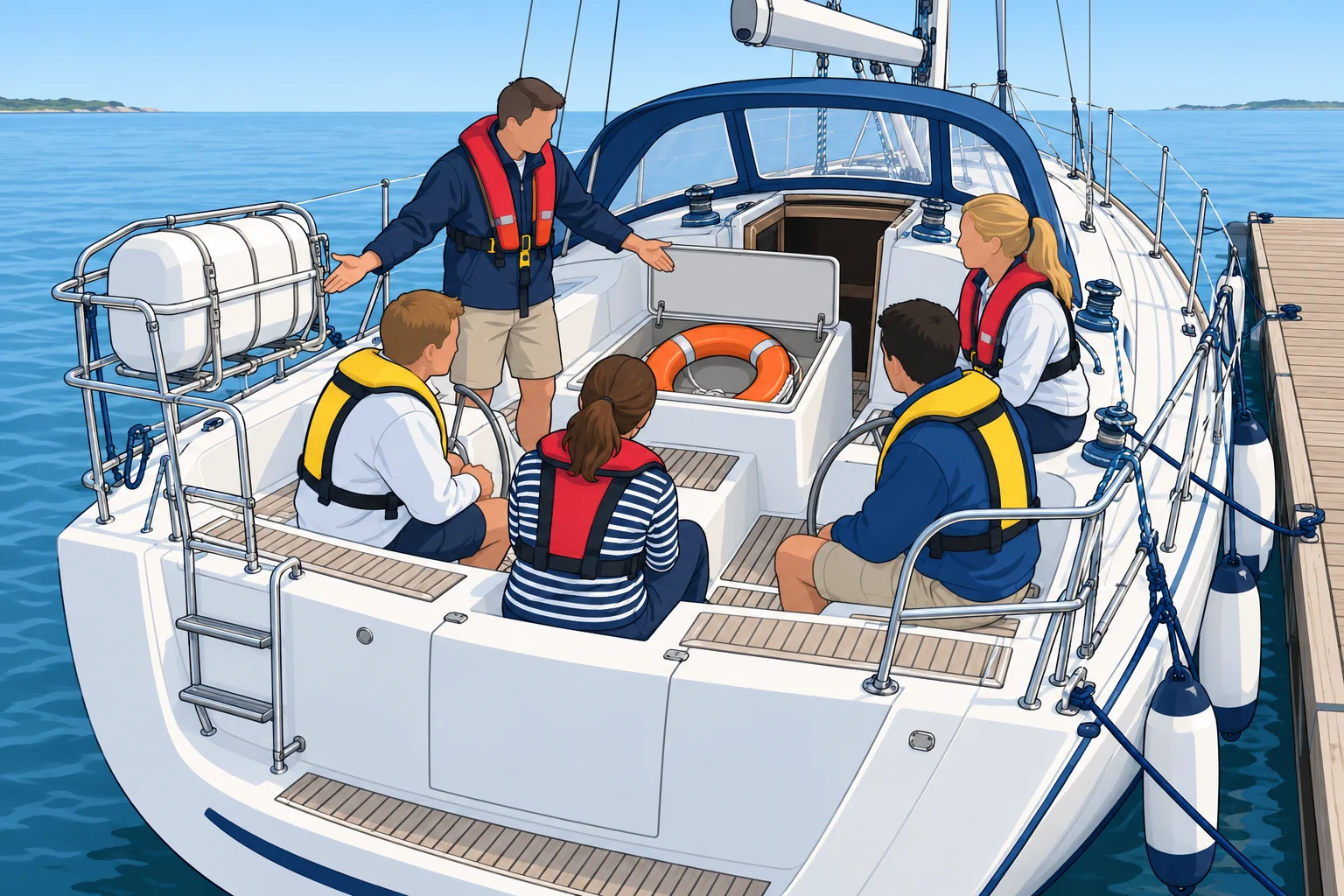
The safety briefing before departure
1The lesson in plain words
Before you cast off, every person aboard learns where the kit is, how to use it and what to do if the skipper is the one in trouble.
Why brief
A crew that has never seen the liferaft or the radio cannot use them in the dark. The briefing turns passengers into crew. Do it every time with new people aboard, and refresh it at the start of a season or a long passage. Keep it short, practical and on the spot: show, don’t just tell.
What to cover
Lifejackets and harnesses: when to wear them and how they fit. Moving safely on deck: one hand for you, one for the boat. The heads, the marine toilet, the cooker and gas, and the engine. Locate extinguishers, fire blanket, bilge pumps (which remove water from inside the hull), bungs (tapered plugs for leaks) and first-aid kit. Show the liferaft, grab bag (a bag of emergency supplies), flares and EPIRB (emergency position-indicating radio beacon).
Calling for help
Explain, without transmitting, that DSC (digital selective calling) distress alerting uses Channel 70 automatically, while a voice Mayday uses Channel 16. Keep a radio card with the boat’s name, call sign, MMSI (the radio’s nine-digit identity) and position instructions. For man overboard (MOB): shout the alarm, throw flotation, point continuously and press the plotter’s MOB button to mark the position.
Personal matters
Ask about swimming ability, seasickness, medical conditions, allergies and medicines, and note them privately. Agree the rules for alcohol, smoking and going on deck at night. Tell the crew the passage plan and the weather, and who to wake if in doubt. Write in the log that the briefing was given.
2Step by step
A safety briefing in order
- 1
Fit everyone’s lifejacket and harness, and say when they must be worn.
Checking the fit beforehand avoids delay and catches problems before an emergency.
- 2
Walk the deck: handholds, clipping points, jackstays (deck safety lines for clipping on), winches and lines.
Most injuries and falls happen on deck.
- 3
Go below: heads, gas and cooker, engine start and stop, seacocks (valves at hull openings), pumps and bungs.
Misused heads, gas and seacocks can flood or explode the boat.
- 4
Show the fire kit, first-aid kit, flares, liferaft, grab bag and EPIRB.
Everyone must reach them without asking.
- 5
Identify distress controls without operating them. Rehearse the voice Mayday aloud without transmitting, and demonstrate MOB first actions.
The skipper may be the casualty.
- 6
Ask about health and swimming, give the passage plan, and log the briefing.
You need to know your crew; the log shows the briefing was given.
3Key points
- 1
Brief every new crew, and refresh at season start or before long passages.
- 2
Show the kit in place; do not just list it.
- 3
Every person can send a DSC alert and voice Mayday.
- 4
Cover MOB first actions, engine stop and the gas routine.
- 5
Ask about health and swimming; log the briefing.
4Frequent mistakes
Wrong: A safety card on the bulkhead replaces the briefing.
Right: A card helps, but people remember what they were shown and did.
Wrong: Experienced friends do not need a briefing.
Right: They do not know this boat: where her kit is, how her radio and gas work.
5Practice case & exam keys
Four friends join you for a day sail. Two have never sailed. You have 15 minutes before the bridge opens. How do you brief them?
Show the answer
Do not let the bridge opening rush the briefing; wait for the next opening if needed. Fit lifejackets and harnesses, walk the deck and show the heads, gas and engine controls. Locate fire, first-aid and abandon kit. Rehearse help calls off air and MOB first actions. Ask crew to show key controls back to you. Cover health, swimming, rules and the passage plan, then log the briefing.
Exam keys
- Brief all new crew before departure; show the kit in place.
- Lifejackets, harnesses, deck safety, heads, gas, engine, seacocks.
- Fire, first-aid and abandon-ship kit; DSC alert and voice Mayday; MOB actions.
- Health, swimming, rules on board, passage plan; log the briefing.
Open practise
It opens here in IALACOLREG Academy. When you finish, come back to this unit: your result counts towards this module.
My notes for this unit
No notes