

Roles and checklist culture
1The lesson in plain words
In an emergency, everyone needs a job and the skipper needs a checklist. Decide the jobs before you leave and keep the checklists where you can reach them.
Give everyone a role
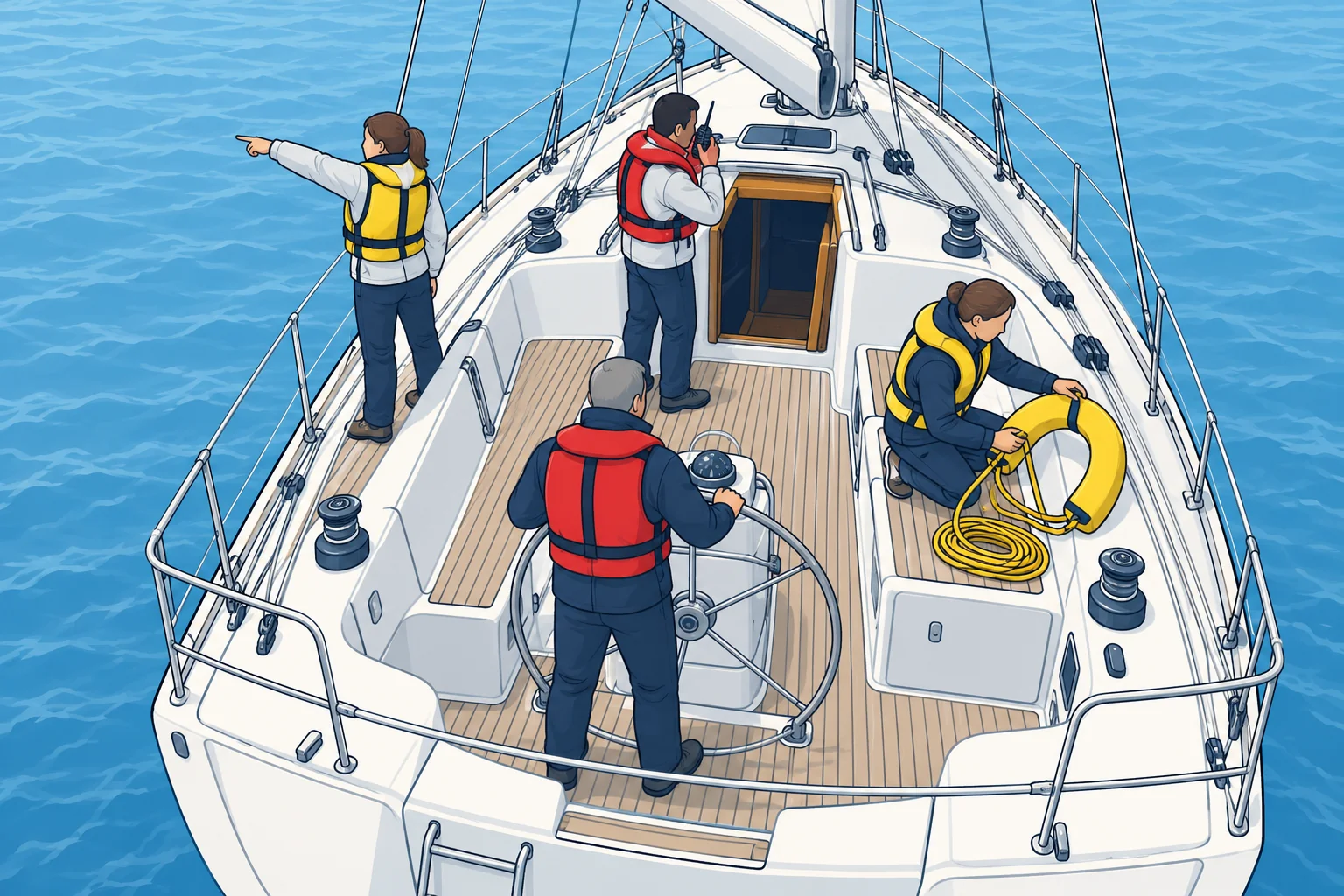
Assign named jobs to suit your crew; combine compatible tasks and set priorities. For MOB: a spotter who keeps pointing, someone to steer, radio and recovery gear. For fire: isolate the source where safe, call for help and prepare to abandon. Attempt to extinguish a small fire only if safe, with a clear escape route; withdraw if unsafe. For abandoning: assign the raft, grab bag and help for anyone needing it.
The skipper leads
The skipper should stay free to think and give orders, not disappear into the fire or the engine. Give clear, short commands to named people: ‘Ana, point at him and don’t stop.’ If the skipper is the casualty, a named second-in-command takes over. Agree this at the briefing.
Checklists
Pilots and ship officers use checklists because stress makes everyone forget steps. Keep short emergency cards for MOB, fire, flooding, abandon ship and the Mayday call, laminated and stowed at the chart table and in the cockpit. Use routine checklists too: before leaving, engine checks, before dark, and arriving.
A culture, not a form
Encourage anyone to speak up: ‘I smell gas’, ‘we’re getting close to those rocks’. Thank them even when it was nothing. Saying out loud what you are going to do, and checking with someone else, catches mistakes before they become emergencies.
2Key points
- 1
Agree roles for MOB, fire and abandon ship before you leave.
- 2
The spotter points and never looks away.
- 3
The skipper leads and decides; a named second-in-command takes over if needed.
- 4
Laminated emergency cards at the chart table and in the cockpit.
- 5
Make it normal to speak up and to think aloud.
3Frequent mistakes
Wrong: The skipper should personally do the most important job.
Right: The skipper leads. Doing a task hands-on often means nobody is watching the whole situation.
Wrong: Checklists are for beginners; experienced crews remember.
Right: Stress makes experts skip steps too. Checklists protect everyone.
4Practice case & exam keys
You skipper with three crew. In an engine-fire drill, all three reach for an extinguisher. Nobody handles the shutdown or simulated call. How do you allocate the work?
Show the answer
Keep yourself free to coordinate. Name one crew member for safe engine and fuel shutdown, one for the simulated call, and one for appropriate fire equipment. Attempt only a small fire with a clear escape route; withdraw if unsafe. Assign raft preparation once someone’s first task is complete. Name a deputy and write the priorities on the fire card. Repeat the drill and check for missed tasks.
Exam keys
- Roles agreed in advance: spotter, helm, radio, recovery; fire and abandon roles.
- Skipper leads with short, named commands; second-in-command named.
- Emergency cards and routine checklists.
- Speak-up culture; think aloud and cross-check.
Open practise
It opens here in IALACOLREG Academy. When you finish, come back to this unit: your result counts towards this module.
My notes for this unit
No notes