

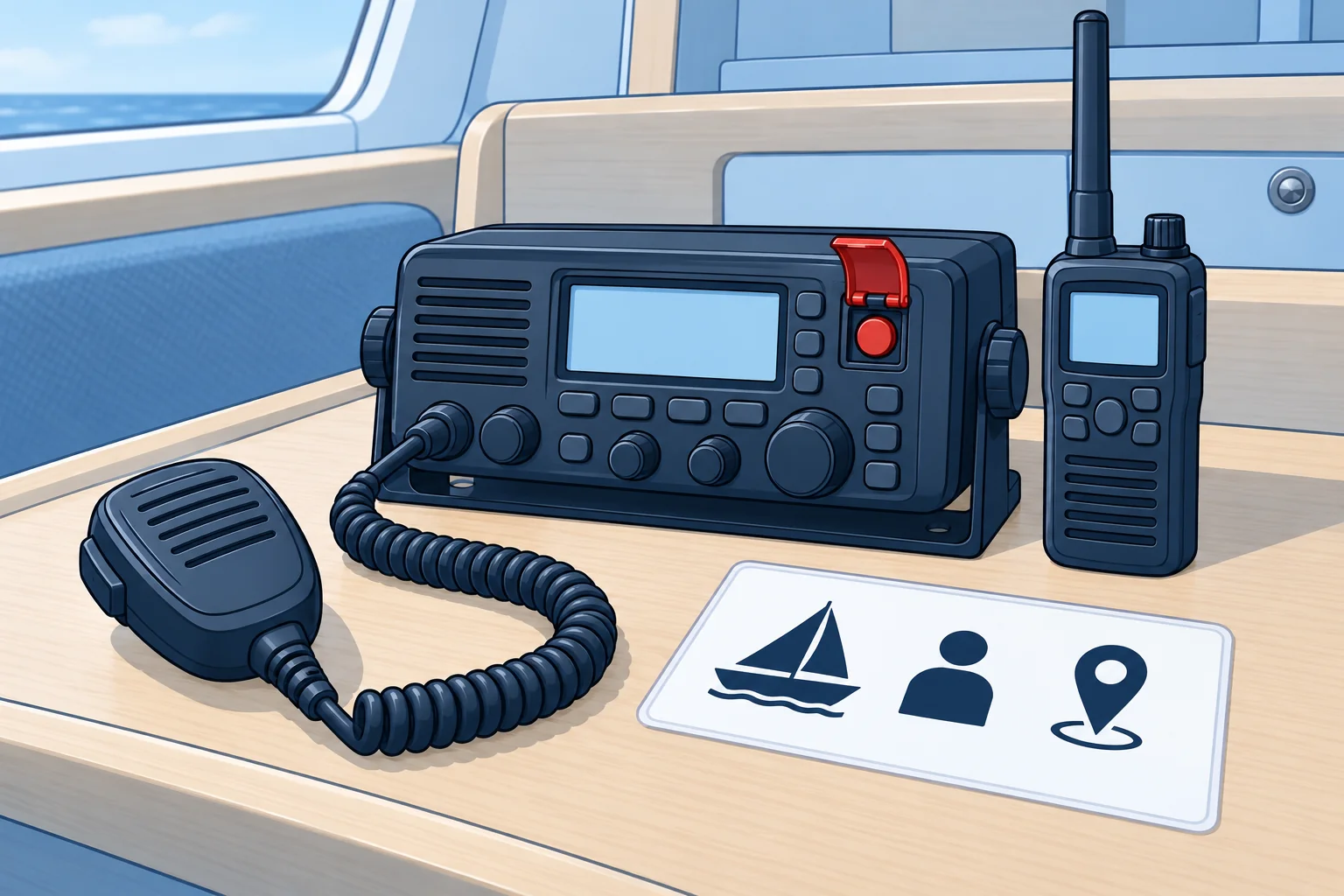
Practising emergency calls with the VHF
1The lesson in plain words
A Mayday is easy to say and hard to get right under stress. Rehearse it off air with a simulator or course, until the actions and words come naturally.
Why rehearse
In an emergency, people forget the boat’s name, the position or which button to press. A practised call is clear and complete. Rehearse without transmitting: a real Mayday, even by mistake, can launch a search and endanger rescuers.
How to practise
Use a VHF simulator, a radio course or a manufacturer-confirmed non-transmitting training mode. A dummy load absorbs transmitter power instead of the aerial; use one only in a properly isolated, instructor-controlled setup. On an ordinary live set, identify controls without operating distress controls or pressing transmit. Read the Mayday card aloud. For operating instructions, see the GMDSS lesson on distress calls.
What to practise
In simulation, practise reading your position from the plotter in latitude and longitude, or as a true bearing (measured from true north) and distance in nautical miles from a charted point. Give the number of people and the help you need. Practise switching to Channel 16 and high power, using a handheld VHF from the cockpit or liferaft, and cancelling a false alert.
Routine checks
A radio check with a coast station or marina, where allowed, confirms transmission. A DSC test call to a station that supports these calls checks the DSC link without a distress alert. Check that the radio shows a current position from its built-in or connected GNSS (satellite-navigation) receiver. If unavailable, enter and update position and UTC (Coordinated Universal Time) manually according to its instructions.
2Key points
- 1
Rehearse the Mayday off air: simulator, confirmed non-transmitting mode or dummy load in an instructor-controlled setup.
- 2
Practise DSC alerts and voice Mayday only in a confirmed safe training setup.
- 3
Practise reading the position and stating people aboard.
- 4
Use a DSC test call to a compatible station to check the link without a distress alert.
- 5
Check the DSC radio’s position is current, whether automatic or manually entered.
3Frequent mistakes
Wrong: Press the red DSC button for a few seconds to test it.
Right: That can send a real distress alert. Use the test-call function with a compatible station; rehearse alerts only off air.
Wrong: The DSC alert always includes your position.
Right: Check that the radio shows a current position. It may use a built-in receiver, an external feed or manual entry; update manual position and UTC.
4Practice case & exam keys
Your new crew member asks how she can practise a Mayday before the passage. The boat’s VHF is a fixed DSC set. What do you suggest?
Show the answer
Keep the fixed set in normal service. Identify its controls without operating them. Have her read the Mayday card aloud, using the plotter position and stating people aboard and help needed. Practise button presses on a simulator or a set confirmed to be in non-transmitting training mode. For operating instructions, see the GMDSS lesson on distress calls.
Exam keys
- Rehearse off air: simulator, course, confirmed non-transmitting mode or dummy load in an instructor-controlled setup.
- Practise DSC alert, voice Mayday, position, people aboard, help needed.
- DSC test calls check the link; radio checks where permitted.
- Check the DSC radio has a current position; missing or stale coordinates can delay rescue.
Open practise
It opens here in IALACOLREG Academy. When you finish, come back to this unit: your result counts towards this module.
My notes for this unit
No notes