

 See units
Fire on ships: fire chemistry, ignition sources, detection and fixed systems (STCW A-VI/1-2)
Fire chemistry: what burns, and when
1The lesson in plain words
Liquids do not burn; their vapour does. Flash point, auto-ignition and flammable limits tell you when a fuel on board becomes a fire.
The tetrahedron
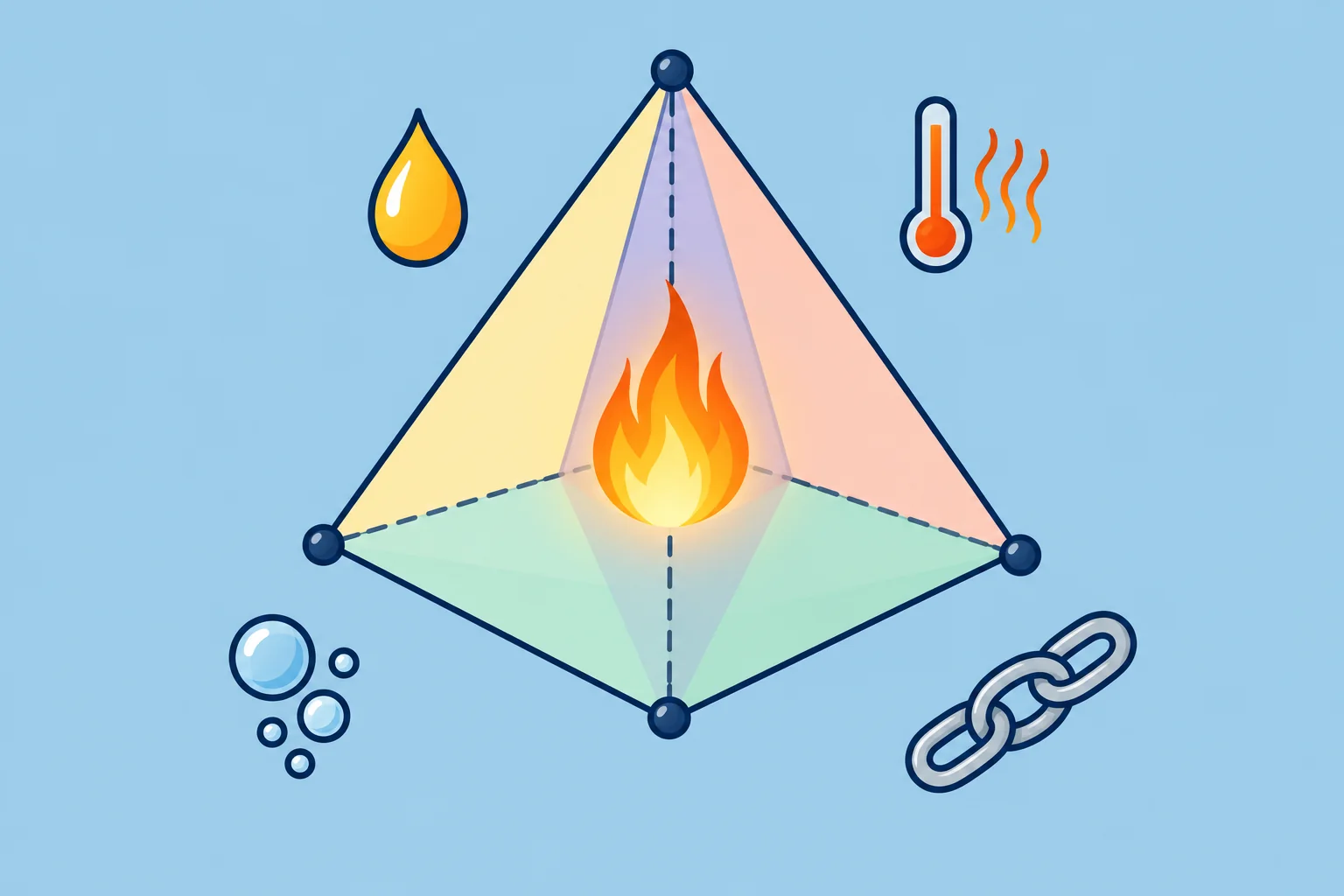
You may know the fire triangle: fuel, heat and oxygen. Flames also need a self-sustaining chain reaction in the burning gases, which makes the fire tetrahedron. There are four ways to put a fire out: cooling removes heat (water), smothering keeps oxygen from the fuel (foam) or reduces oxygen around the fire (CO₂), starving removes fuel (closing a fuel valve, moving cargo away) and breaking the chain reaction (dry powder). This unit gives the knowledge; you practise on real fires, with breathing apparatus (BA), in your approved course.
Flash point and fire point
The flash point is the lowest temperature at which a liquid gives off enough vapour to ignite briefly when a flame is applied. The fire point, a few degrees higher, is where the vapour keeps burning. SOLAS, the International Convention for the Safety of Life at Sea, normally requires fuel oil with a flash point of at least 60 °C. Heating fuel increases vapour production. A fine fuel mist from a leak can ignite even below the liquid’s flash point.
Auto-ignition
The auto-ignition temperature is the temperature at which a substance catches fire by itself, with no flame or spark. Marine diesel is often quoted around 250 °C, but values vary by fuel and test conditions. An engine exhaust manifold or turbocharger casing can be much hotter than that. This is why fuel spraying from a cracked pipe onto an uninsulated hot surface can start an engine-room fire.
Flammable limits
Vapour burns only when mixed with air in the right proportion. The lower flammable limit (LFL) is the leanest mixture that burns; the upper flammable limit (UFL) is the richest. For petroleum vapours the range is roughly 1–10 % by volume. A mixture above the UFL is too rich, but it becomes flammable as air gets in. For oil cargoes, inerting keeps oxygen at 8 % or less and maintains positive pressure to keep air out, preventing a flammable hydrocarbon-air mixture.
Classes of fire
Standard EN 2 groups fires by fuel: A solids such as wood and paper; B liquids such as fuel oil and paint; C gases such as liquefied petroleum gas (LPG) and acetylene; D metals such as magnesium; F cooking oils and fats. IMO guidance accommodates different classifications. This lesson uses EN 2; check the classification on your ship’s equipment. Electrical equipment is not a class: it is a shock hazard until isolated. US National Fire Protection Association (NFPA): A solids, B liquids/gases, C live electrical, D metals, K cooking oils.
2Key data
- Fuel-oil flash point (SOLAS)
- At least 60 °C (43 °C allowed for emergency generators)
- Diesel auto-ignition
- Typically about 250 °C; hot exhausts run far hotter
- Petroleum vapour range
- Roughly 1–10 % by volume in air (LFL to UFL)
- Inerted oil-cargo tank
- Oxygen 8 % by volume or less
- EN 2 classes
- A solids, B liquids, C gases, D metals, F cooking oils
- Electrical fires
- Under EN 2: a shock hazard, not a fire class
3Key points
- 1
Four ways to extinguish: cool, smother, starve, break the chain reaction.
- 2
Liquids burn as vapour: the flash point tells you when there is enough of it.
- 3
Heating fuel increases vapour; a fine fuel mist can ignite below its flash point.
- 4
Fuel spray can ignite on a hot surface without a flame or spark; actual ignition conditions vary.
- 5
A too-rich mixture becomes flammable as air enters; oil-cargo inerting keeps oxygen at 8 % or less.
4Frequent mistakes
Wrong: Diesel has a flash point above 60 °C, so a diesel leak cannot catch fire.
Right: A fine spray can ignite below the liquid’s flash point, especially on a hot surface.
Wrong: A tank too rich to burn is safe to ventilate and enter.
Right: Fresh air can bring the mixture into the flammable range. Do not ventilate or enter the tank yourself; report the hazard.
Wrong: Electrical fires are a separate class with their own letter.
Right: Under EN 2 electricity is a hazard, not a class. Isolate the supply; the burning material sets the class.
5Practice case & exam keys
A shipmate says a tank atmosphere above the upper flammable limit cannot burn, so opening it to admit fresh air must be safe. How do you respond?
Show the answer
Do not open it. Above the UFL the mixture is too rich to burn, but admitting air can bring it into the flammable range. Tell your shipmate why the reading does not prove safety and report to the responsible officer. A non-burning atmosphere may still be deadly to breathe.
Exam keys
- Fire tetrahedron: fuel, heat, oxygen and chain reaction; extinguish by cooling, smothering, starving or chain-breaking.
- Flash point: brief ignition of vapour with a flame; fire point: sustained burning; auto-ignition: no flame needed.
- LFL and UFL bound the flammable range; inerted oil-cargo tanks hold oxygen at 8 % or less.
- EN 2: A solids, B liquids, C gases, D metals, F cooking oils; electricity is a hazard, not a class.
Finish this unit
When you've read it, answer three questions. Get all three right to finish the unit; opening the page alone doesn't count.
My notes for this unit
No notes