

 See units
Fire on ships: fire chemistry, ignition sources, detection and fixed systems (STCW A-VI/1-2)
Fixed fire-extinguishing systems
1The lesson in plain words
Fixed systems protect machinery, cargo and accommodation spaces. Know what each system does. When the CO₂ alarm sounds, leave immediately.
CO₂ flooding
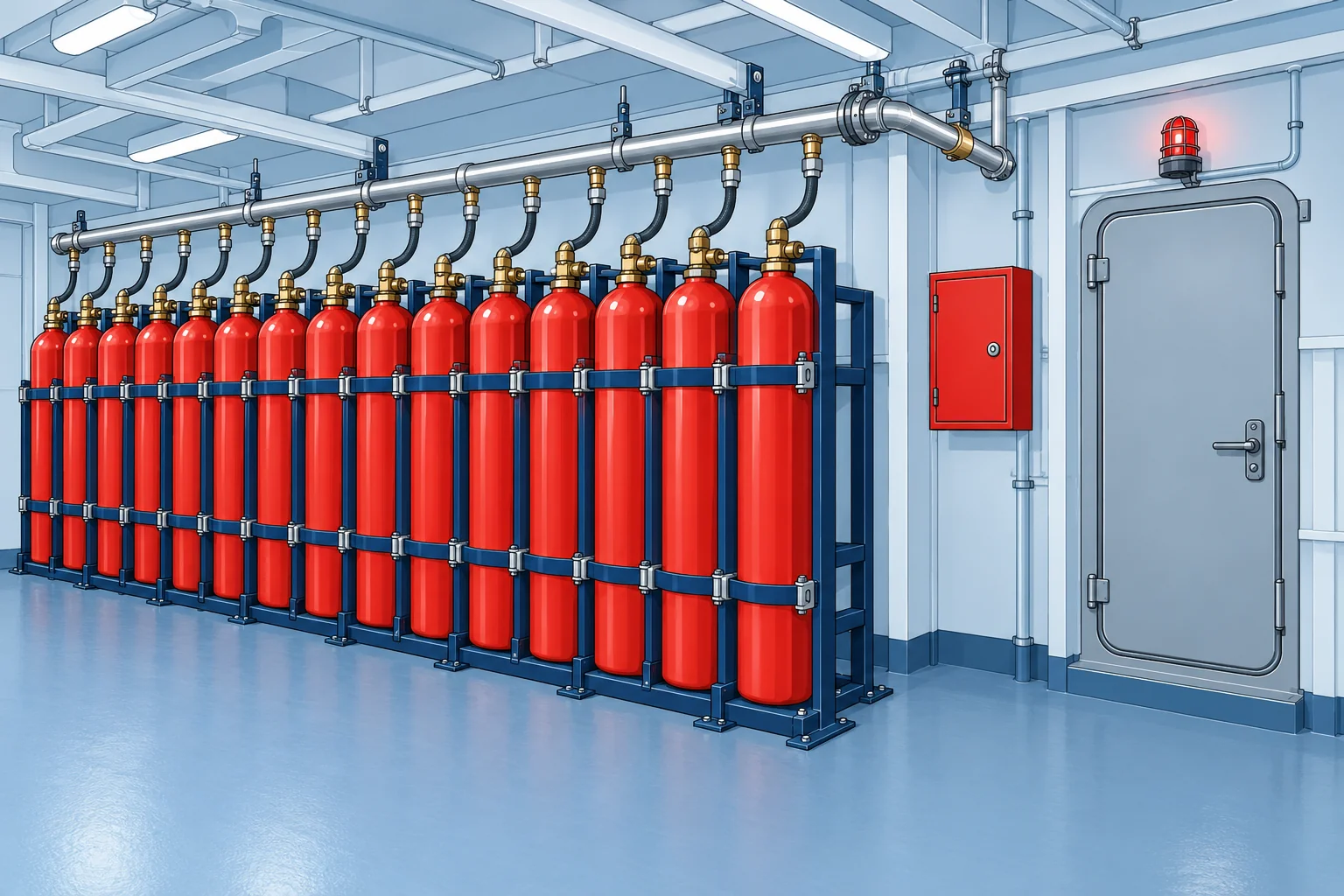
Carbon dioxide (CO₂) systems flood a closed space, such as an engine room or cargo hold, and smother fire by reducing oxygen. High-pressure systems store CO₂ in banks of cylinders; low-pressure systems keep it liquid in one refrigerated tank, at about −18 °C. FSS Code chapter 5 requires 85% of the required machinery-space CO₂ quantity to discharge within two minutes. CO₂ at flooding concentration is lethal through oxygen reduction and direct toxicity.
The CO₂ alarm
The pre-discharge alarm gives audible and visual warning in the protected space. It must sound for at least 20 seconds before release, and longer if needed for evacuation. Leave immediately; do not finish your job or collect belongings. Report for the headcount and report anyone missing, including their last known location. Do not operate release controls.
Foam systems
Foam is water, a foam concentrate and air. High-expansion foam, up to about 1,000 times its liquid volume, fills an engine room or hold. Medium-expansion foam covers areas such as deck spills. Low-expansion foam, under about 20 times, is thick and travels far; tankers use it for their deck foam systems. Foam cools and smothers fuel fires. FSS Code chapter 6 covers fixed foam systems and chapter 14 tanker deck foam.
Water mist and local application
Water mist systems spray very fine droplets that cool fast and push oxygen away close to the fire, with little water. Local application systems, required in specified SOLAS machinery spaces, protect the main hazards, such as purifiers, boiler fronts, engine fuel injection and incinerators, without flooding the whole space. FSS Code chapter 7 covers water-spray and water-mist systems.
Sprinklers
Automatic sprinkler systems protect accommodation on passenger ships and on some cargo ships. Heat opens each sprinkler head individually, often by breaking a glass bulb. Accommodation heads normally operate at 68–79 °C; hotter spaces may need higher ratings. Only heads heated enough to operate open. FSS Code chapter 8 covers them. Never hang clothes on a sprinkler head or paint it.
2Step by step
When the CO₂ pre-discharge alarm sounds
- 1
Leave immediately by the nearest safe exit; do not delay.
You have only seconds; CO₂ at flooding strength kills.
- 2
Close doors behind you if safe, without delaying escape.
The space must be sealed for the CO₂ to work.
- 3
Go to your muster station and report for the headcount.
Report promptly so responders know who has escaped and who may remain inside.
- 4
Report anyone missing and their last known location.
The officer needs their identity and last known location immediately.
- 5
Never re-enter after release without orders and breathing apparatus.
The space stays deadly long after the fire is out.
3Key data
- CO₂ pre-discharge alarm (FSS ch. 5)
- At least 20 s before release; longer if needed to evacuate
- CO₂ in machinery spaces
- 85 % of the gas discharged within 2 min
- Foam expansion
- Low < about 20; medium about 20–200; high up to 1,000
- Sprinkler operating temperature
- Normally 68–79 °C in accommodation; higher ratings in hotter spaces
- FSS Code chapters
- 5 gas, 6 foam, 7 water mist, 8 sprinkler, 14 deck foam
4Key points
- 1
CO₂ smothers a closed space and is lethal to people at flooding strength.
- 2
Pre-discharge alarm: at least 20 seconds; leave immediately.
- 3
High-pressure CO₂ uses cylinder banks; low-pressure CO₂ uses a refrigerated liquid-storage tank.
- 4
Foam: high expansion fills spaces; low expansion travels far on tanker decks.
- 5
Water mist cools; sprinklers normally operate at 68–79 °C in accommodation, with higher ratings in hotter spaces.
5Frequent mistakes
Wrong: When the CO₂ alarm sounds, you have time to finish and tidy up.
Right: Leave at once. The alarm may last only 20 seconds before the gas comes.
Wrong: After a CO₂ release you can enter as soon as the fire seems out.
Right: Keep the space closed while it cools. Re-entry is ordered by the master, in breathing apparatus.
Wrong: A sprinkler system floods every cabin when one head opens.
Right: Only heads heated by the fire open, so water falls where it is needed.
6Practice case & exam keys
You are cleaning a filter in the engine room when the ship’s identified CO₂ pre-discharge alarm sounds. A shipmate says it is probably a test and wants to finish the job first.
Show the answer
Tell your shipmate to leave now and head for the nearest safe exit. Do not delay your escape to finish work, argue or force them to move. Close doors as you leave if safe. Report at your muster station. If your shipmate has not left, immediately tell the officer their name and last known location. Treat the alarm as real even if you suspect a test.
Exam keys
- CO₂ pre-discharge alarm: at least 20 s before release (FSS ch. 5); leave at once.
- High-pressure CO₂: banks of cylinders; low-pressure CO₂: liquid in a refrigerated tank.
- Foam: high, medium and low expansion; water mist and local application; sprinklers normally 68–79 °C in accommodation, higher in hotter spaces.
- FSS Code: ch. 5 gas, 6 foam, 7 water spray and mist, 8 sprinklers.
Finish this unit
When you've read it, answer three questions. Get all three right to finish the unit; opening the page alone doesn't count.
My notes for this unit
No notes