

 See units
Fire on ships: fire chemistry, ignition sources, detection and fixed systems (STCW A-VI/1-2)
Fire detection and alarm systems
1The lesson in plain words
Detectors, call points and the fire panel give the earliest warning. Know what each detector senses and what to do when the alarm comes in.
Why detection matters
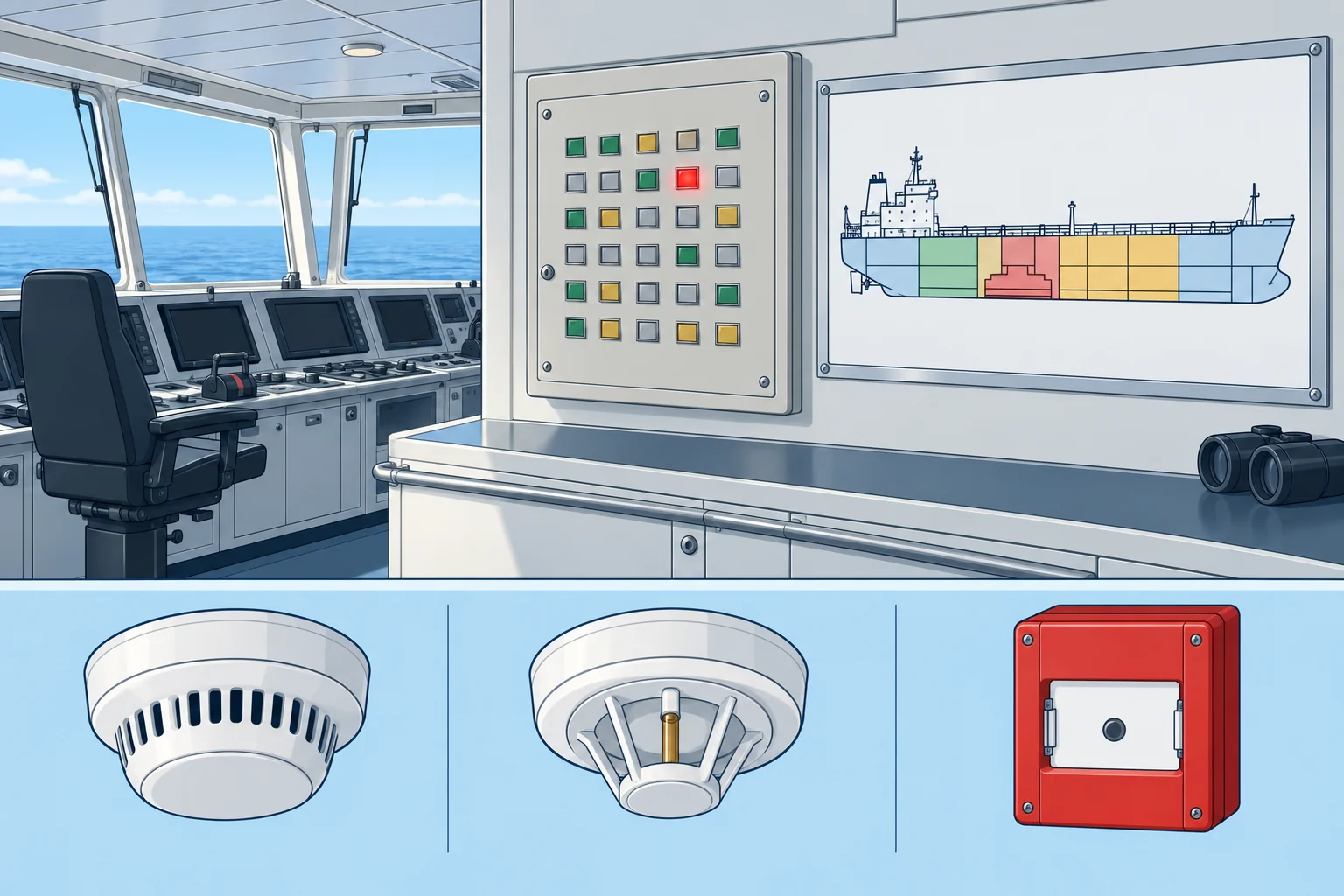
Early detection gives you time to raise the alarm and escape. SOLAS II-2/7 requires fixed fire detection and fire alarm systems in specified spaces, including periodically unattended machinery spaces and accommodation. The FSS Code (Fire Safety Systems Code under SOLAS), chapter 9, sets how these systems work. The control panel identifies the alarm section and, on addressable systems that identify individual devices, the detector or call point.
Three kinds of detector
Smoke detectors sense smoke particles and usually warn earliest; they suit cabins, alleyways and stairways. Heat detectors respond to a fixed temperature or a rapid temperature rise; they suit galleys and laundries where smoke or steam is normal. Fixed-temperature detectors normally operate at 54–78 °C; approved higher settings suit hotter spaces. Flame detectors sense infrared or ultraviolet light from flames and are used near engines, purifiers and boilers.
Manual call points
A manual call point is a red box with a glass or plastic panel that you break or press to raise the fire alarm. They are fitted throughout the accommodation, service spaces and control stations, with one at each exit. If you find a fire, raise the alarm at once with the nearest call point, then report the location to the bridge by phone or radio. Do not assume someone else has done it.
The fire panel
On cargo ships, the panel is on the bridge or in the fire control station; on passenger ships, it is in the safety centre. It identifies the alarm section or device, not the fire’s size. After two minutes without acknowledgement, an audible alarm sounds in crew accommodation, service spaces, control stations and category A machinery spaces, such as engine and boiler rooms. It also shows faults and isolated sections. Know where alarms are received on your ship, including in port.
Fire control plan
Find your ship’s fire control plan: a general arrangement drawing showing fire divisions, detectors, call points, extinguishing systems, fire doors, ventilation controls and escape routes. It is normally displayed; a flag-approved booklet is also permitted. A duplicate plan or booklet is kept in a marked weathertight container outside the deckhouse for shore firefighters. Study it when you join.
2Key data
- Rules
- SOLAS II-2/7; FSS Code ch. 9
- Heat detectors (FSS)
- Normally 54–78 °C; approved higher settings in hotter spaces
- Unacknowledged after 2 min
- Alarm: crew/service/control areas; category A machinery spaces
- Call points
- Throughout accommodation and control stations; one at each exit
- Fire control plan
- Displayed plan or approved booklet; duplicate outside for shore crews
3Key points
- 1
Smoke detectors usually warn early in accommodation; heat suits steamy spaces; flame detectors watch machinery hazards.
- 2
The panel identifies the alarm section or device; report the conditions you can safely observe.
- 3
Find a fire: break the nearest call point, then tell the bridge where it is.
- 4
After 2 min unacknowledged: alarm in crew accommodation, service spaces, control stations and category A machinery spaces.
- 5
Study the fire control plan when you join.
4Frequent mistakes
Wrong: If the detector has gone off, the bridge already knows everything.
Right: The panel identifies an alarm location, not the fire’s size or conditions. Report what you can see from safety.
Wrong: Covering a smoke detector while you work stops nuisance alarms safely.
Right: Never cover or isolate a detector yourself. Isolation is done by an officer under a controlled procedure.
Wrong: Heat detectors are best everywhere because they give the earliest warning.
Right: Smoke detectors usually warn earlier. Heat detectors are used where smoke or steam is normal.
5Practice case & exam keys
At night, the bridge fire panel alarms for the laundry and a store room. The officer assigns you, an available crew member with no bridge-watch duty, to investigate with a radio.
Show the answer
Take the radio and a torch. Keep clear of smoke and leave suspect doors closed. If you see fire or smoke, use the nearest safe call point and radio the exact location, what you can see and anyone at risk. If access is unsafe, withdraw and report. Follow the officer’s instructions.
Exam keys
- Smoke: early warning in accommodation; heat: galleys and laundries; flame: machinery hazards.
- Manual call points: raise the alarm, then report the location to the bridge.
- On cargo ships the panel is on the bridge or in the fire control station; it identifies an alarm section or individual device.
- SOLAS II-2/7 and FSS ch. 9; the fire control plan shows all fire equipment.
Finish this unit
When you've read it, answer three questions. Get all three right to finish the unit; opening the page alone doesn't count.
My notes for this unit
No notes